Sculpture has been traditionally described as the result of an operation that subtracts all excess material to bring into existence the shape the artist seeks. Throughout history, other ways of composing objects, such as modeling or assemblage, were folded into the concept, which is now used to name three-dimensional works of art in general. In contemporary art, the aesthetic event materialized as the artwork does not allow itself to be constrained, be it in terms of types of materials, durability, or technique. From the most traditional choices, such as bronze, to the most prosaic, like serially manufactured objects and even inert or organic trash, there isn’t one thing that cannot be used as a compositional element.
Marcia Pastore’s understanding of sculpture goes one step beyond, and often folds the surrounding space, as well as its relationship with the body, into the work. Practically all the works featured in Contracorpo (Counterbody), Pastore’s solo exhibition in São Paulo’s Estação Pinacoteca, curated by Ana María Belluzo, fit into that category. Occupying the building’s ample galleries, well lit by its large windows, the artist’s interventions harmonize with the architecture, be it through their materials, their scale, or their colors.
The main hall, with its iron columns, served as support for the installation Linhas de força (Lines of Force, 2019), created specifically for this show. A thick layer of compacted plaster covers the floor, and preserves intentionally made traces of the dragging of boxes made from the same material. The plaster on the floor is used in a primary state, finely ground, and plays with the illusion that the assembled shapes could crumble at any moment. The dichotomy between the conception of sculpture as something that endures over time and the realization of the ephemeral character of the work comes to the fore. In this way, a narrative is suggested of a displacement of bodies that in reality is impossible, a challenge to the laws of physics materialized poetically, using activities common in the field of construction. The shapes dialog with the architectural elements in the exhibition space, replicating the orthogonal condition of the gallery and the light coming from the windows. The work takes its place at the center, bound by the preexisting columns and leaving enough space around it for circulation and the presence of other works, also connected to the architecture.
Towards the back, on both sides, we see Risco (Risk, 2013), comprised of metal bars that lean against the walls, with the vertical scratches incorporating the register of the time passed in the tracing of those lines and inviting the eye to appreciate the height in full. Leaning at different degrees, some appear on the verge of falling, a tension that the artist delights in probing, as she also does in Linhas de força.
The title of Ossos (Bones, 2019) is a dual reference: to the skeleton of a building, as architects and engineers call its structural frame, and to the painful memory of one of this particular building’s prior uses. The Public and Social Order Delegation (DOPS, in its Portuguese acronym), charged with the surveillance of social movements and individuals deemed subversive, was at some point housed there. Under the military dictatorship in Brazil (1964-1985), political prisoners were held in this location. Pastore cut out square pieces from the ceiling and used iron columns to support and keep them suspended. Their balancing is made possible by the use of tension and force. Those processes are also at the base of Peso-Contrapeso (Weight-Counterweight, 2012). Steel cables and iron rings keep brass tubes suspended at different heights, forming an open space labyrinth that crates the design of a canvas in space. It is possible to walk in the middel with the care that brings not only the dimensions of the gallery but the viewer’s body as well into the experience of enjoyment.
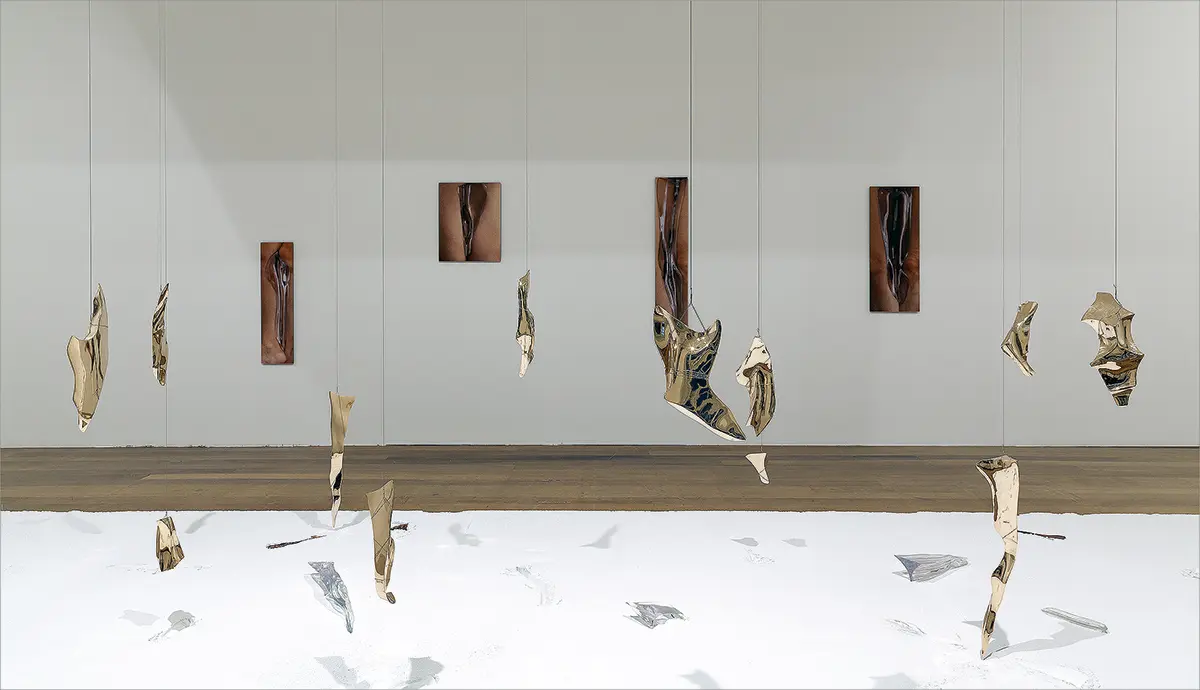
Other sections of the exhibition explore the relationship between the body and works in bronze, resin, or plaster. These sculptures, dating as early as the 1990s, are molded in contact with parts of the human anatomy; they make the latter’s hollows, its interstices solid. Pastore subverts the polarity between “hollow” and “filled,” inverting what we usually understand as sculpture and environment. Some of those shapes, strange and familiar at the same time, are set up autonomously on the floor, doing away with bases or pedestals and inviting approach. Others hang from the ceiling and sway with the breeze, shooting out fleeting reflections onto the walls, or leave traces of their negative doubles on a layer of compacted plaster down below. Finally, there are some that return, like Esculturas vestidas (Dressed Sculptures), upon contact with the hollows in the artist’s own body, in new performative acts transformed into photographs.
Pastore’s creative process always seems situated at the border between tradition and the reinvention of sculpture. She highlights the intertwining of inside and outside, incorporates the two-dimensional as a prolog (or an epilog) to the occupation of space, and invites us to a contemplation where solids and hollows are equally relevant and complementary.
SYLVIA WERNECK