Marcelo Bonevardi’s extensive and remarkable exhibition establishes three convergent analyzes: originality, proof of historical resistance—none of his work has aged aesthetically—and the creation of a zenith in a certain facet of art history. Thirty pieces hanging in a non-rectangular—mansion-style—gallery, unquestionably expose the public to a warmer atmosphere than “the white cube,” while disarming the confrontation with the individual and spacious presence of each work.
Marcelo Bonevardi (Argentina, 1929-1994) resists all museographies. Born in Buenos Aires, he was educated in Córdoba. His architectural and engineering training enabled him to manifest a nodular aesthetic world and to transcend his time. In those days, Surrealist cartoonists and engravers in Argentina and neighboring countries—unlike European Surrealists— possessed a mysterious “penmanship.” The same goes for the painters, although they introduced a honey-toned material that created adjectival areas and surfaces. In this segment of Southern Cone Surrealism, the gray predominating in those cities not inhabited by pre-Columbian cultures is very specific. It is not a gray color but an urban, social, tonal, enveloping, largely intellectualized gray (very different, for example, from the wealth of pictorial grays that distinguish Rufino Tamayo’s work).
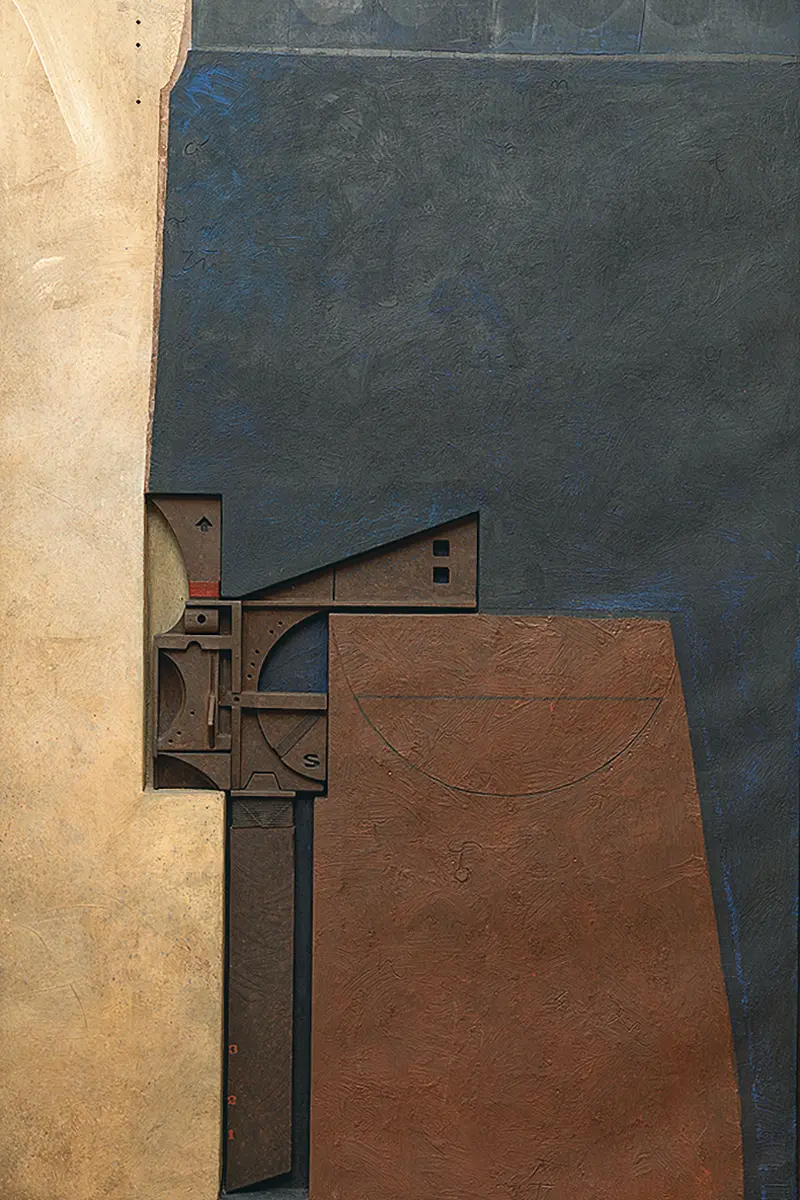
Among the works on display are six of his charcoal and watercolor and ink diagrams, the oldest being Studies for Sacred Enclosure n. VII, 1966. These expose his characteristic thoroughness, but the author did not stop there. He then lead us to mysterious constructions and environments. Let us recall that, during those days, some of his most famous countrymen were alive and actively working. Among them, Jorge Luis Borges, “the writer who never got the Nobel Prize,” Adolfo Bioy Casares, Ernesto Sábato, and Antonio Di Benedetto, to mention only four great writers of metaphysics and varied mysteries. Bonevardi’s thoroughness mentioned above includes construction tools and torture hooks; although he did not experience Argentina’s harsh military rule, he did not ignore it either.
His art studies in Italy exposed him to mural painting and the metaphysics of Giorgio de Chirico. From the latter, the absence of people, the resounding architecture, and the textures are reflected in some of Bonevardi’s works—both in his painting on canvas mounted on wood or those he made directly on wood to avoid the mediatic canvas. While he lived and exhibited in Buenos Aires, his retina still carried Italianizing colors. Gradually, these colors gave way to materials that were not pictorial, but rather “writers,” less of uninhabited solitude than of secrecy and mystery. In 1958, Bonevardi settled in New York with his family thanks to a Guggenheim scholarship. He arrived with all his artistic background in a city where he discovered American authors such as Joseph Cornell, Louise Nevelson, Gonzalo Fonseca, and Julio Alpuy—these two, former members and disciples of the Constructivism of Joaquín Torres García. The conversations of the three South American artists, as well as Bonevardi’s exchanges at the Cedar Bar, and the exhibitions he visited, strengthened the rich seeds he had brought with him. New York in the 1960s and 1970s fortified his oeuvre. He considered that mutual respect for his colleagues kept each one in his or her real place, and did not point to an artist who had particularly influenced him.
In “Reconsidering Bonevardi,” one can perceive the lines painted on his canvasses, the metaphorical depth in his woodwork, or the two-dimensional and three-dimensional pathways, as in Inmured (1969) or Lock (1974). Marcelo Bonevardi developed very personal planes, mastabas, door openings, pyramids, various mini-windows, openings—visited or sealed by those little balls that pretend to be the children of the world—or Cornellian spheres and other volumetric dimensions. Although Marcelo Bonevardi was initially devoted to painting, the shapes and the development of his work towards three-dimensionality define him as an author of reliefs of various depths and irregular contours. Cavities, arcane hiding places, powerful silences due to a non-strident visual language: all of these are movements that include temporality, both in realization and in observation. “I manufacture every part, however small it may be ... My aim is not to shock.”
Several sketches of full-size sculptures—especially the urban project for McGraw-Hill—occupied him in the second half of the 1960s. It was the only time Marcelo Bonevardi expressed real frustration: another work was erected. The painted wooden model with a sculpted base can be understood as a chronological metaphor for the works he has created since the beginning. On the many occasions when I visited the artist in his workshop—where the comments I quote here come from—I regret never having met his son Gustavo, a solid architect, and cartoonist who is rescuing his father’s work for the world.
Bonevardi’s curriculum is made up of various and prestigious exhibitions, along with awards in numerous countries. One of his joys was a contract with the Ponce Gallery in Mexico City: “Meeting creators of those languages will be important. I have seen them in photos and admire their works.” The text by Tomás Alva Negri published by the Quebec Museum, my own writings, the essay by Elena Bertola Oliveras and Fermín Febre published by CEAL, the text of the current exhibition’s catalog by Susan Temkin, the out-of-print book by Dore Ashton and Ronald Christ, Gustavo Bonevardi’s and Cecilia de Torres’s publication, and Estrellita Brodsky’s article in Miami Rail comprise the most rounded bibliography on Marcelo Bonevardi and contribute to enhance the work of an artist that should not and cannot be forgotten.
GRACIELA KARTOFEL