The intrinsic mixture of words and images is the leitmotif in the work of Luiz d’Orey, as demonstrated by the young artist’s recent exhibition Eu não falei? (Did I not Speak?), at Mercedes Viegas Arte Contemporánea, in Gávea. It featured nearly twenty artworks, among them one video, one sound installation, and works from the Cascade series, all of which revealed, as a group, d’Orey’s interest in working with the textual and the visual in search of original formal solutions.
The Cascade series’ title is a reference to the opening of many simultaneous windows on a computer screen. It features works created on laser-cut layers of paper—some spray-painted, some printed—that, as they overlap, result in a kind of weave where colorful textures combine with comments. In this way, the artist creates a “pixelated vision” that can either refer to distorted images or binary codes, in an attempt to capture the flow of the Internet.
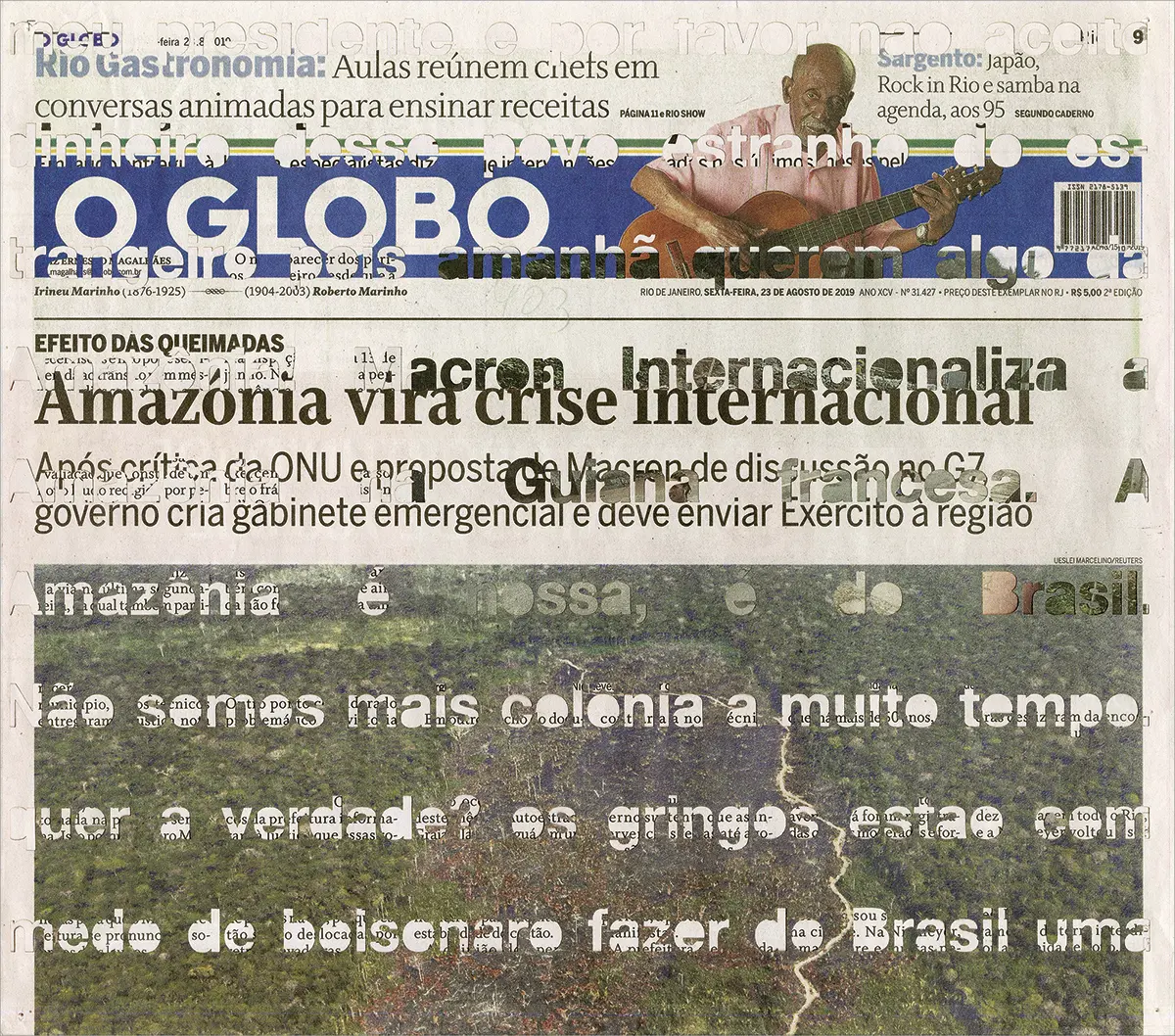
“I pick out comments from Twitter and Facebook without curating. My goal is not to debate the content, but how it is shared and how opinions travel in social media,” d’Orey explains. To prompt this debate, he created artworks using newspapers alongside his works on canvas. In those cases, the first pages are intervened with comments about significant events of the day, taken from such social media as Twitter and Facebook.
Works like d´Orey’s illustrate contemporary art’s drive towards an emphasis on the verbal. This, however, does not make it interdisciplinary in intent. As the philosopher Jacques Rancière observed in The Future of the Image, contemporary art moved from the analogy of the signified to the combinatory of the signifier, as the arts ceased to “analogize” one another and to interact at a distance. Their materialities combined, and they are taken in as a whole. The big question that arises, then, is how to think about the effects and implications of such combinatory. According to Rancière, a new mode of articulation of words and images has emerged.
It is along these lines, between the visible and the sayable, that works like d’Orey’s sound installation with multicolor ribbons can be analyzed. Used as masking for the spray-painted layers of paper, the ribbons accumulated in his studio. But they ended up acquiring a new function: a sculpture that contains the sound of many voices opining at the same time, like a murmur
“Today, former newspaper readers, TV viewers, and radio listeners fight for the same social media space as the large broadcasters. We all have access to mass communication tools, which gives everything the undertones of an argument and subjects it to questioning. What interests me is how each person uses fragments of the available information to assert their own narrative.”
Also, working with media and with superpositions is not a new endeavor for d’Orey. In his first solo exhibition in Rio, Quase Plano (Almost Flat), held in 2017, he focused on a different unconventional mode of communication. For the construction of each image, with photographs of buildings and of New York City architectural landmarks as the starting point, d’Orey used posters of a type known as lambe-lambe, ripped from construction-site hoardings, as his raw material. After each painting was finished, he photographed the image and reproduced it on poster paper, which was placed on a wall. After a daily record on photographs and video, d’Orey took down his work and reused it as the start of a new production.
Born in Río de Janeiro in 1993, d´Orey relocated to New York City in 2012 and graduated as a B.F.A from the School of Visual Arts. He currently divides his time between the two cities. Selected for the 2019 PIPA Prize, he recently presented the exhibition Rumor at Elga Wimmer Gallery, New York. During his four years as a student at the SVA, he was the recipient of several honors such as Award (2016), the Sillas H Rhodes Award (2016), and the Gilbert Stone Scholarship (2015). His CV records group shows in New York, London, and Rio de Janeiro; solo shows in Rio, Belo Horizonte, and New York; and participation in fairs like Pulse Art Fair (Miami), SP-Arte, and ArtRio.
Luiz d’Orey has also worked as an assistant to artists Raul Mourão (in his New York studio) and Carlos Vergara during his visits in Río). It is possible to find a rather expressive connection with Vergara’s work in d’Orey’s poetics. The displacement of urban signs towards art and vice versa, the geometric compositions, and the elaborate chromatic proposals based on overlapping layers indicate not only this connection to Vergara but also d’Orey’s own search for art in a permanent formal investigation.
ALESSANDRA SIMÕES