
I imagine the artist finally arriving at her studio on the sixth floor of building in Bogotá, Colombia. She is aching to focus on her drawings, to lose herself in their lines, with their lines, between their lines. She opens the window, however, and an epic of the routine takes the studio by storm: screams, screeching tires, car horns, ambulances, peddlers, unlicensed preachers. The artist goes back to her paper and attempts to continue with the soft curves that the turn of her wrist generates. To no avail: the noise coming from outside overcomes her like a collective demon. Exasperated, she grabs her pencils with fury and rubs them against the sheet, like a medium in a trance. She pierces the paper, creases it, covers it with dots, angled lines, blotches, smears. The artist goes into a nervous creative state and leaves drawing behind: the color markings are jumbles or nerves, electrical axioms, and commands.
I don’t have to stretch my imagination that much. On exhibit inside one of the spaces of the Rafael Pérez Hernando Gallery is Fonografías (Phonographies, 2012), a video where the artist’s hands, as though transformed into a seismograph for city sounds, “transmit” the racket and gabble of the street, manipulating pencils and other elements, such as office tacks, in an arbitrary and agitated manner. “If you can’t beat them, join them,” one of the gallery workers said to me. Watching this audiovisual is a must if one is to understand the drawings it features, all made the same day the video was recorded: October 18, 2012. It would have been excellent for the entire exhibition to consist of what Lina Espinosa (Bogotá, 1964) did that morning: open to the public for two months, a presentation of what the artist did for a few hours while alone in her studio. I say this without irony, and in no way to detract from the other works included in Líneas improbables (Improbable Lines).
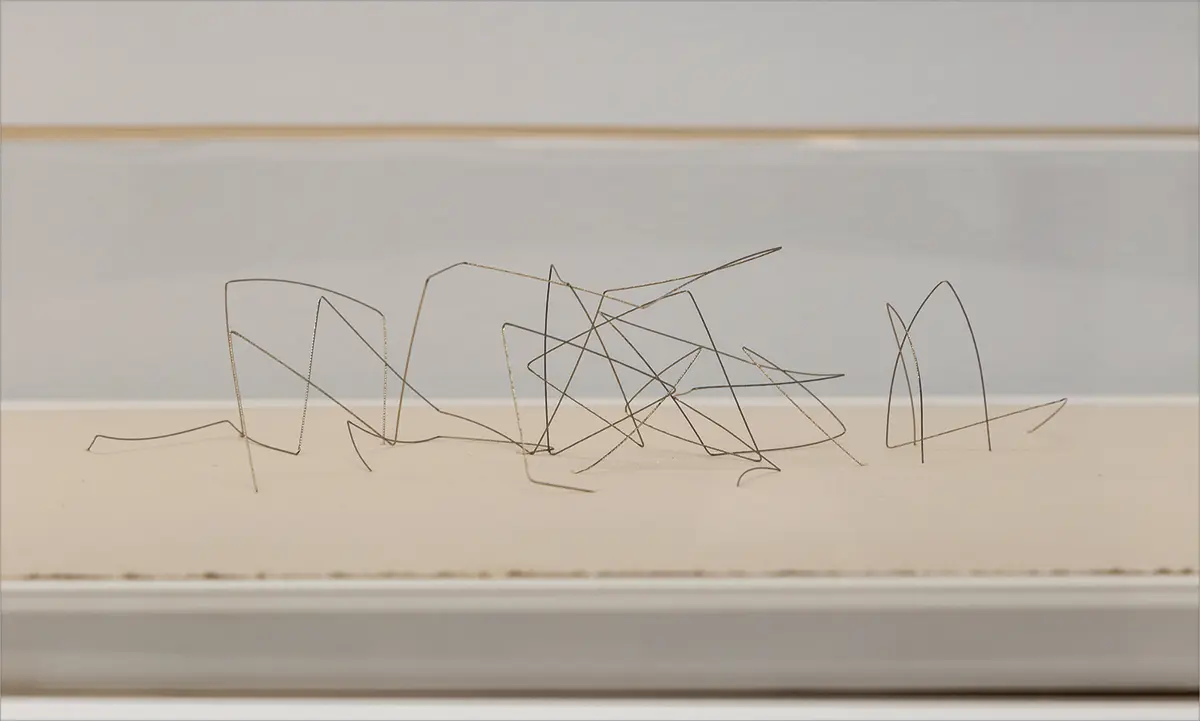
Recent, very recent works share the space with earlier ones. Notable among the former is Historias que no fueron (Stories That Weren’t, 2019), a curtain comprised of small reflecting pieces, tears raining down interspersed with shadows: the projection of the figures onto the gallery wall is part of the work. Such interplay of shadows is also established in other, smaller items, like Ancestro encontrado (Found Ancestor, 2018), a copper wire that could very well be a dragged jewel, or Otras olas (Other Waves, 2019), which connects with the neurotic drawings mentioned above.
Many of the small-format sculptures combine presumably luxurious items with found elements, garbage from a dump, throwing down a “probable line” between the art object and the useless remainder, between that which is covered in gold and that which is made of plastic.
Tanteo (Rough Estimate, 2013) and Cobija (Blanket, 2019) seem to mock their materials. The former uses a type of pita cord standard in construction projects, and the latter uses bronze wire. The composition is similar, and the final product resides between the secular and the sacred. This is reinforced by how they are displayed: they can be tied to a rope or presented inside transparent cases. Espinosa’s mastery is well summarized by the capacity of these small, hanging (or emerging) works to evoke sensations or moods: nostalgic, confused, entertained, hurt. All of it delicately worked, with the uncertainty that comes from the fact that a breeze rushing through the gallery could blow them to the ceiling. A poetic current imbues Espinosa’s work, and it is never hidden. The curatorial essay itself, printed on crumpled paper, is composed in brief verses that begin: “Improbable lines / inhabit silence.” In the line sewn on paper of Generaciones (Generations, 2019), one point at the beginning and one point at the end remind us that this story, or all stories, is a set of linkages that enter and then leave.
The silence is broken again. A car passes outside the gallery. The noise comes into the space and accompanies the viewer, who returns to the starting point: that performative drawing, or drawing performance. The results of the work documented in Fonografías demonstrate the effort to consciously “make chance,” an exercise in amateurism where the artist becomes the manipulator of a group of puppets—her pencils—that dance to the sounds of a Colombian street’s frantic life. We see the traces, the signs, the accidents, and intuit the rhythm.
JUAN JOSÉ SANTOS