Leonel Vásquez’s solo show, entitled “Canto rodado” (Boulder), brings together a video and a series of photographs and sound sculptures, as a result of a field investigation carried out in 2019. The artist explored several Colombian rivers, such as the Claro River (Antioquia), the Chenche River (Tolima), the polluted Bogotá River, and the Aguas Blancas Creek, a tributary of the Ranchería River (La Guajira). The latter, whose flow was diverted in favor of “progress,” is the place that gave rise to this project. When he found its old course—dried up and turned into a river of stones—the artist picked up a boulder and contemplated the possibility of finding its voice through the scars generated by the passage of water and time.
After touring, observing, and listening to this exhibition, and talking to the artist, I understood that, in his research, he became the person who walked and learned to listen and in turn transmit what was told to him both by the people who he met along the way—of which the interviews are a testimony—and by the water and the stones that have found, through Vásquez, a way to make their voices heard.
In the exhibition, his photographic images begin to reveal the artist’s scientific interest in the footprints left by the water in geological formations, as we can see in The Workings of the River. La Danta Cave or in Dissolutions 1. In these images, it is precisely the idea of the trace that becomes evident. The force of water generates grooves in the rocks, shaping and piercing them during such a tremendously long period that we are incapable of conceiving it. Vásquez explains that as humans, we are inherently aware of what is hard and what is soft, but we lack time to experience the natural transformation of things. However, in the rhythm imposed by progress, human beings are responsible for generating vertiginous changes. In his journey through these landscapes, the artist soon ran into the marks and the presence of human beings. That is why he has framed his research and his artwork within the anthropogenic.
The video piece Sound postcards/ Boulders conceptually lies somewhere between the scientific properties of the photographs and the poetic resonances of the sound sculptures. The work not only presents the stories that describe how these waterways are losing their voice, narrated by people living near rivers, but also reproduces these very sounds as if the water and the boulders had also been interviewed. The storytellers talk about their relationship with these water beings and the changes they have witnessed over the years, reminding us that the lives of the rivers and our lives are intimately and perversely interrelated. Human beings always want to gain something, seeking more and more benefits, even while knowing that in the long term, we will end up losing what we need for our very survival.
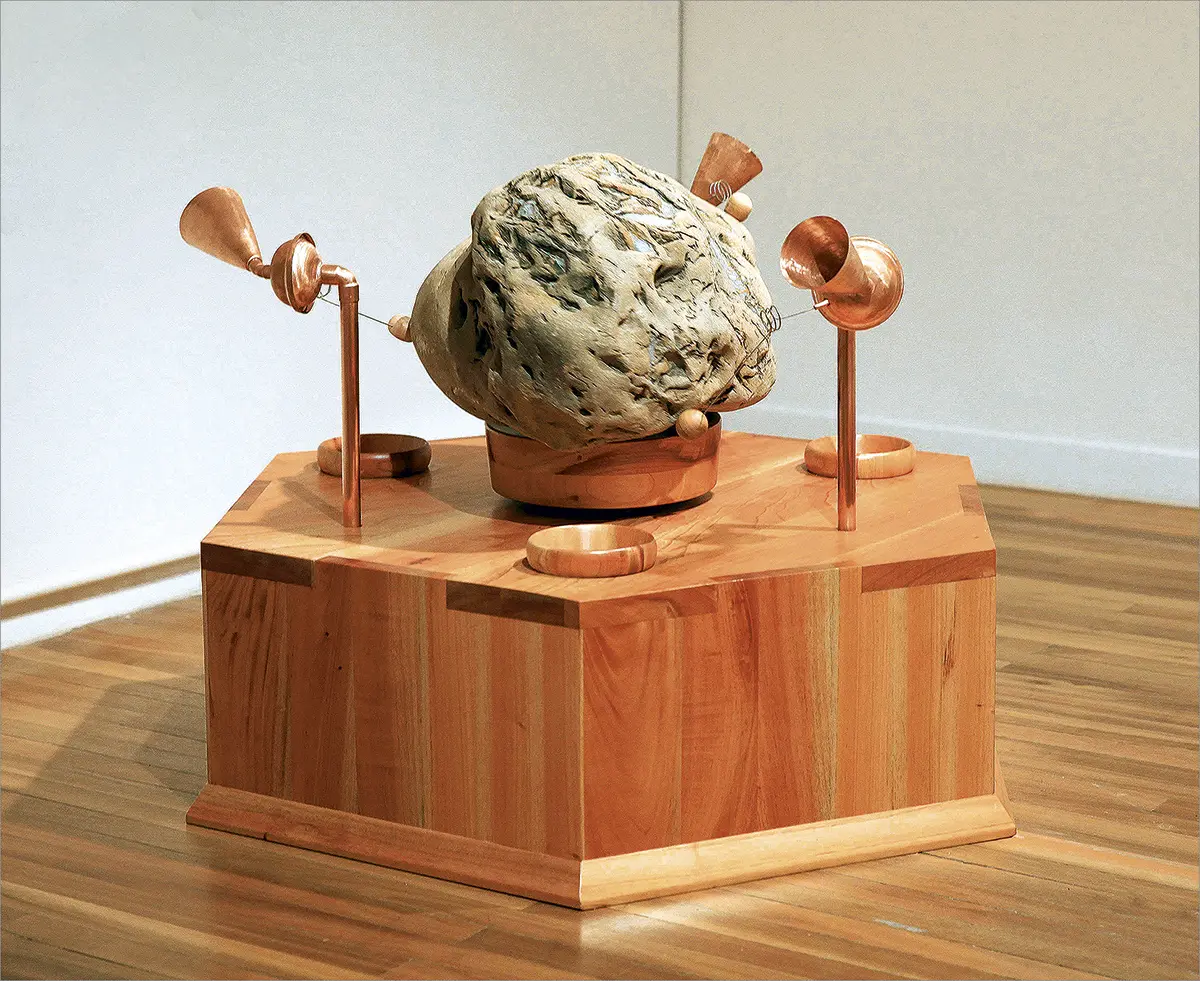
The evidence of the imprint that aroused the poetic and artistic interest of Vásquez’s research has opened the door to experiment with the sound possibilities of the stones. In his search for various types of witnesses, Vásquez found some that are silent but which have a more in-depth story to tell: rocks found on the road that once belonged to a body of water in constant flow. Large grooves of knowledge are recorded in their skins, stratified by the passage of water in a time that seems infinite to us. We can then imagine how someone who patiently practices the habit of listening, decides to invent a device that allows us to listen to something never heard before. He has thus assembled a library of singing stones: the patrimonial sound archive of water landscapes—as the artist also calls them—which can be heard through a lathe, a kind of gramophone invented by the artist to amplify the sound of stones mechanically. Several compositions of sound sculptures—some mechanical and others electrical—are turned on by sensors that detect the movement of bodies. An almost miraculous concert of inert objects, in principle considered dead, fills the air. The same idea of technology that drives the so-called progress is placed here at the service of stones transformed by human action. Thanks to the excellent craftsmanship employed to create these machines, the sounds become a subtle polyphonic lament emerging from the geological entrails of another era, another world, another land. They also demonstrate the great love and attention that Leonel Vásquez has invested for us to be able to listen to them. Furthermore, his work proves that to listen is, undeniably, a political act.
CARIDAD BOTELLA