The Miami exhibition circuit is offering more and more spaces during Art Week (coinciding with Art Basel Miami Beach) to artists who are either currently part of their artistic community or have been in the past. The 2019 Art Week edition was a particularly exemplary case. The numerous personal exhibitions held both in galleries and museum institutions include the solo shows “Carlos Estévez. Cities of the Mind” (Lowe Art Museum), “Tomás Esson Miami Flow II” (Fredric Snitzer Gallery), “John William Baily. The Roses of Fibonacci” (LnS Gallery), and “Teresita Fernández. Elementary” (PAMM), and group exhibitions such as “For Now: Contemporary Venezuelan Art of the Miami Diaspora” (Coral Gables Art Museum) and “10-A Decade” (Dimensions Variable).
“Julio Larraz. Behind the Curtain of Dreams,” exhibited in Ascaso Gallery’s new venue, has been arguably the most comprehensive solo show within the city’s gallery circuit for this art event. The show, comprising almost thirty paintings, also included six sculptures—three of them with monumental dimensions—specially produced for the occasion and spanning more than six years of Larraz’s oeuvre. It is the artists’ most complete and important exhibition in the United States in recent years.
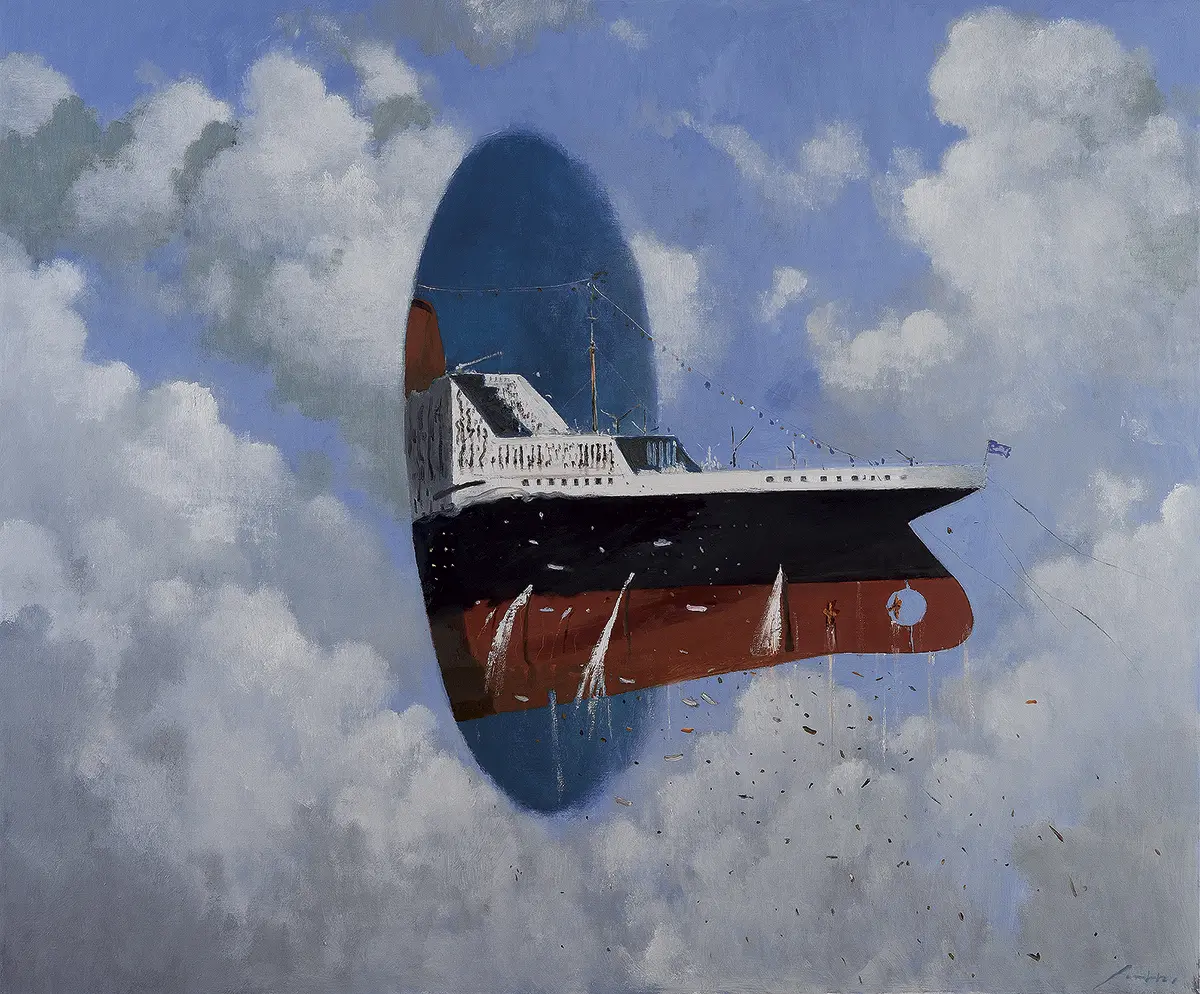
“Behind the Curtain of Dreams,” complemented with a catalogue raisonné, displays all the poetic and discursive power that has characterized Larraz’s trajectory. One that has produced a very personal style of great expressive singularity, making him one of the key figures of Neofiguration. And precisely the distinctive pictorial features of his neofigurative language is what brings expressive uniqueness to his poetics. In this sense, the figure-ground relation is harmonized by a palette of flat colors and resolutely expressive lines, allowing the gaze to go beyond the frame and towards the pictures’ horizons. Larraz also reveals a vocation for narrative synthesis, distilled from his beginnings as an illustrator before plunging into the world of neofigurative painting. This narrative synergy is visible in paintings such as Forest Murmurs (2015), Au Revoir (2016), and Undocumented (2015), among many others. His narrative pictorial synthesis depicts a world of objects and things where details are never explicit. Among other reasons, because his treatment of light—somewhat in the postimpressionist way—avoids precise contours. And this slight “blurring” of contours, which his neofigurative language brings to most of his representations, implies that our perceptions acquire a greater subjective thickness.
From the discursive perspective, the landscape was another protagonist in this selection of works. Here, many paintings addressed the landscape genre, often with a neo-romantic breath. Ideal natural spaces involved the human presence, as in Dreaming of Petrarca (2015) and Flower Storm over Punta (2018), to name a few. Larraz’s world has the appearance of reality, mainly because of how his neofigurative language assumes the representations of the world. But the appearance of reality is contrasted with diverse spatial and temporal dimensions, as in Forest Murmurs (2015) or Au Revoir. Ships that cross the skies (Au Revoir), modernist telephones facing insurmountable walls... These paintings bring together, in one scenario, symbolically dissociated cultural dimensions of meaning. Hence, the surreal breath of many of his paintings, and sculptures such as the monumental Retrofit and Strong Man, both from 2019.
In Retrofit, Larraz carries classical Greek mythology into contemporary imagery by reproducing the statue of the goddess Niké—also known as The Winged Victory of Samothrace—but replacing her wings with two jet engines that seem to thrust her through the universe at the speed of light. Larraz’s world is revealed to us as a sequence of images projected over reality in the manner of reveries. They are desired but inexistent places, situations made up of pure longing, scenarios that invite us to remember who we are, as we enter the fascinating imaginary of Julio Larraz.
DENNYS MATOS