Seen through the works of today’s artists, who confront us insistently with the complexity and intricate contrariety of the present, the decade of the 1950s, when a large portion of Julián Althabe’s activity took place, was the time when the idea of beauty and happiness that—according to some—characterized the modern project, became explicit in the art field. It is often forgotten that the decade’s groundbreaking character implied questioning established values, with a tendency towards the destruction of the old and the recomposition of the new.
The dawn of visual-arts modernity took place in Argentina in the 1940s, connected to the arrival in the Rio de la Plata region of Joaquín Torres García in 1934, bringing along the renewal of creativity that he had experienced in Paris.
The publication in Buenos Aires of the sole issue of the journal Arturo, in 1944, gave a forceful shock to the local arts scene and pushed it to emphasize the forsaking of figuration.
It was thus that, on March 18 of 1946, when the Asociación Arte Concreto Invención (ACI) presented its first exhibition in Buenos Aires, the names of Tomás Maldonado, Alfredo Hlito, Claudio Girola, Lidi Prati, Enio Iommi, Manuel Espinosa, and Gregorio Vardanega, destined to take painting and sculpture in the country to the greatest heights, jumped forward.
Adding to this was the emergence of the Madí group, with figures of such importance as Kosice, Arden Quin, and Blaszko, and of Perceptism, born from a splintering of the ACI and led by Raúl Lozza.
This period extended beyond the 1950s, a decade when, beyond the circle of artists interested in the new expressions, there existed in Buenos Aires an audience for contemporary articulated around professor Jorge Romero Brest, the noted editor of the journal Ver y Estimar, and a charismatic personality.
Julián Althabe manifested from the start of his professional activity a deep generosity. Besides his art production, which we will review presently, he devoted himself to teaching and the reorganization of the Escuela Superior de Arte in the city of Córdoba, in search of interdisciplinarity and of a constant updating of pedagogy.
In 1959, while Althabe was working as a teacher at the Escuela Superior de Bellas Artes, Ernesto de la Cárcova presented a program for a workshop in Spatial Art, revealing the importance that space and the possibility of representing it had in his creative horizon.
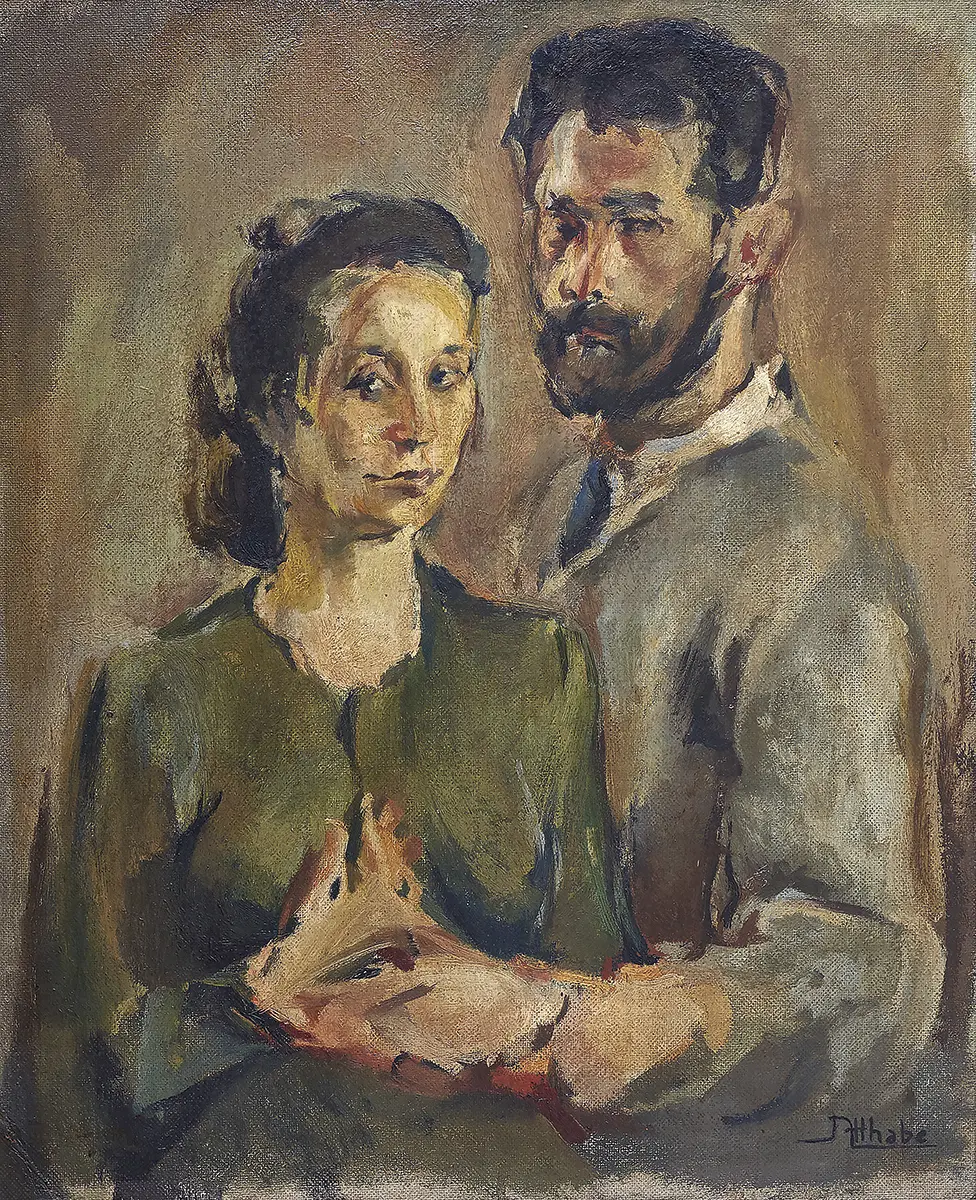
It was precisely this early interest in space, at a time in his career when he focused on painting, that drove him also to explore the double vision, the binocular capture that our perception makes of an object, by which the superposition of what each eye separately sees creates a three-dimensional image. Some works remain that attest to those concerns: Sofía y Yo (Sofía and I) is a portrait where the effect of double vision distorts the figures.
Nevertheless, Althabe was not to remain a painter; he adopted the three-dimensionality of sculpture, a discipline where the field of his prior investigations expanded and deepened.
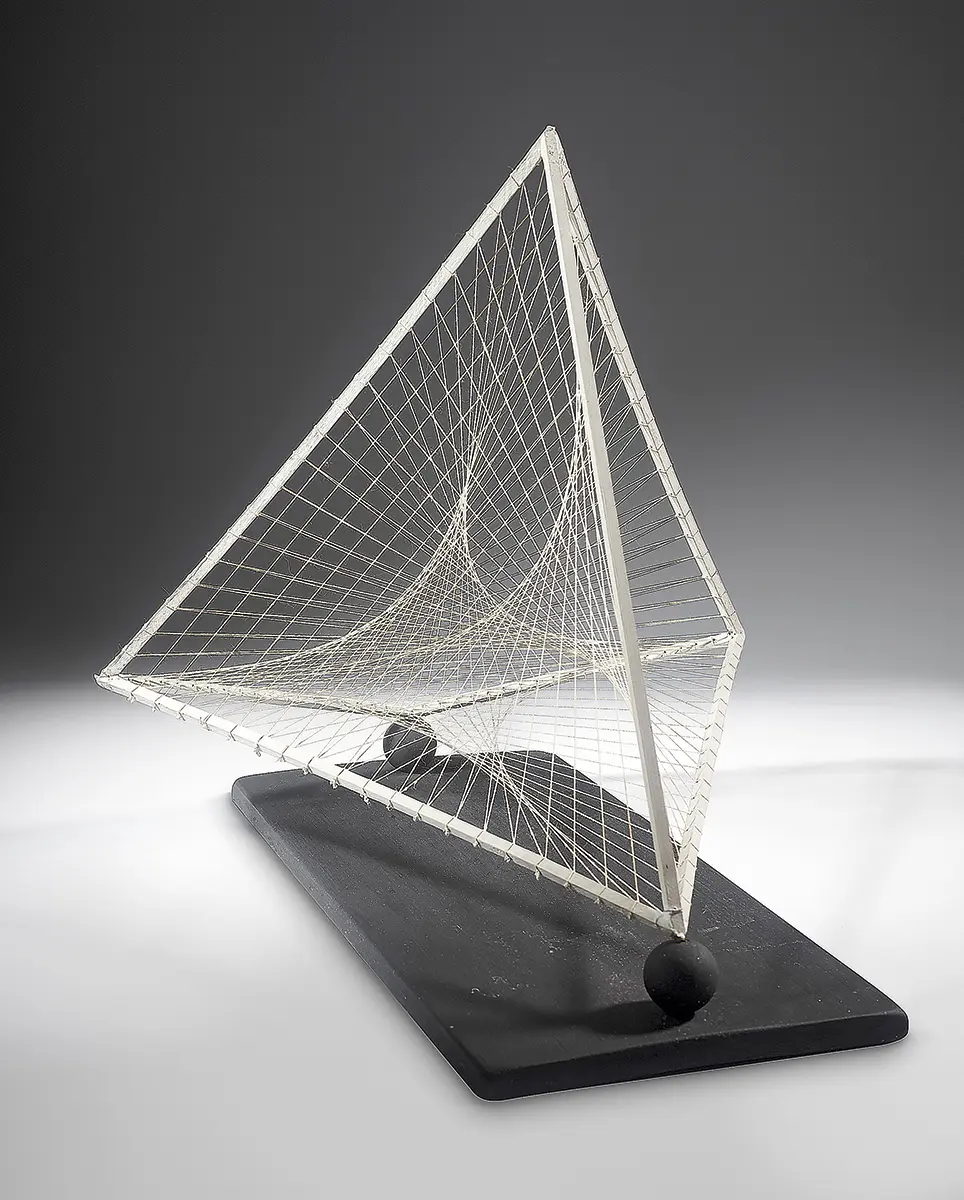
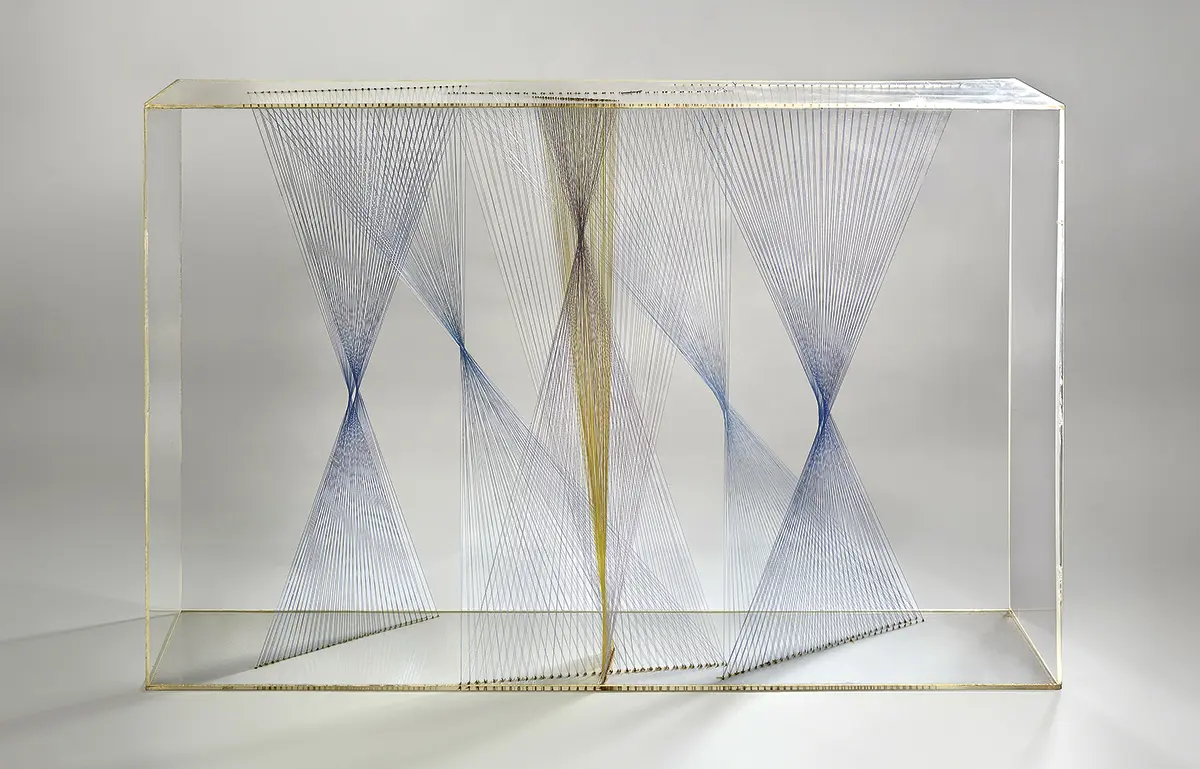
Already in 1950, we find him setting out down that road with Monumento místico (Mystical Monument), built using balsa wood as support for white threads that traverse the interior space of the work in a crisscrossing grid, defining virtual planes.
Monumento civil (Civilian Monument) follows a similar path, seeking to centralize the viewer’s gaze. Still, at that point, Althabe began to diversify his approach, introducing curves and empty space as plastic elements in his work.
Elena Oliveras has observed that Althabe used the moiré effect seen in that body of work through the mid-1970s. She mentions other examples, such as Luces en el espacio (Lights in Space) and Tensiones espaciales (Spatial Tensions). She notes that other Latin American artists, like Jesús Soto and Cruz-Diez, also used the moiré effect. Althabe first adopted it in the early 1950s, “thus demonstrating that his contributions to Latin American kinetic art are unquestionably innovative.”1
Julián Althabe was closely attuned to the era’s scientific advances, to the emergence of non-traditional materials, and, above all, to the circulation of novel, incandescent ideas.
Even from a cursory overview, it is easy to understand why the work done in non-Euclidean geometry starting the Nineteenth Century—from Gauss to Lobachevski’s and Bolyai’s hyperbolic geometry, to Riemann’s elliptical geometry, all the way to Einstein’s theory of relativity—inevitably shook the conceptual basis of all artistic disciplines.
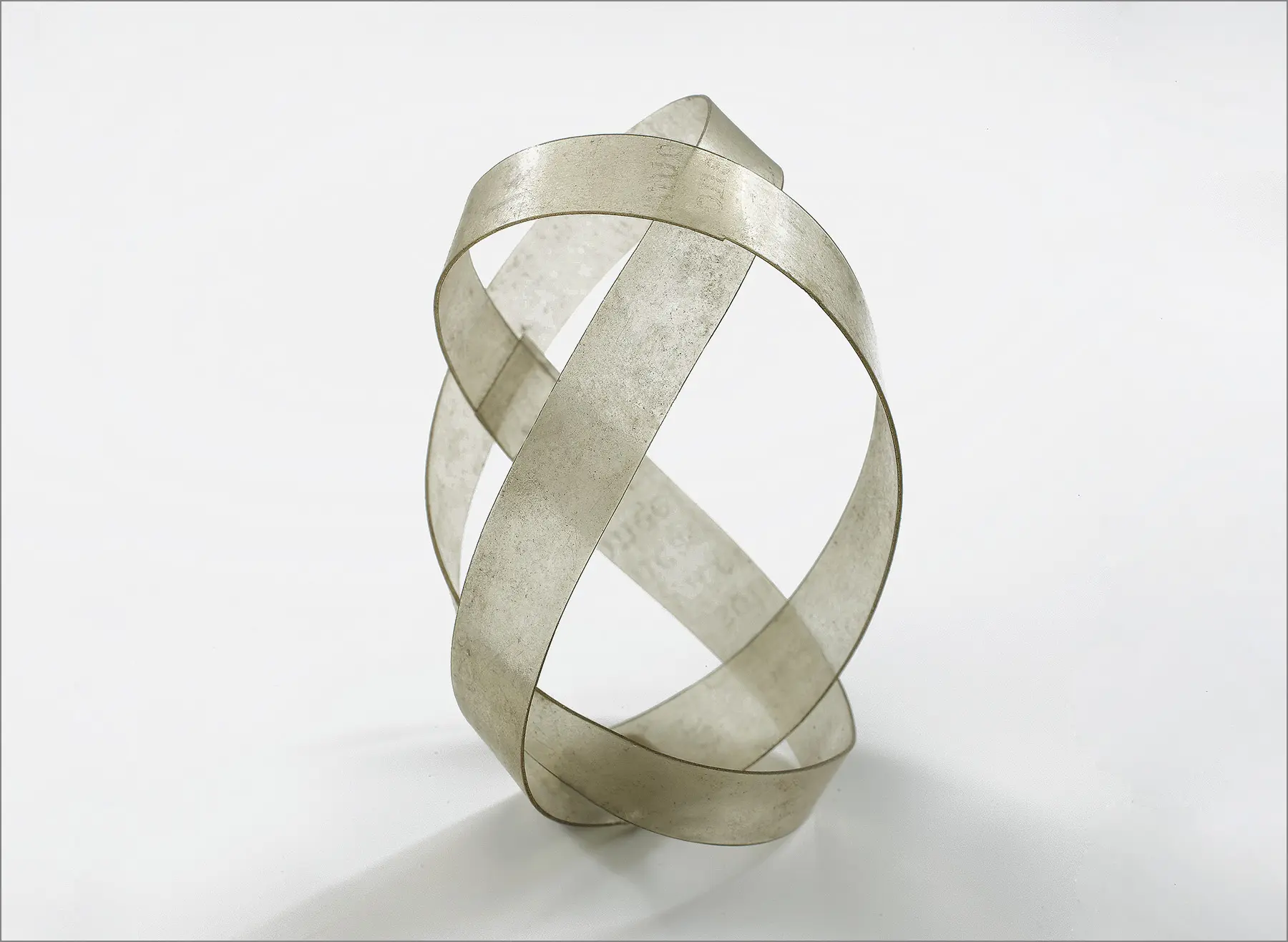
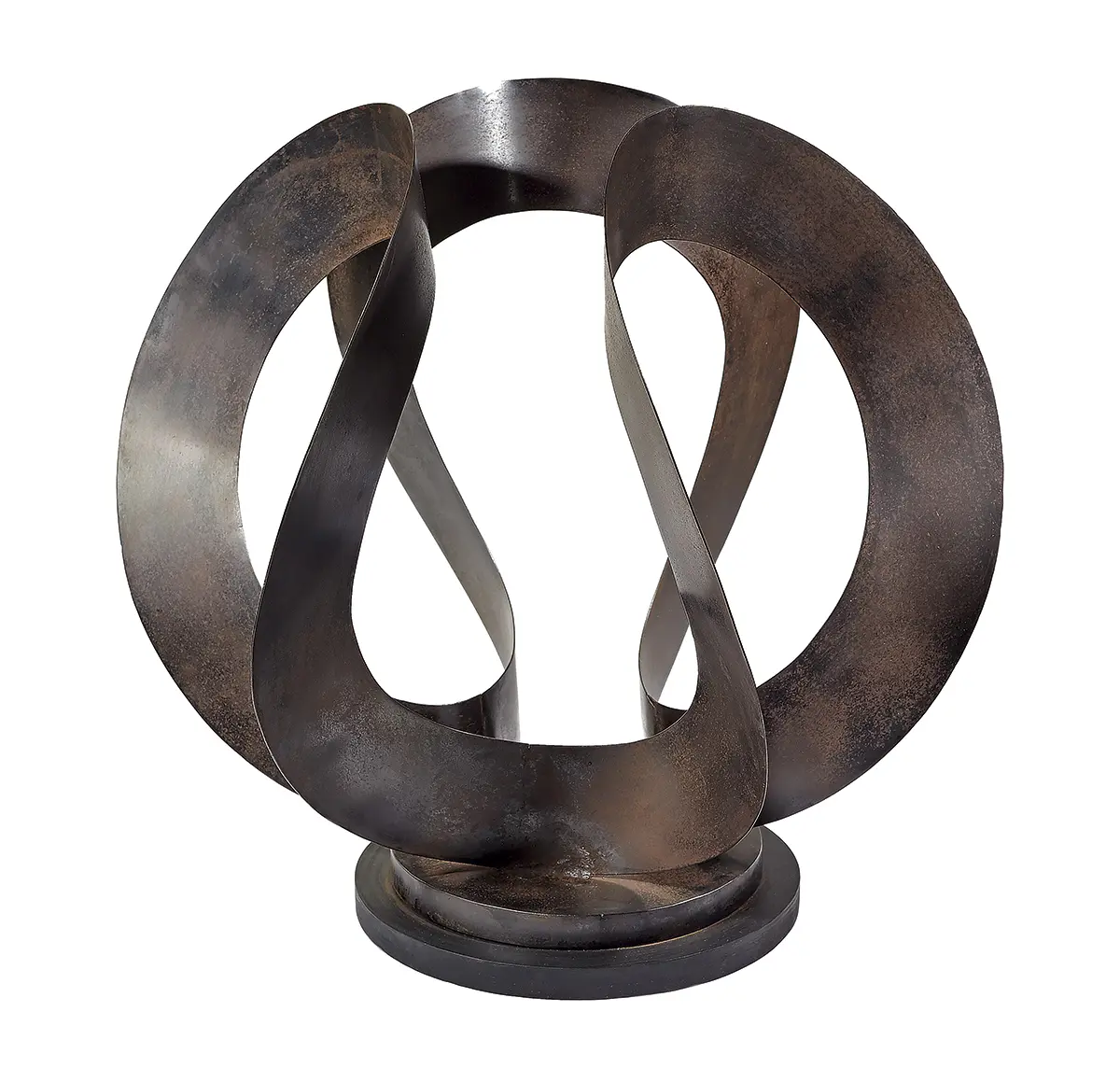
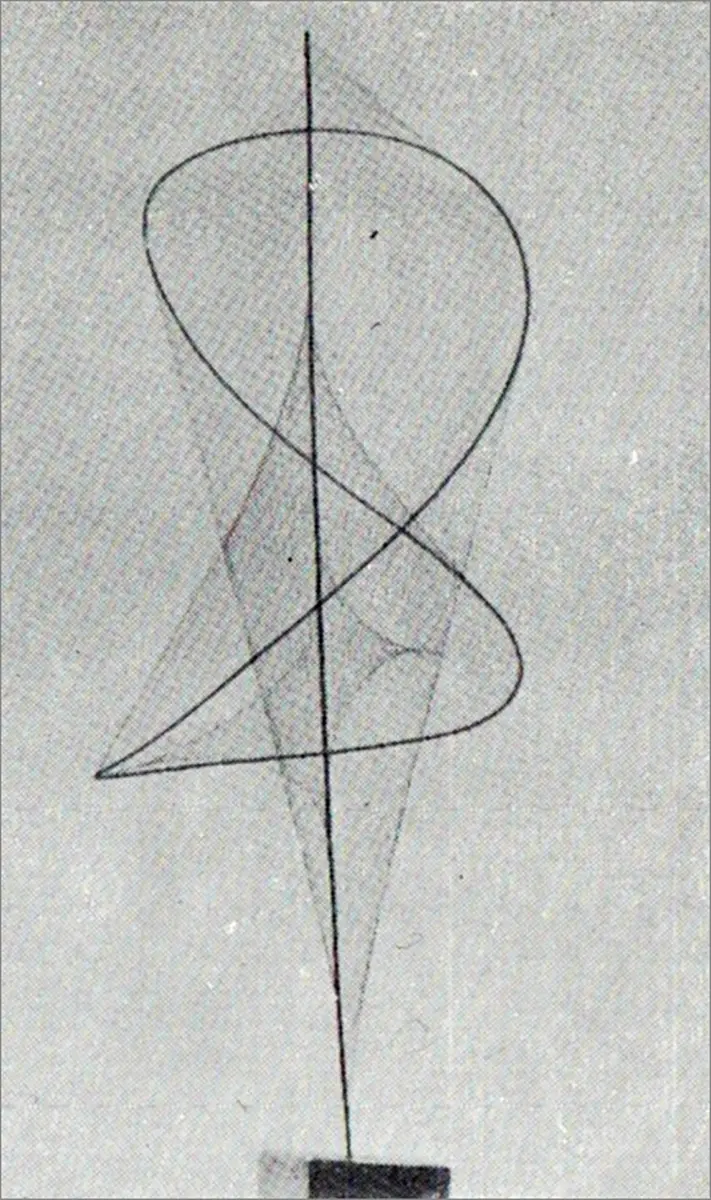
Let’s remember that Moebius’ publications about his strip—of which we have seen brilliant versions in the Twentieth Century—date from 1827. Indeed, Julián Althabe incorporates the Moebius strip into some of his works, for its simultaneous capture of the inside and the outside in three-dimensional space.
In that regard, Elena Oliveras points out in the book she devoted to Althabe, simultaneous vision and simultaneous time place his work on a quantum path, in the direction of a (microscopic) world where objects are so lightweight that the pressure of a ray of light can provoke violent changes in position. As happens at the level of the atom, a peculiar and characteristic “superposition of states” occurs in Althabe’s constructions, bringing us face to face with the quantum-mechanical conceptual revolution, i.e., with the loss of an objective reality in favor of several realities that exist simultaneously. We arrive then to the crossroads of parallel worlds, a grid of timelines that approach or ignore each other, coming together or drifting apart. It is the world presented by Borges in “The Garden of Forking Paths,” in the image of a temporal rather than spatial labyrinth.2
To complete the picture of Argentina’s heated stimulating art scene, at the time when Julián Althabe began his activity, let’s also mention the article that Tomás Maldonado wrote for the first issue of Nueva Visión about Vantongerloo, “who intended to give aesthetic expression to a world of non-measurable dimensions.”
The collector Ignacio Pirovano published Writings by Vantongerloo In Buenos Aires in 1981 through his eponymous foundation, in a Spanish, English, and French edition. In the prologue, Pirovano tells the story of a time when, visited in Paris by several Argentinean artists, Maldonado, among them, Vantongerloo wondered: How is it possible that while here I am practically unknown, over there, so far away, they know about my existence?
Tomás Maldonado expressed his admiration for Max Bill3 in several ways, among them, by devoting a book to him. News of Max Bill had reached Buenos Aires after he won First Prize in the first São Paulo Biennial, in 1951.
Julián Althabe included Max Bill among the foreign artists that most interested him. He studied Bill’s handling of interior and exterior contours and the way he took sculpture from its static state to a visible mobility. Another reason for his interest was that “Bill’s work attests to a new type of coherence, one that is open, dialectical, a new plural unit.”
Max Bill published “The Mathematical Approach in Contemporary Art,” an inescapable reference for the young practitioners of geometric abstraction, in 1949. His concept facilitated access to other domains of knowledge: theory of perception, set theory, topology, among others.4
We will attempt to penetrate the interest that the themes Julián Althabe engaged in his work arose, and the effervescence and debates that emerged in the scene around them.
In the mid-Twentieth Century, the push seen in De Stijl, Bauhaus, and Max Bill for art that harmonized individual freedom with the urgent demands of the new mass society—which would come to be known as the comfort society—had reached a high level of objective materialization in Argentina.
This was the moment that the work of Julián Althabe captured. In the early 1960s, Althabe began to work in acrylic, for its properties of light and transparency. As Ayelén Vázquez observes, this material allowed him to create bodies devoid of opacity, where interior and exterior spaces extend in continuity.
Althabe further developed these ideas in works that he presented at Gradiva gallery in 1970. “The three-dimensional images on exhibit here point towards simultaneous time,” he said with regards to these works. “They can be seen in full from any angle, without anything obstructing a real and distinct view.”
In that catalog, Althabe acknowledged Gabo and Pevsner as strong influences, albeit recognizing his conceptual differences with both.
In terms of Althabe’s works for public spaces, the first one, from 1960, was situated in the grounds of La Rural in Buenos Aires. Eight meters tall, above an illuminated reflecting pool, its transparency allowed for the simultaneous apprehension of different aspects of the work. Unfortunately, it was destroyed after the event.
In 1962 Althabe won the contest for a “Monument to Argentina’s Industrial Development,” organized by Kaiser Industries Argentina (IKA in its Spanish acronym). His sculpture was titled Juntos construimos (Together We Build); it was 29 meters tall and was intended for the access way to the facilities, in Córdoba province, Argentina.
A sense of monumentality had been present in Althabe’s work since his earliest works of the 1950s, among which was Monumento a la democracia (Monument to Democracy, 1958), in sheet metal, plaster, and wire, which competed in the 5th São Paulo Biennial.
Althabe’s monuments have an assertive, celebratory character. As Federico Baeza5 points out, in 1969, a column of three thousand Kaiser Industries workers clashed with the police in a political event that came to be known as the Cordobazo.
In 1971, another brilliant Argentinean sculptor began his series of Monumentos inútiles (Useless Monuments). Those figures-monuments are a palpable testament to the fall of all grand narratives and to a world where the heroic seems to have lost all reason for being. The moment to which Julián Althabe had given objective form was one of a positive vision, of open possibilities. In turn, Aldo Paparella gives shape to space as a site of violence and fragmentation.
NOTES
1. Elena Oliveras, “Julián Althabe, histórico y contemporáneo”. In Julián Althabe, De la doble visión a la cuarta dimensión. Ciudad Autónoma de Buenos Aires, 2017.
2. Ibid.
3. Tomás Maldonado. Max Bill. Ed. Nueva Visión, 1955, Buenos Aires.
4. Willy Rotzler, in Les années 50. Centre Pompidou, November, 1988.
5. Federico Baeza, “En qué consiste el arte. Nadie lo sabe”. En Julián Althabe, De la doble visión a la cuarta dimensión, op. cit.
NELLY PERAZZO