The Past of This Afro-Cuban Present is the title of Juan Roberto Diago’s most recent solo exhibition. Curated by Alejandro Fernández at the University of Miami Lowe Art Museum, the show is an exhaustive review of the prolific career of a Cuban artist (Havana, 1971) whose poetics focus on his own racial identity and his condition of inequality in the midst of contemporary Cuban society.
Although racial issues where erased by decree in Cuba’s public sphere, using a constitutional prohibition of discrimination for reasons of race and skin color, there has never been in the country a conscious affirmative-action effort capable of contributing, with a post-colonial focus, to the effective integration of a historically excluded segment of the population, and to the dismantling of the many stereotypes and prejudices about black people that have persisted since colonial times. In this way, a stratified construction of rigid racial identities rooted in the colonial apparatus (white, creole, mulatto, black), is reinforced by a homogenizing discourse about the nation built based on patriarchal structures, and by the myth of white-European superiority extant in Cuba even today, all of which condemns the urgent debate of racial inequality to ostracism and invisibility. This is the precise crossroads where the work of Juan Roberto Diago is situated.
The Past of This Afro-Cuban Present offers a panoramic view of Diago’s work from its beginnings to the present, which can be subdivided, in broad strokes, in two lines of work. A rather narrative line, where we find conventional genres, and a second line characterized by formal and conceptual synthesis.
Diago has been interested in his immediate surroundings (the working-class neighborhood of Pogolotti) and its inhabitants since early in his career. Subaltern myths and cultures find an echo in the recycled materials that function as support for his proposals, constructing an effective plea about the growing problem of racism in Cuban society. Diago’s exploration of traditional genres derives from recognition, self-recognition, and denunciation.
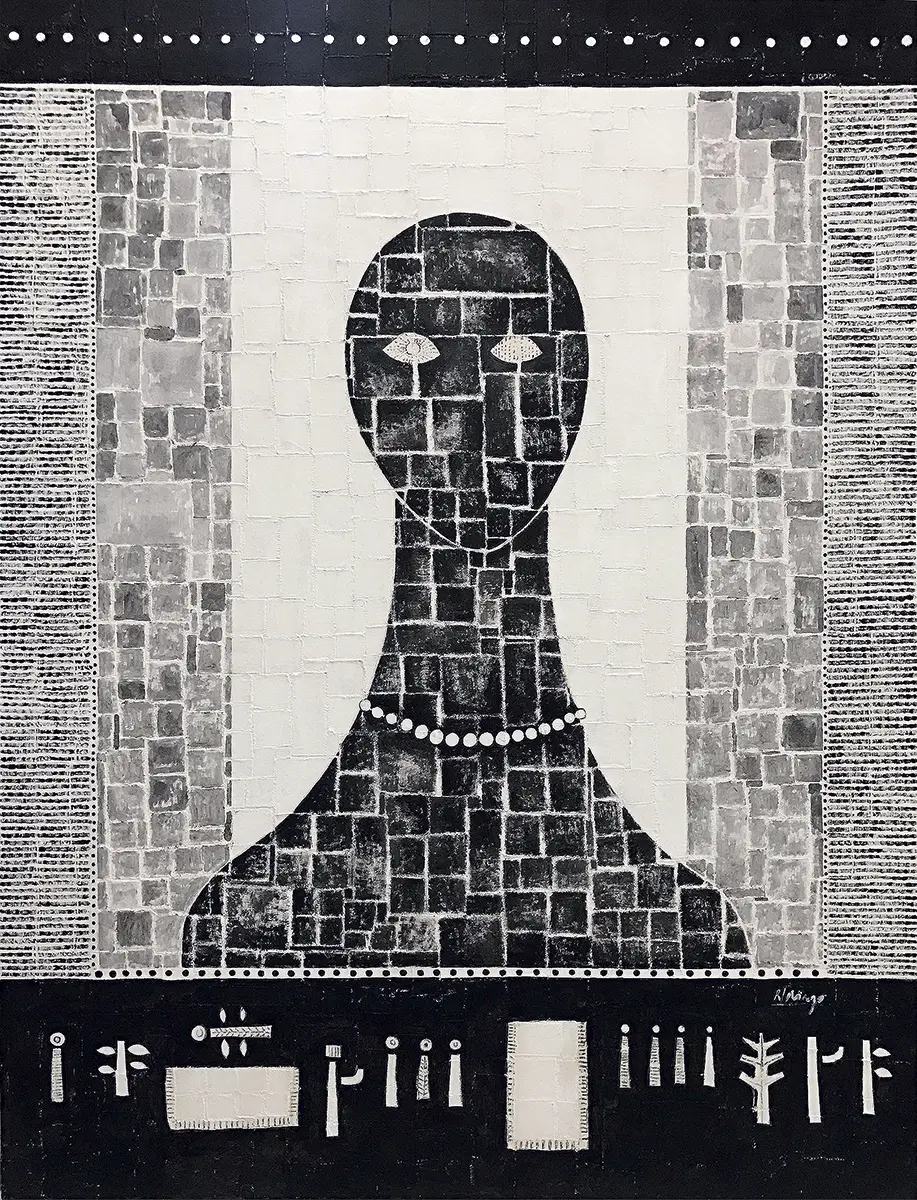
In this way, portraiture, quintessentially a genre of self-affirmation and empowerment, helps Diago give new visibility to black individuals, situating them in the space of representation not based on the typical folklorist approach of the negrismo that dominated Cuba’s visual and literary avant-garde of the 1930s, but in a human sense. Assumed as entelechies, the stoically dignified portrait subjects become accusatory by their mere presence. They are not seconded by any attribute denoting his social condition. This is a timeless kind of portraiture where the centrality of the face, the clean-cut head, and the lack of expression all question us. The eyes like empty sockets and the absence of a mouth emphasize the centrality of the gaze: beings that can see everything, yet are deprived of speech. Sin título (Untitled), from 2011, is a kind of artist’s statement where, based on the concept of dualism (positive/negative space; white/black; up/down), Diago masterfully summarizes the fractured character of contemporary Cuban society and the Afro-Cuban community’s demand of full inclusion.
In Diago’s still lifes, freighted with all the moral and historical weightiness of the genre, the flower pot becomes nganga. Matando flores (Killing Flowers, 2001) contains three instances (somewhat in the manner of Kosuth). The original referent does not exist. We witness three representations that, like apparitions, materialize progressively. Such reiteration seems to signal a kind of magical action, wherein a persistent invocation ultimately renders the invisible, visible. A connotation of vanitas painting is also crucial here.
Diago’s landscapes emerge from a context of marginalization, historical denial, and recycling. They are a kind of urban archeology that returns those excluded to the public sphere. Omitted passages, marginalized characters, and silenced voices are vindicated through the material and the words embodied in graffiti (that silent and anonymous scream, more often than not born in a clandestine, middle-of-the-night gesture.) “My story is your story”; “Spain, give me back my Gods”; “Being a man is not difficult, being black is”; these are some of the clamors that official history stifles and Diago’s painting returns to the mainstream.
The second vector in Diago’s oeuvre, an evolution and a compendium of the first one, takes narrative elements already decidedly “loaded” onto his proposal and distills them. Diago focuses now in the fragment, and especially in the border zone, be it suture or burr, that points to the scar as the embodiment of memory, and to the necessary action of reconnecting a torn social fabric and healing a wound. This is why the real protagonist of these works is the suture: the conscious act of assisting the repair of body and soul. We encounter an act of healing and regeneration that is only possible based on scarring—the keloid—assumed here as scarification rather than an insult, as pride in belonging and cultural identity.
Like the Japanese technique of kintsugi, which celebrates the dialectic of totality and fragmentation, Juan Roberto Diago chooses not to hide the cracks but to emphasize and celebrate them. The scarring that results from this healing act possesses an irreplaceable beauty, as it is the carrier of a historical weight that gives support to the original object (a cracked nation) and turns it—provided the healing is possible—into a warrior against time. It is precisely this test of its resiliency that the Cuban nation is undergoing today.
JANET BATET