Attracted by children’s behavior, play, and audacity, Javier Caraballo (Barranquilla, 1985) exhibited in the Museo Rayo a series of paintings that enact some interesting contradictions determined by pictorial technical complexity vis-à-vis the meaning of these images. The paintings I will refer to represent children intervening (vandalizing, modifying, scratching, improving, inhabiting, interpreting) canonical works of art. In other words, these pictures contain other pictures, and also the moment when these children, who turn their backs on us, transform them.
The subject is very specific and has to do with children’s graphic language, which is part of the artist’s conceptual quest in obvious tension with the technical expertise he demonstrates in his works. By saying that it is a particular subject, I want to emphasize that it is very unusual to see paintings of children scratching works of art. However, these paintings could be identified with a certain current (so to speak) concerned with the relationship between popular culture (everyday life) and established culture (what is preserved); in this case, with scenes that show the destruction of icons inscribed in the collective memory.
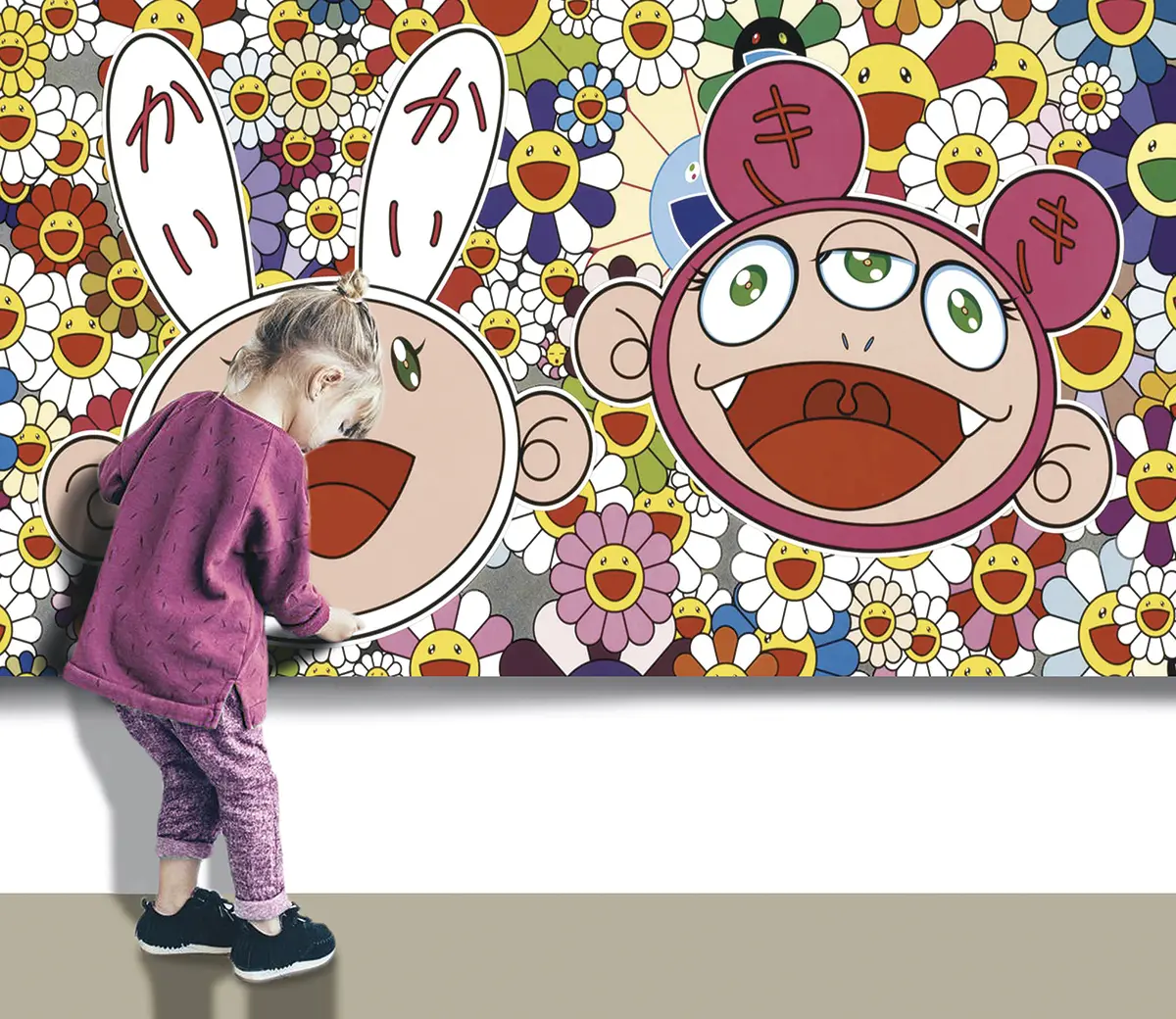
The paintings, which allude to innocence and spontaneity, are painstakingly constructed as if they were photographs. The conventions of color and form have two planes: the human figure seems to be registered under the lens of a camera, in clear opposition to another plane, which accurately reproduces famous works of art by Monet, Murakami, Van Gogh, Dalí, and Warhol, among others. This double plane tries to take its plot for granted: children’s creative stages, the doodle, the first strokes, and, on the other hand, naivety.
However, they are meticulously calculated pieces for which the artist has explored various fortuitous signs: children’s clothing (some in shorts or pajamas, as if they were at home and not in a museum), the uncomplicated gesture of their movements, the childish figures that intervene on the pictures, and the effect of seeing an exact copy of a masterpiece in the background, that is, desacralized and banalized. The scenes give an account of a domestic world that emerges to the foreground.
This representation of the fortuitous contains a virtuoso artist’s trap: he has managed to make us think of his paintings in terms of the theme (the doodle) and not of the pictorial display needed to view his technique as a secondary factor. The series called Master of Painting tries to redirect the mastery of the artist (the legend) towards the child’s gesture, paradoxically using a technique that is commonly thought of as masterful: the painting that looks like a photograph.
This work, curated by Miguel González, is only a fraction of Caraballo’s production, which centers on children’s creativity in correspondence with consecrated art, the primary stroke of the child depending on the pictorial techniques more complex and the same art history, although always as a subject, as a representation. The fact that they are recognizable works delves into the popular condition of the scenes, makes us think of referents such as Marco Mojica or Nadín Ospina, who pose such games. Likewise, we remember the condition of much of the art scene today, which reviews its history to question it.
I consider this examination to be a timely artistic tool (or weapon) if one takes into account the fact that art history (“with capital letters,” as they say) revolves around the art of a single continent and its capacity for cultural expansion (colonial or not). Producers outside that history bring to their work other traditions that, in some cases, are critical only because of their origin. There is something in this series of paintings that made me think precisely about that: a children’s continent (“new” or childish) that is looking for other ways of doing art, politicizing everything, and continually desacralizing its references. Local (everyday) thinking tends to internalize what it cannot touch: the global. While it is clear that the artist does not work along these conceptual lines, we may want to think a little more about these paintings, considering that they contain interesting contradictions for us to ponder on.
BREYNER HUERTAS