There are rare times when an exhibition title perfectly encapsulates the major esthetic of the artist. So it is here with Iñaki Bonillas’ first exhibition in kurimanzutto’s New York space: “Marginalia.” In normal use, the word sets apart what is less important. To artists it points to a domain for attention and creation outside the mainstream as a pathway to better see and reveal not only what is important but the ways in which something is made to be important. In a famous essay, Alan Sekula pointed out that photography picks up its meaning from the context, and the issue becomes not what but how meaning is made. Margins can point both ways, in and out, to literally play outside its original source. These projects by the Mexican artist push the margins to the point of their disappearance to initiate a new story.
“Marginalia” is a series of large, framed, and rephotographed collages of images taken from photography books, a fact that initially marks two degrees of separation. The original has already vanished in the first photograph as it appears in the book, then vanishes again by the second re-photograph. Conceptually that might be sufficient to make the point. But most viewers confront photographs on a primary level to search their experiences for the singular outside reference immediately; a version of “oh yeah, I saw that!” That was insufficient for Bonillas.
The images have been trimmed of their original white margins that enframed the important image, then rearranged as white lines reconstructed into pathways across a solid and contrasting black background to connect the different, now borderless images. Viewers can still play what Hermann Hesse called “The Glass Bead Game” by making different connections with no apparent guiding rules, as you can read the pathways along with both directions or simply see the isolated image. The strategic lack of names for individual photo-collages helps allow us to imagine free-floating references. However, we are not free-form travelers; the author’s imagination remains palpable.
There are relationships between the images he selected for each group. One group of images of sculptures range from ancient to modern; a diptych shows people in motion and unconscious of being photographed; another group of fruits invokes the traditions of still-lifes and their symbols of abundance. Often there are what the Surrealists would call part-objects grouped together: fragments of heads or a group of apparently unrelated objects such as a shoe, hat, and spoon placed in juxtaposition.
The second major project showcases different but related aspects of Bonillas’ concerns: writing, archives, and playing off of or redoubling the thoughts of others translated through his own imagination. “Voyage Autour de ma Chambre” (“Voyage Around My Room,”), 1794, is a literal title of imagination by the 18th C French writer and military man Xavier de Maistre (1763-1852). Imprisoned in his room for six months because he refused a duel, he constructed a parody of a grand travel “voyage,” a word used later by the Symbolists to mean imagination. Bonilla can’t resist the bait: a reimaging of another’s imagination that itself is a marginal mockery of its genre. Perfect.
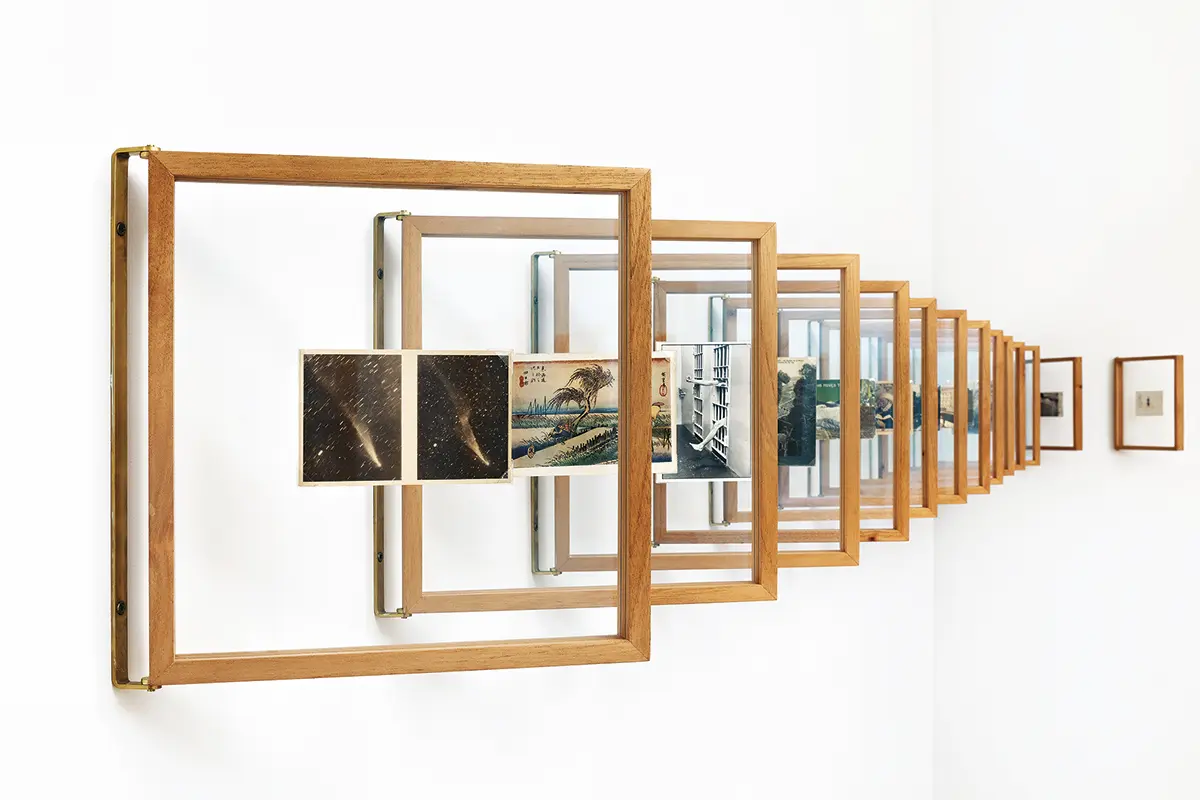
Bonillas’ equivalent to bedroom confinement was the internet. While Xavier de Maistre voyaged around his room, from desk to drawers, to door, to armchair in 42 brief chapters, Bonilla went online to locate the travel postcards of other people’s voyages. His selection depended upon his interpretation of each chapter, now condensed into a single small image. On the back of each, he inscribed the book in print so small the viewer needs a magnifying glass.
The installation echoed a book structure, with each card-chapter placed into a two-sided glass frame and hung separately on the wall such that one could walk down the line and swing each out from the wall to access either side. They become, as the press release so presciently remarked, like notes sent back in time to the author from someone both outside and yet inside his room. This is a position for Bonillas’ liking. And in many ways, it is the position that photographs occupy, which makes them the favorite vehicle of conceptualists.
Bonilla has been called a para-photographer. I would reverse that idea. As far as I know, it was the US West Coast conceptual photographer Robert Heinecken who first described himself as a “para-photographer” because he was “outside” photography, using found and re-photographed images. Like Heinecken, Bonillas’ esthetic involves redefining perception and re-photographing, but his pathway is directly through the inherent paradox of photography; that it is a vehicle of information and while re-presenting things is a thing unto itself. While Heinecken thought of photographs as objects or things to be made into other objects, Bonilla uses their margins as a conceptual vehicle for re-entry into their meanings through their own language.
RICHARD LESLIE