As curator of this exhibition, Christian Viveros-Fauné first defined contemporary Chilean art as a “laboratory of ideas.” And he also took seriously what Claudio Engel— the owner of the collection he was to curate—conceives of as art. For Engel “a work of art is not only a material creation, but a manifestation of the context where it originated.” Therefore, each piece in “my collection... narrates, from a particular perspective, the history of each artist and our Chilean history.” The sum of both concepts enabled “Gran Sur” (Great South) to be more than a simple contemporary group show: a cove in a story starring Chilean artists who, in their laboratories, have tested both ideas about art and ideas about the reality of their country.
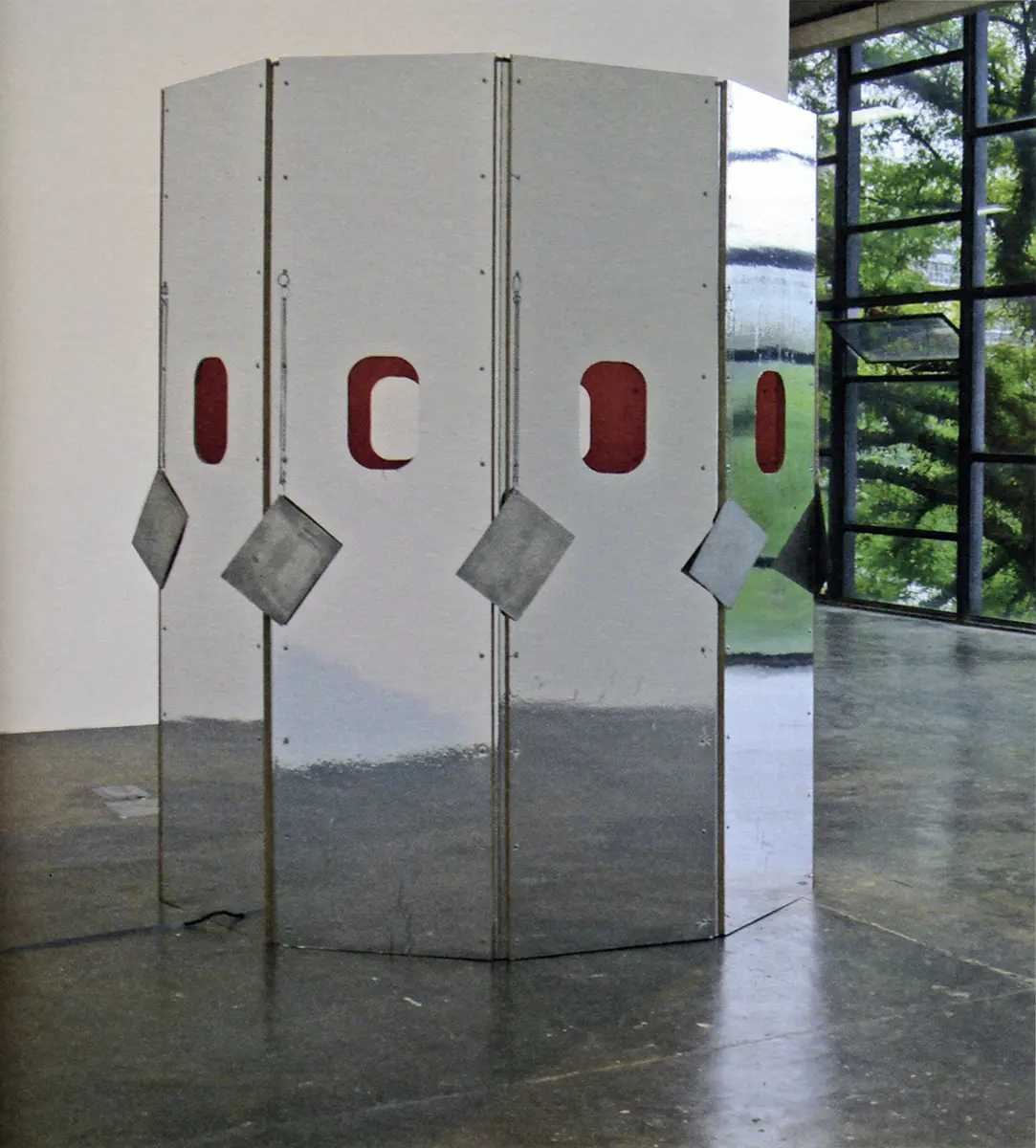
The latter ideas have been of exceptional importance because, although these works were first exhibited in Chile, they had, and still have, extraordinary international repercussions. The first idea asserted the possibility of a peaceful transition from capitalism to socialism promoted by a democratically elected government, as opposed to the idea that associated this transition to insurrection and dictatorship, prescribed by the Russian and Chinese experiences, as well as the Cuban revolution. The artist Mario Navarro evokes this idea in Red Diamond, an installation or sculpture consisting of a hexagonal polygon with windows, inside of which a reproduction of a mythical space can be seen: the Opsroom. Salvador Allende, the candidate for the Popular Unity Party, won the general elections of 1970 and his victory was recognized by the parliament, which proclaimed him president of Chile. Allende also persuaded the parliament to approve the nationalization of copper, the most important industry in all of Chile. He then decided to foster a planned economy with the purpose of overcoming underdevelopment and to guarantee the wellbeing of the country’s majorities. Allende went on to hire the British consultant Stafford Beer to design the necessary technical means to carry out this plan. Beer’s response to the president’s request was the Cybersyn Project, a computer system that could obtain real-time information on the activities of key centers of the national economy and on the population’s needs and degrees of satisfaction with these results. This meant the commitment to socialism in the information age. The nerve center of this network would be the Opsroom, whose prototype was built at the headquarters of the Chilean Telecommunications Company in Santiago by German designer Gui Bonsiepe. It consisted—as Viveros Fauné explains in the catalogue’s main text—“of a hexagonal space, ten meters in diameter, which housed seven white swivel chairs with red cushions and four futuristic screens on the walls, connected in turn with 500 teletype machines that kept transferring information from important industrial plants throughout the country.”
The other idea opposing democratic socialism was to reduce the role of the state to the bare minimum and leave the country’s economy in private hands: a nineteenth-century idea that seemed completely forgotten in the 1950s and 1960s. On the contrary, the welfare state system, then predominant in the United States and Western Europe, presupposed strong state interventionism to put an end to the laissez faire, laissez passer defended by classical liberalism. Milton Friedman, however, disagreed and turned his chair in Economics at the University of Chicago into a stronghold for the propagation of his ideas. He had numerous disciples, among them a group of Chilean students who were to become the Chicago Boys when—thanks to Pinochet’s military coup, which overthrew the Allende government in 1973—they were able to gain control of the country’s economic policy and apply Friedman’s ideas. They turned Chile “into the first laboratory of neoliberalism on a global scale,” as Nelly Richards explained in the wall text of The Chicago Boys’ Project (The Brick), the installation shown at the Reina Sofia Museum in Madrid in 2018-2019.
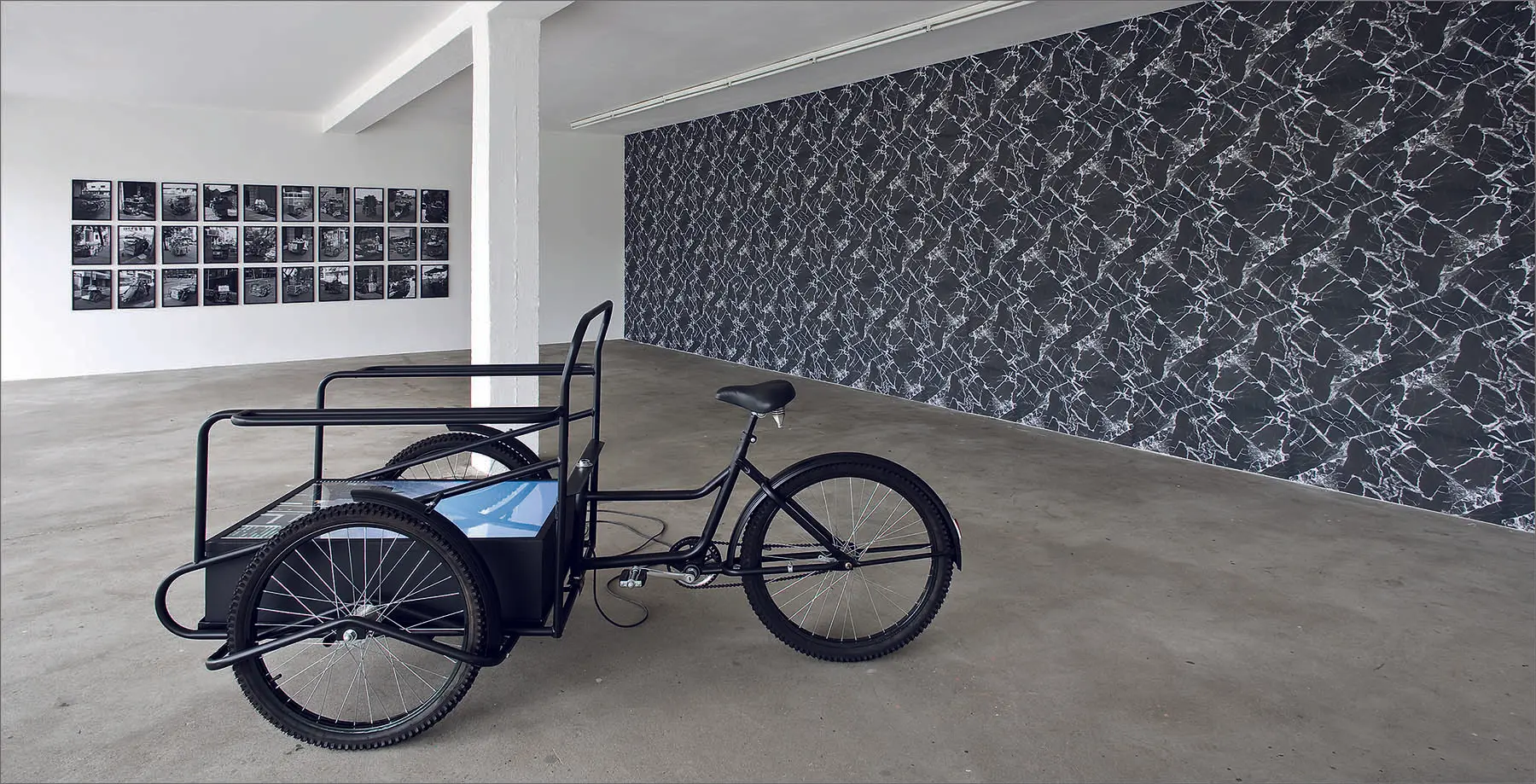
But if in that work Patrick Hamilton made archeology out of the brutal imposition of neoliberalism in Chile, Santiago Derivé Project (2006-2008)—exhibited in “Gran Sur”–shows its effects four decades later. This piece is also an installation: a delivery tricycle carries a light box with an image of Santiago’s financial district; 200 black and white photographs document the daily use of these tricycles on the streets of the capital city; and a high wall is covered with a wallpaper that imitates slabs of white-veined black marble. This work contrasts the dazzling skyscrapers of Santiago—symbols of the omnipotence of finance—with the human-powered vehicles commonly used by informal workers. The heads and tails of neoliberalism.

The triumph of Pinochet’s military coup opened the doors to another unique experience, with few precedents on an international scale: making contemporary art under a fierce military dictatorship. The source of inspiration was the vibrant New York art scene that, between the 1960s and 1970s, gave rise to happenings, body art, installations, and video art, and where Gordon Matta-Clark and Juan Downey played leading roles. The latter was represented in “Gran Sur” with the 1979 video The Laughing Alligator, the product of a stay among the Yanomanis. The result of this influence was given a name—“Escena de Avanzada” (Avante-garde Scene)—by Nelly Richards, who included or associated a number of artists, such as the CADA art collective, and artists Lotty Rosenfeld, Paz Errázuriz, and Elías Adasme.
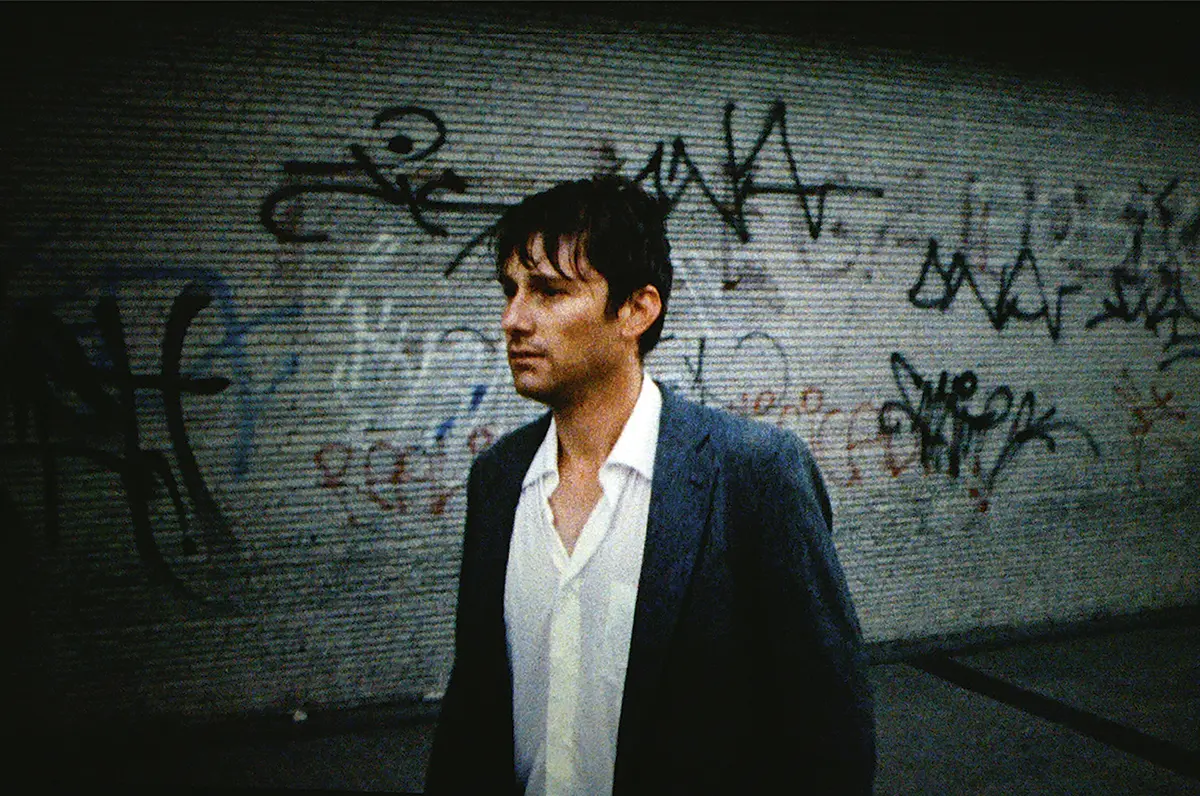
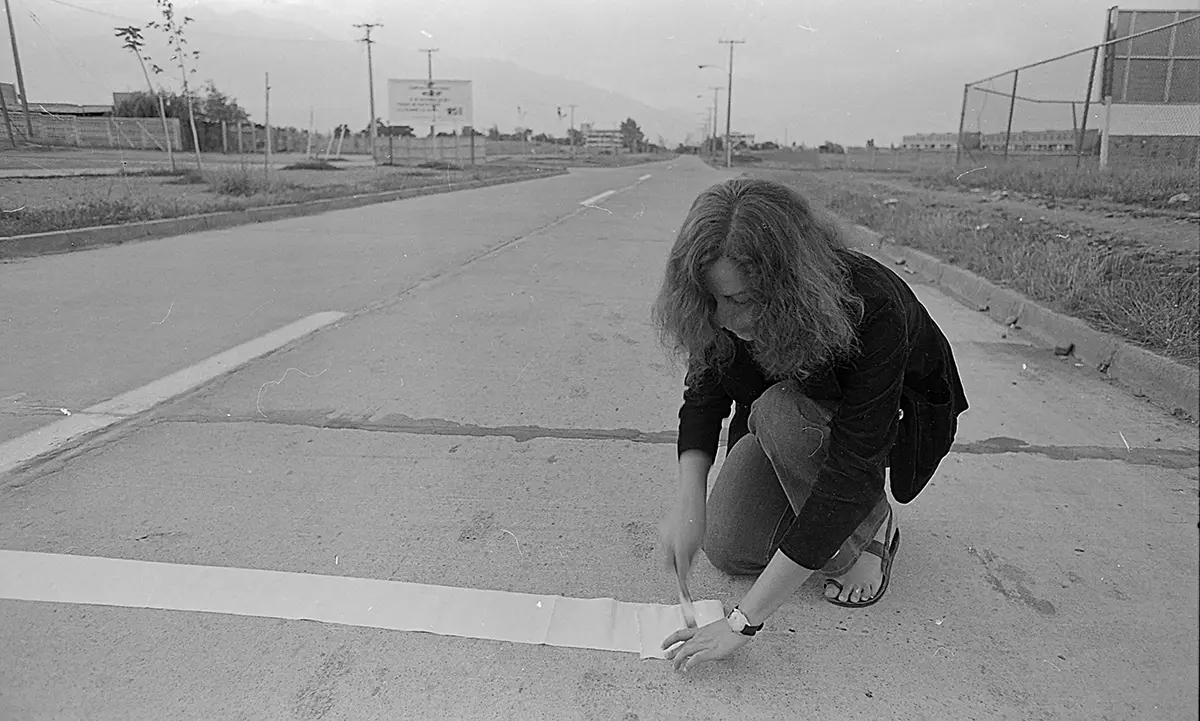
Rosenfeld was represented in “Gran Sur” by Art Actions, Making Of (Selection) 1979-2010, a video that documents her reenactments, in different places and dates, of her performance A Mile of Crosses on the Pavement. Carried out for the first time in 1979, Rosenfeld turned a Chilean road into a symbolic cemetery. Errázuriz exhibited six black and white photographs belonging to the series Adam’s Apple (1987) and Heart Attack of the Soul (1994): rows of marginalized sexual dissidents whose very existence contradicted the optimism of official advertising, and on which Nicolás Franco worked a posteriori and differently, leading to his piece Yesterday and Today (2013), a polyptych of 58 identically-formatted pictures, each of which is a constructivist composition reshaped from a page of a propaganda brochure by same title. Franco cut and folded them in an unusual paperfolding exercise.
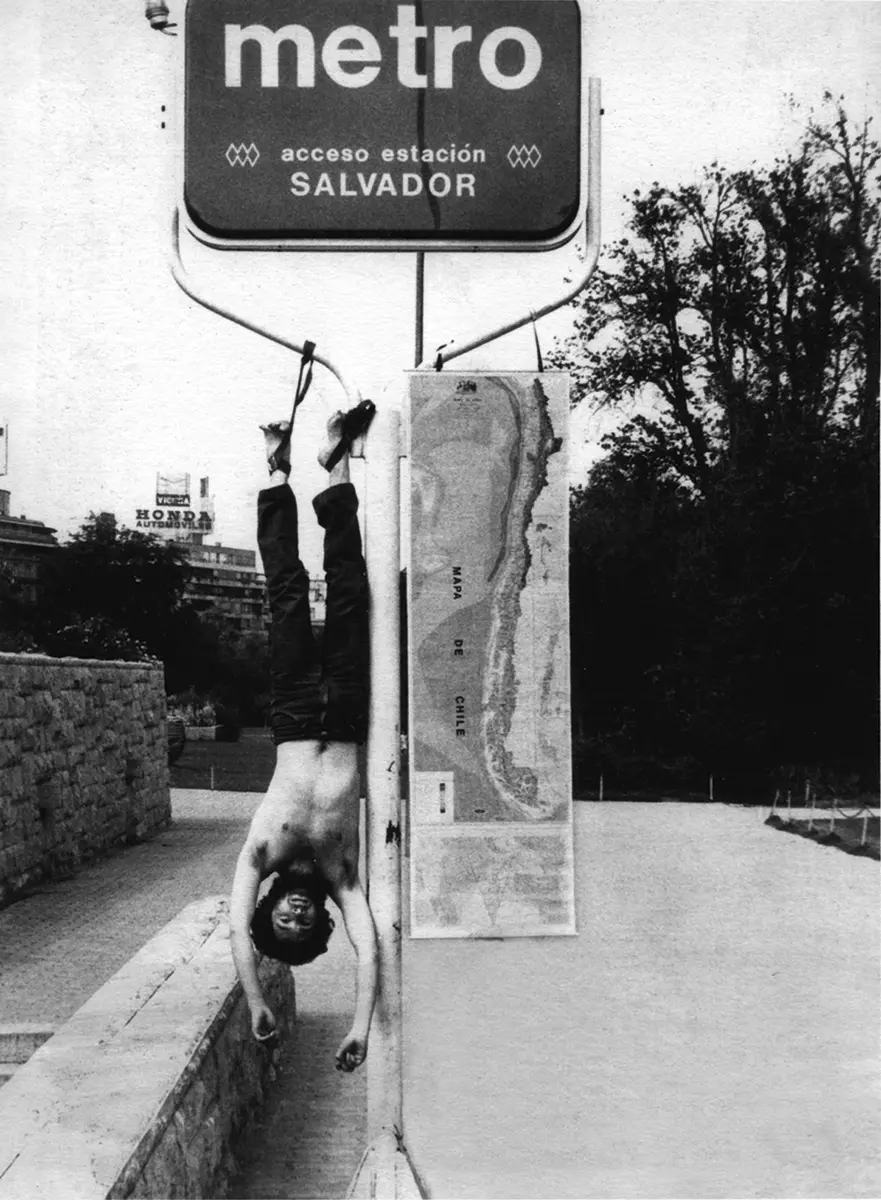
Elías Adasme’s piece For Chile (1979-1980) stemmed from a harsh personal experience. As he was leaving the police station where he had been detained, Adasme decided to hang himself, semi-naked and upside down, from the signpost of the entrance to the Salvador metro station in Santiago. He also hung a map of Chile right next to him, in order to identify his sufferings with those of his country. The work was completed by a set of images of the public places where he hung the original photograph.
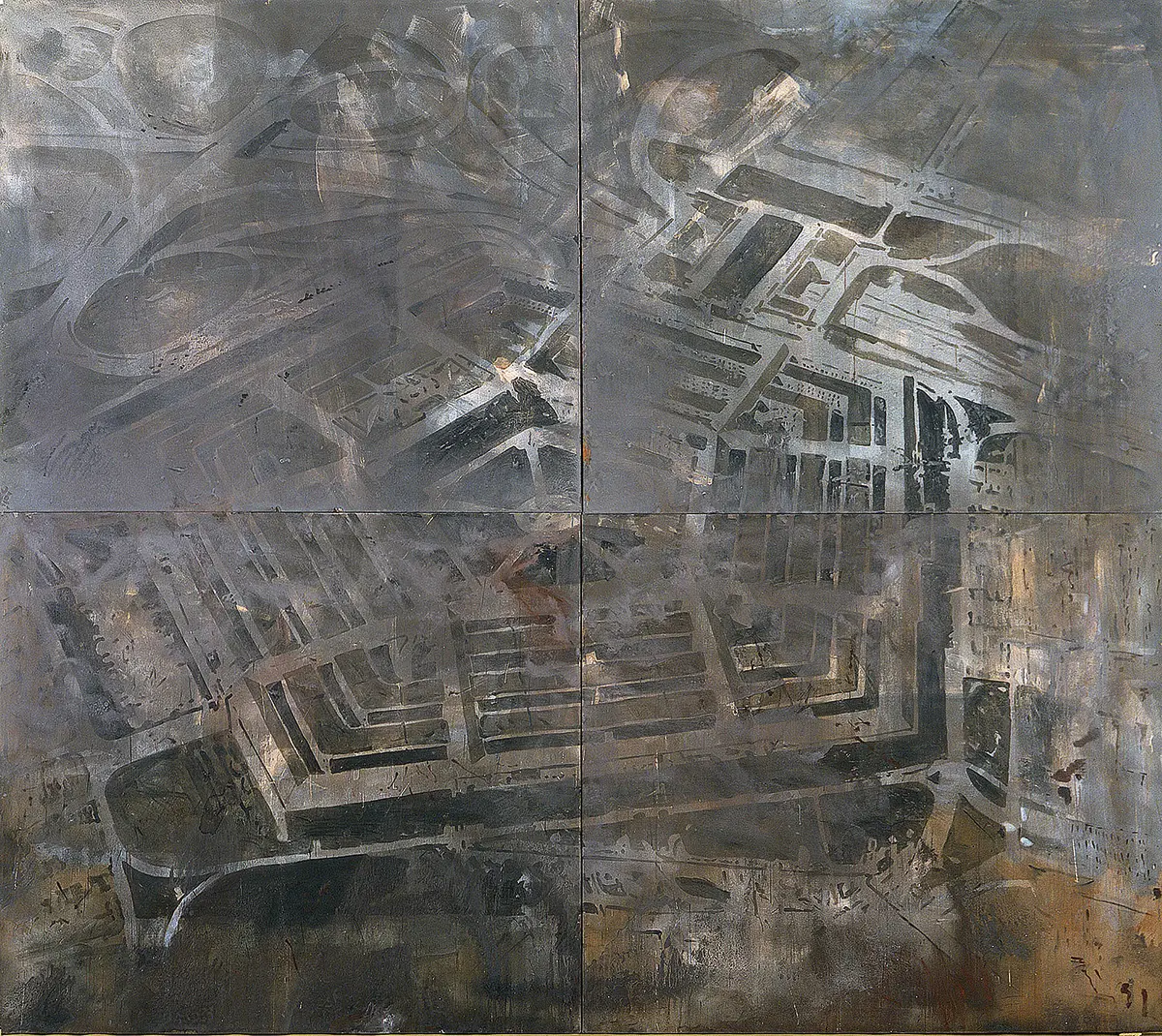
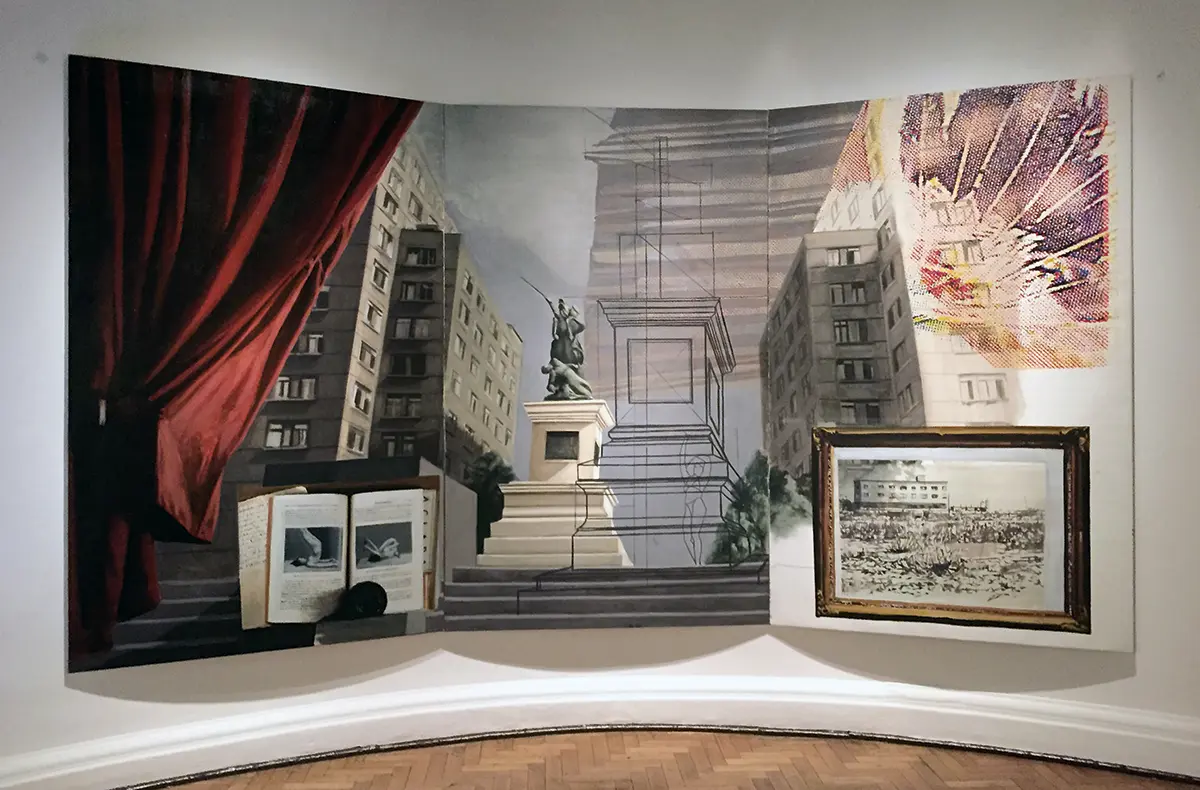
Other pieces included in this large exhibition revolved around the questioning of monuments: The Garden of Earthly Delights (1995), a triptych by Voluspa Jarpa; The Raft of the Medusa (2015), a large-format tapestry by Josefina Guilisasti; and Andrés Durán’s series of digitally intervened photographs of monuments commemorating national heroes. Or works recalling the rigors imposed by the dictatorship: the videos by Catalina González, called Convolutions (2017), and by Enrique Martínez, called Brisas (Gentle Winds, 2008). Or works that address certain signs and symbols: Arbeit macht frei and Table mise, both painted by Arturo Duclos in 1997; Distribution of the Primaries (1995), by Jorge Tacla, a large-format painting dedicated to the Pentagon; Resistance (2009), an installation by Iván Navarro; No. 5 (from the “South America” series, 2015) by Francisca Anima, which is a map of Latin America made with debris; and Community Wheelbarrow (2012), an installation by Camila Ramírez. And there was also a copy of the original video that documented A Logo for America, Alfredo Jaar’s legendary 1987 intervention on a digital screen in Times Square.
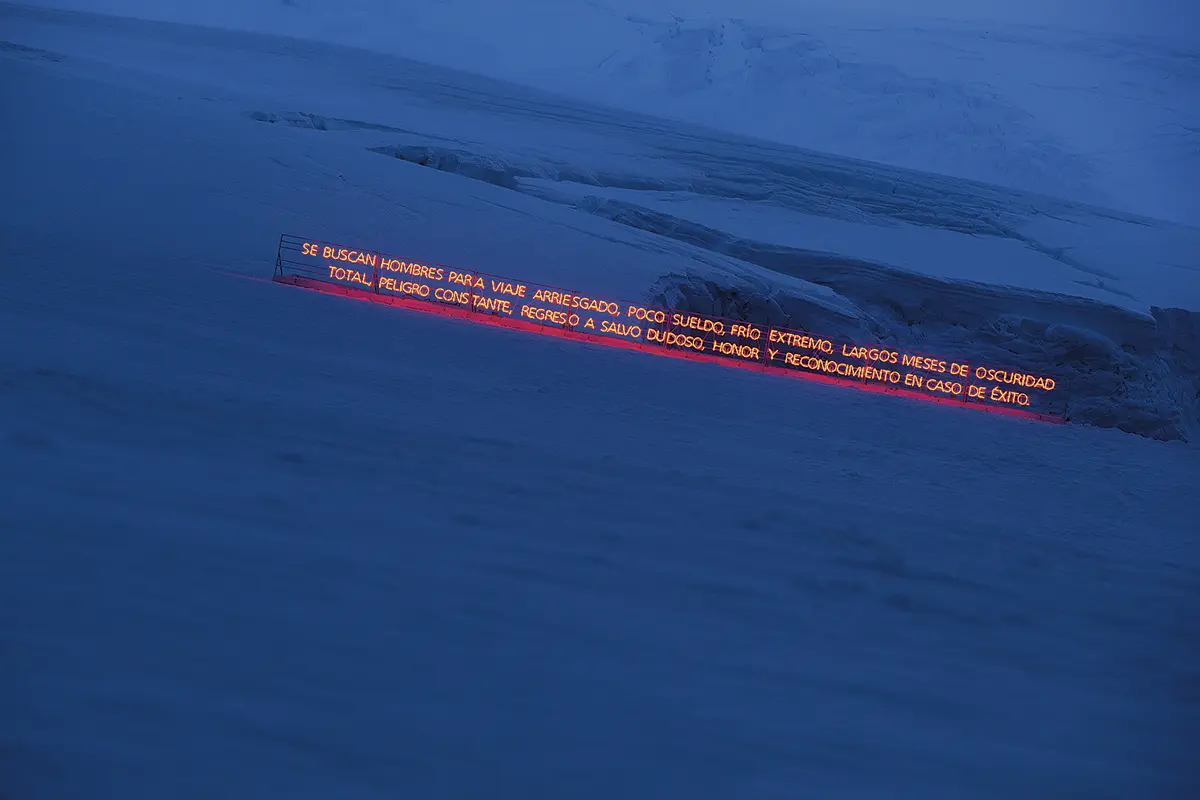
Aside from the aforementioned Hamilton installation, the section that exhibited pieces that denounce the neoliberal model included the Hoffman’s House collective’s If I Can Make It Here, I Can Make It Anywhere (2007), which reveals artists’ current state of precariousness; María TV (2014), a video by Rodrigo Valenzuela; and Fernando Prats’ impressive neon installation Gran Sur (2011), which reproduces (in Spanish) Shackelton’s news ad: “Men wanted for hazardous journey. Low wages, bitter cold, long hours of complete darkness. Safe return doubtful. Honor and recognition in event of success.”
The exhibition was completed with works by Juan Pablo Langlois, Álvaro Oyarzún, Natalia Babarovic, Mónica Bengoa, Francisca Benítez, Camilo Yáñez, Alejandra Prieto, Cristóbal Cea, Gianfranco Foschino, Magdalena Correa, Pilar Quinteros, Francisco Rodríguez, and the Río Seco Natural History Museum.