“El calor derrite los estilos” (The Heat Melts the Styles) stems from the artists’ research in libraries dedicated to Amazonian themes, in Iquitos, deep in the Peruvian jungle.
These investigations led Mantilla and Chaves to collect images, drawings, graphics, musical scores, texts, news, quotes, and texts, to explore how these materials symbolically construct a given territory.
The artists were especially interested in the way images function communicationally, considering their different burdens, relative to their origins, functions, specificities, materials, circulation channels, etc. One of their main concerns is the way we relate to images from the standpoint of what they show, and what they hide, what they describe, and what they obfuscate. Based on this premise, Mantilla and Chaves work with the associative processes that these images set in motion, leading us to other images and other reflections. They juxtapose diverse images and highlight specific details and features that guide, reorient, and disorient our reading of them.
Through this decontextualization and recontextualization of images, the artists promote a metonymic displacement (by similarity and contiguity), but also a metaphorical one, by exchanging and substituting their meanings to make us reflect on their role in the construction of the Amazonian territory as a geographical and cultural category.
The exhibition is organized in groups of works called “chapters.” No Man’s Land includes a polyptych consisting of photos taken from print media—such as newspapers, magazines, and books—which is evident by the dot gain of the offset prints and by the tonalities of the photographs (different shades of white, sepia, and yellow). These correspond to the state of the original papers since they are scanned materials. The image, the grain, the color, and the textures of the print—errors included—are clues that allow us to imagine the source of each photograph (newspapers, books, magazines…), but also its age and its function (documentary, informative, promotional...).
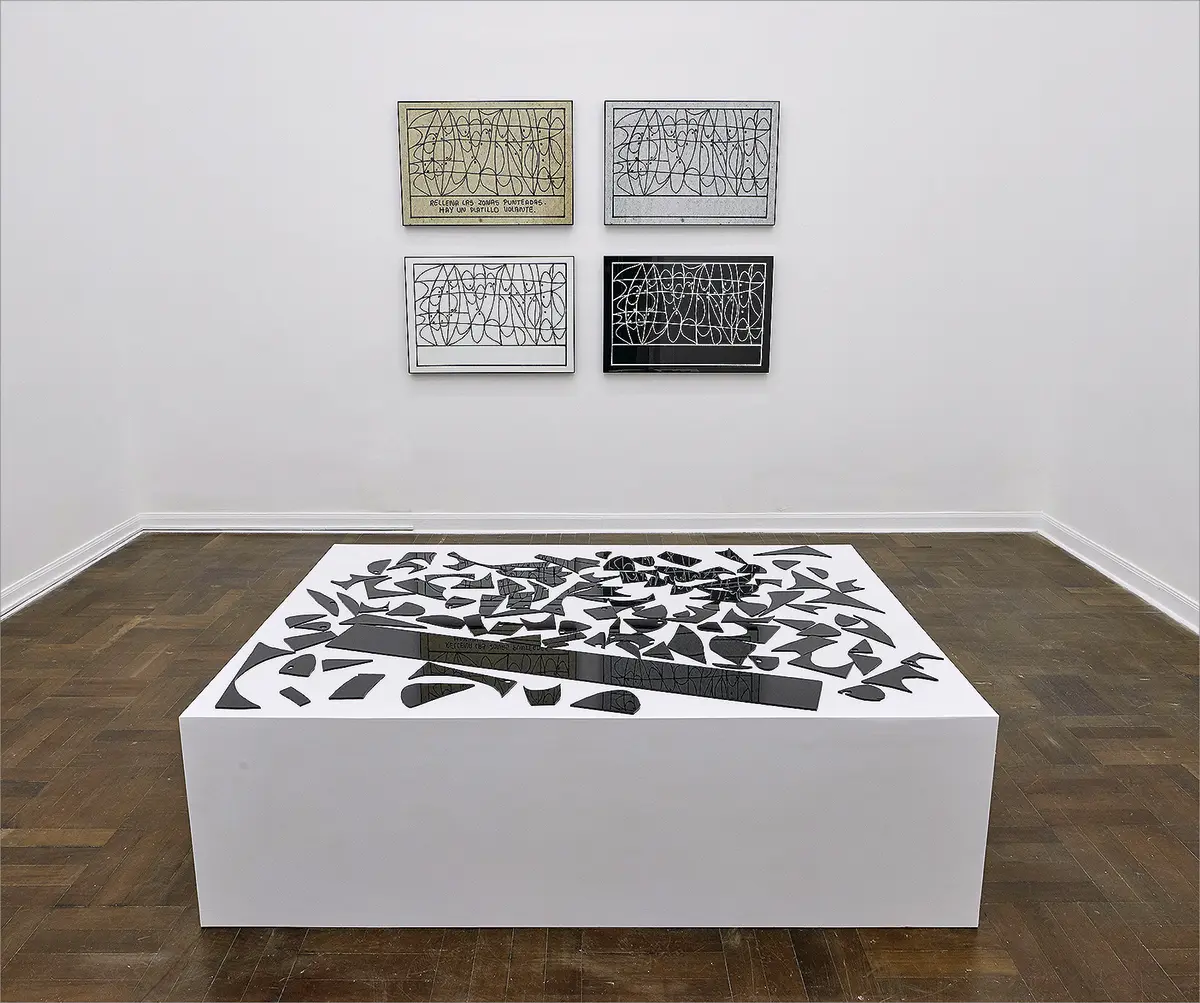
In the Abstract Cabinet chapter, based on the entertainment section of a newspaper or weekly, we must fill in the dotted areas of a drawing to discover a hidden figure. Firstly, Mantilla and Chaves synthesize a diagram by highlighting its abstract dimension. They also transform it into a sculptural object made of black methacrylate cutouts, following the linear pattern of the drawing. Therefore, based on an image that has been visually decomposed by the lines that cross it, they materialize that fragmentation and radicalize it, dispersing the parts of the drawing. In other words, the artists translate an image into an object, which in turn creates a new image, entirely different from its source, also containing the hidden image of the original, but now impossible to decipher.
Interposed grid includes steel railing along with images of gates and grids. The formal drift resulting from these structures allows us to interpret, for example, that the caged cougar in one of the photographs is one of the consequences of the development of cartography and the organization of space into coordinates. In short, from geography to colonialism and exploitation.
In Secrets of the Amazon, a double slide show contrasts images taken from printed material with captions describing other photographs. The parallel between both projections creates a sort of short circuit between the descriptions and the images, whereby neither of them offers enough information to be conclusive, given the ambiguities of the text, as well as the photographs’ degrees of abstraction due to their framing, the offset prints, and its defects, etc.
In A Certain Narrative, we see a video in which Mantilla and Chaves have incorporated all the themes they researched in the Amazonian archive. Again, they confront images by creating unexpected associations to provoke an interpretative drift. This chapter also includes digital prints of photographic images from print media; the artists have erased the photographs, leaving only their captions. The texts invite us to imagine the pictures that correspond to their description, but the information gaps also encourage us to speculate on meaning and function.
Once Upon a Time, There was a Natural History Museum presents a video of Iquitos’ Natural History Museum, highlighting its small scale and bewildering “displays.” It includes two abstract sculptural pieces in galvanized steel (referring to the paiche fish and the pink dolphin, both species of the Amazon River), a painting that looks like a landscape, and a photograph of soldiers in camouflage—thereby creating a mystifying scene.
Critically articulating the notions of archive, image, and territory, Gilda Mantilla and Raimond Chaves propose a reflective exercise on our role as receivers and as agents for the recirculation of discourses, forms, and contents. All of these are supports for the construction of a notion of place that can enable or challenge different ways of relating to it.
MAX HERNÁNDEZ–CALVO