
Spreading one’s arms, bringing them together above the head, and then lowering them all the way down to the legs makes an almost perfect circle. Anyone who has attempted to study the geometry that can be derived from the human body will have noticed that this gesture, subtle as it may seem, transforms the body into a drawing instrument, a compass. But both the action and the drawing can be made more complex, as new lines are added. Thus, the motion ceases to be geometrical and is no longer limited to the circle that the compass traces. The combination of movements can produce the most extensive and diverse variety of images.
Curated by Anel Jiménez, Moverse para nombrar (Moving to Name), an exhibition held between October 2019 and January 2020 at the Museo de Arte Carrillo Gil, revisited the investigation that Galia Eibenschutz (Mexico City) has been carrying out for more than a decade. In it, performance, drawing, and contemporary dance are skillfully brought together to shape two fields of work: the visual arts and the stage arts. In this junction, the disposition of lines and markings on different surfaces, the capture of time in an image, the systematic repetition of gestures, pedagogy, and collective labor sketch a visual archipelago comprised of large-format drawings, video recordings of actions, or activations in the exhibition space itself (three in total) that highlight the inherent theatricality of Eibenschutz’s art.
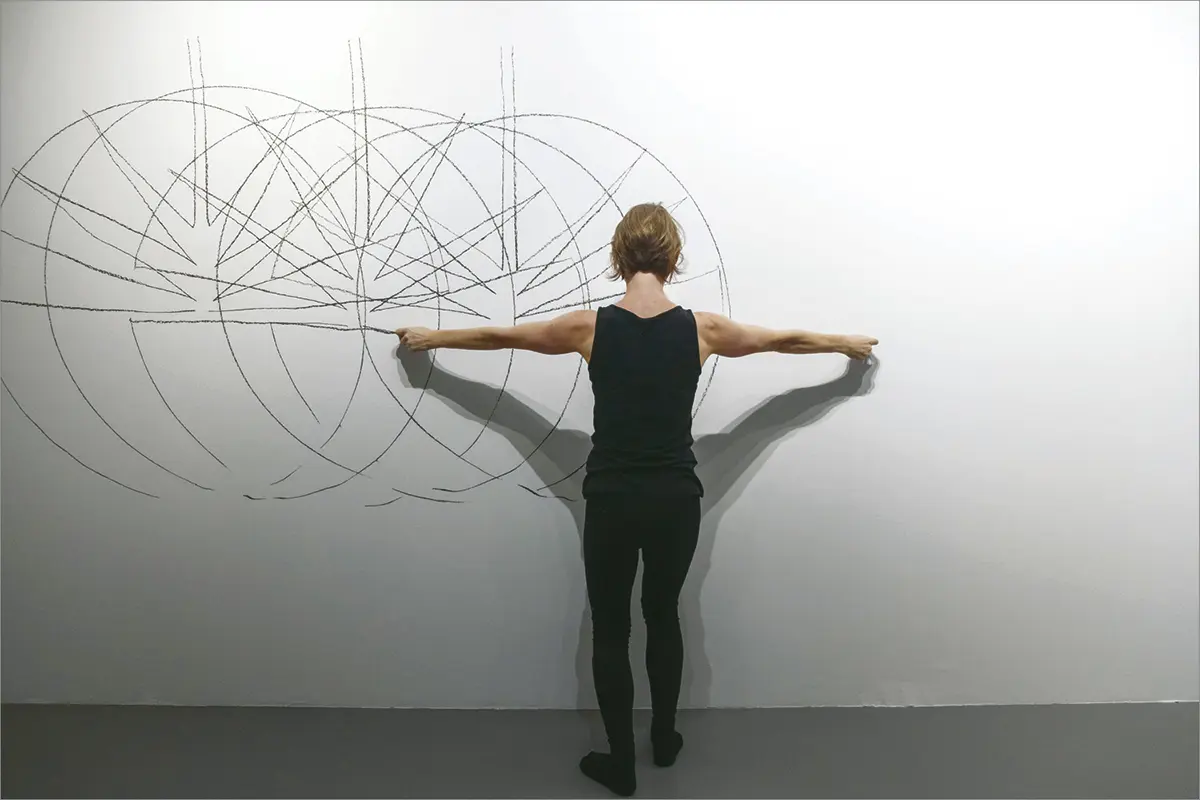
The first activation, titled Dibujos efímeros (Ephemeral Drawings) and staged on opening day, for example, involved a sequence of situations. Eibenschutz invited four dancers, a singer, and a drummer to execute a group action for approximately 30 minutes. Starting with de drummer in silence, Eibenschutz and the singer facing one wall, and the dancers facing another, the six performers slowly began to make an almost imperceptible compass motion with their arms. Then, the four dancers, who started the performance wearing jackets designed by the artist, began to draw with white chalk on a canvas set on the floor. At the same time, Eibenschutz made a horizontal, large format drawing of her own: Dibujo brazo con desfases (Arm Drawing with Desynchronizations), 2019. At this point, with the drummer already drumming to mark the intensities of the action, Eibenschutz dancing, and the singer vocalizing, there were enough aspects and events in the action to reveal the layering of meaning that is always a feature of Eibenschutz’s work. Both the singer (after occupying five different spots) and Eibenschutz (after completing her sequence of drawings) then moved towards the gray rectangle to finish the image alongside the other four performers. In the end, the drumming stopped, and all that was left was the sound of chalk against the canvas, the agitated breathing of the six artists, and the four jackets dumped on a corner like small sculptural gestures—an undoubtedly intense and seamless mise-en-scène.
Eibenschutz’s investigation reveals one of its points of origin in several videos included in the exhibition. These resulted from the need to have a witness to the movements. Given the absence of a human eye capable of noticing the gestures that produced the lines and markings, the camera allowed Eibenschutz to feel an external gaze, which helped determine what worked and what had to be definitely set aside. To reconstruct the sequence of movements, a titanic task that would otherwise have to be entrusted to memory. But that first moment was to be decisive, above all, for a vital reason: to dance again after years of stillness.
Dibujos en transmisión (Drawings in Transmission) was the second activation. Eibenschutz invited five female artists to create a group action alongside her. The plan was more or less as follows. The six artists first divided into three duos. In each pair, one person faced a wall, and the other drew on the first one’s back with her finger; the first one transferred the drawing to the wall using black chalk (the immediate reference for this image is Dennis Oppenheim’s 2-Stage Transfer Drawing, from 1971). Then, two three-person groups were set up, and finally, one group with the full six participants. Replicating motion, extending it, and transferring it from one body to another until the group produces an image can be posited as the coordinates for a work of art that persistently engages the weight of feeling and relinquishes thought, to forge a record of the time and the transmission of ideas across different generations.
The third action was Terreno vulnerable (Vulnerable Terrain). For it, Eibenschutz created a choreography, designed three paper dresses in collaboration with Deny Ramos, and invited three contemporary dance performers to execute the movements on ceramic tiles of different colors, arranged on the floor. Accompanied by a musical score created specifically for this action by the composer Carlos Iturralde, the three dancers moved on the tiles to perform the choreography. There is no doubt that art direction is one of the most suggestive outlets for the performative element of Eibenschutz’s work.
Attempting to inscribe the motions of the human body on a Cartesian coordinate plane, as has often been done by Western dance, does little to locate the shared horizon that dance and the visual arts sketch in Moverse para nombrar. Perhaps this is because right or left, up or down, forwards or backward, diagonal or spiral, will always be insufficient descriptions for an oeuvre so rich in bodily expressiveness and the potential-filled gestures.
JORGE LOPERA