With 800 works on display in the institute’s three levels, Franz Weissmann’s exhibition at São Paulo’s Itaú Cultural presented the public with the unique opportunity of rich immersion in the sculptor’s oeuvre.
Curated by Felipe Scovino, the show Franz Weissmann: o vazio como forma (Franz Weissmann: The Void as Form) brought together drawings, architectural models, Weissmann’s so-called “kneadings” and sculptures, covering the artist’s journey from figuration to abstraction, from the 1940s into the early twenty-first century. On display were nearly 50 sculptures in small, medium, and large formats; ten “kneadings,” with supports in aluminum, steel, and other metal plates; some fifty drawings; and 730 models. Of the works on exhibit, fourteen were accessible to the visually impaired, apt for handling, and exploring by touch. By means of virtual reality, visitors were introduced to Monumento à Paz (Monument to Peace), a never-completed public-space project presented here for the first time.
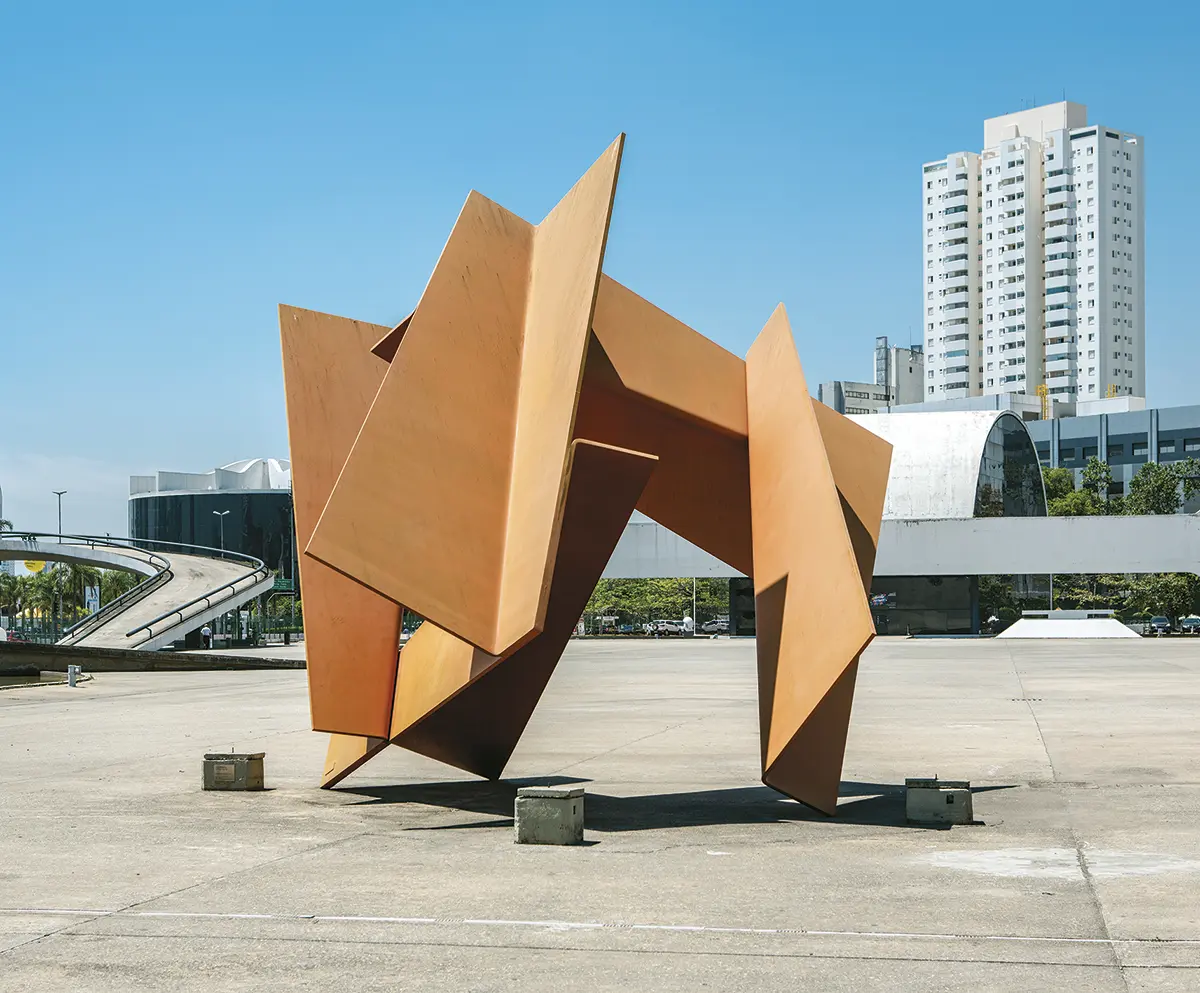
Thanks to a timeline with photographs of Weissmann’s life and work, visitors were able to follow his evolution over a long period. A map provided information about the location of his public-space works in São Paulo (ten) and Río de Janeiro (twelve).
According to the curator Felipe Scovino, the show brought to the fore “Weissmann’s pioneering role in the exploration of abstract sculpture, in the midst of Brazil’s dominant tradition of figurative art.” Fernando Ortega, the director of the Weissmann Institute, observed that the artist used different colors in his investigations: yellow (generally in works with narrow, fine-pointed forms) and black (in works where he wanted to emphasize drawing and neo-concrete elements). Weissmann also used red, blue, and green.
Strongly inclined towards public spaces, Weissmann’s sculptures invite visitors to “enter” them. Aesthetically, an empty space signals a volume that is traversed by air, and it is key for and understanding of how Weissmann operated in the creation of his works.
Franz Weissmann was born in Knittelfeld (Austria) in 1911 and died in Río de Janeiro in 2005. His family came to Brazil in 1921 and settled first in the interior of the state of São Paulo. In 1927 Weissmann moved to the state capital, and in 1929, to Río de Janeiro. In 1939 he was admitted to the latter city’s School of Fine Arts, where he took classes in Architecture but did not feel entirely at home. In the school’s curriculum, work with living models only took place in the third year, as part of the design course. The curricular model was geared towards architecture, rather than painting or sculpture; Weissmann, who was after a visual-arts experience, ended up dropping out in search of a more hands-on type of training under master artists. He studied with the Río de Janeiro-based Polish sculptor August Zamoyski.
In 1944, Weissmann moved to Belo Horizonte, in the state of Minas Gerais, and joined an artistic milieu interested in Modern art. For a while, at the invitation of the painter, after whom the institution was named, Weissmann taught sculpture and modeling at the Guignard School, an important space for young artists’ training. In Belo Horizonte, says Fernando Ortega, Weissmann had an opportunity to observe from his studio the raising of several buildings. He was fascinated by the rebar used in such projects and began to experiment with it. The results have a clear Concrete-art inflection, pioneering in the Brazilian context, and explore voids in what would become one of the central characteristics of Weissmann’s later oeuvre, as we have said: the void must be understood as a constructive element of meaning.
In the 1950s, Weissman was a member of Grupo Frente, which brought together artists working in abstraction like Ivan Serpa, Lygia Clark, and Aluísio Carvão, among others.
In 1958, Franz Weissmann won the National Salon of Modern Art’s travel grant for study abroad and traveled to Japan and India. The appeal of Zen Buddhism was a further incentive for his interest in empty spaces. Scovino brought to the audience’s attention the fact that Zen Buddhism also influenced the expressivity of Weissmann’s lines and the use of color, alongside hollowed spaces, in his constructive quest.
Weissmann participated in the first São Paulo Biennial and several other editions of the international art event; his work was featured in the National Exhibition of Concrete Art in São Paulo (1956) and Rio de Janeiro (1967). Weissmann’s name is linked not only to Brazil’s Concrete Art but also to the history of the Neo-concrete movement, which emerged in Rio in opposition to the São Paulo Concretismo. The Rio artists strove for greater freedom; they valued subjectivity in art and critiqued their São Paulo counterpart’s rationalism and dogmatism.
LISBETH REBOLLO GONÇALVES