Good Blue Day, Eugenio Espinoza’s exhibition at Piero Atchugarry Gallery covers five decades of artistic production. Without being a retrospective or being organized chronologically, the exhibition allows us to appreciate how the use of the grid and the pictorial surface play a fundamental role in the development of a work whose origins date back to conceptualism, geometric abstraction and minimalism.
Two early pieces illustrate his interest in the grid and the frame as a support. In the first one, Untitled (Unique Reconstruction-1972), the fabric is detached from the frame in the upper left corner, while the top of the work folds over showing the malleability of the piece. In the second one, Untitled (1972), a rhombus becomes a kite by tying up the lower left corner of the canvas with a rope and anchoring it symbolically to the floor. Through the use of common objects such as rope and raw canvas, the creation of flexible forms and a unique management of space, Espinoza creates a particular language that calls into question, not only the aesthetics of geometric abstraction, but also Modernism’s categorizations that have predominated in Venezuela since the fifties.
Through his iconic work, Impenetrable (1972) –a large canvas held horizontally by an elevated wooden structure painted with a black grid that occupies the entire space preventing the viewer from accessing it— questions the way it perceives and exhibits the work of art. Although the installation is not part of this exhibition, it is continually mentioned in the catalog and provides a historical and conceptual basis for the show. Uno Dos Tres (One Two Three, 2013), for example, is a large canvas painted with the same black grid. What at first glance seems to be a new version of the canvas of the seventies, is actually the superposition of three layers of fabric tempered in aluminum frames. Due to their flexibility, they the canvases arch and become a subtly three-dimensional sculptural object. Espinoza plays again with the mind of the observer who perceives a single plane when in reality there are three overlapping canvases.
As Claire Breukel, curator of the exhibition, explains “In the last seven years, the transition from the use of canvas (without support) to metal in order to achieve an ideal flat grid has released it more and more and allowed it to act on the grid’s surface manifesting multiple situations. The game, specifically activation, as well as the use of common symbols and signifiers, remains critical to his practice. ” Three pieces, Facetious (2015), Translucent (2015) and Flavor (2015) question the perception and management of space based on new formal proposals. Espinoza switches from fabric to aluminum and from acrylic to enamel, while introducing pastel colors, applied irregularly so that they reveal the metal surface of the support, and hanging elements that remind us of Calder’s mobiles.
In 2019, Espinoza experiences what Breukel calls “an existential period, an intense energy.” In Walgreen (2019), he combines four white canvases painted with colored squares to form a large cube. By joining the four paintings he makes an object which he then “des-objectifies” by detaching the fabric on one corner and showing the wooden frame. In addition, he plays with the perception that the viewer has of the work raising it by placing a coconut under a corner. In this piece, as in the other recent works, Espinoza generates a dialogue between the pictorial and sculptural nature of the installation.
The use of common or found objects, which refers to Arte Povera, can be interpreted as a criticism of consumerism and the destruction of the environment in works such as Nostalgia and Prophecy (2019), a tangle of cut felt held by a plastic basket, and Scientific Terrorism (2019), which includes a sack of coffee and a bottle of beer.
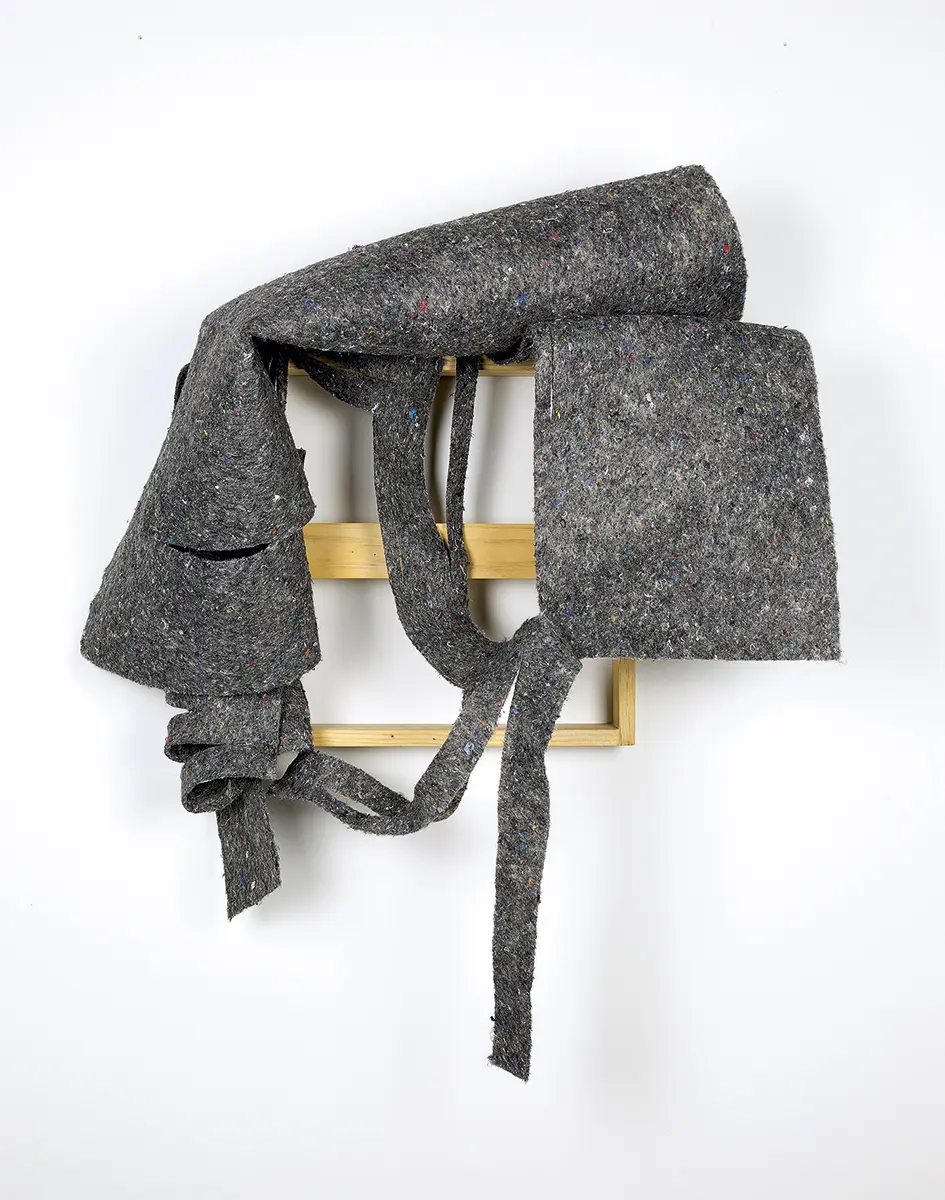
The felt gives a malleable and organic character to the pieces made with felt on square wooden bases such as The Mind (2019), Unfold (2019), and Taxidermist (2019), which invite us to reflect on the relationship between the square as starting point and the concept of “painting.”
After fifty years, the starting point remains the square as a unit. However, the most recent works convey a liberating spirit that not only admits but also stimulates conversations based on the dialogue established between the rigidity of the original geometric structure and the fluid and imperfect forms created by elements such as wire and felt.
NOTE
1. Claire Breukel. “Good Blue Day: A Colorful Rebellion.” Eugenio Espinoza Good Blue Day. Exhibition Catalog (Miami: Piero Atchugarry Gallery), 2019, p. 11. Translation by the author