Vigo is a key player in the field of visual poetry in Argentina and, of course, in Latin America as a whole. He brought his relentless energy to bear in the domains of drawing, printmaking, xylography, publishing, and art actions, as well as to the promotion of groups and the establishment of networks. But it was for visual poetry that his skills, his vocation, and his talent were undoubtedly most ideally suited. Visual poetry was, for sure, the nucleus of his protean artistic activity. Both the curator Belén Gache and the collector Juan Espino-Sánchez Grande understand this, and they have worked together to make this exhibition of works by Vigo, in essence, a show by a visual poet.
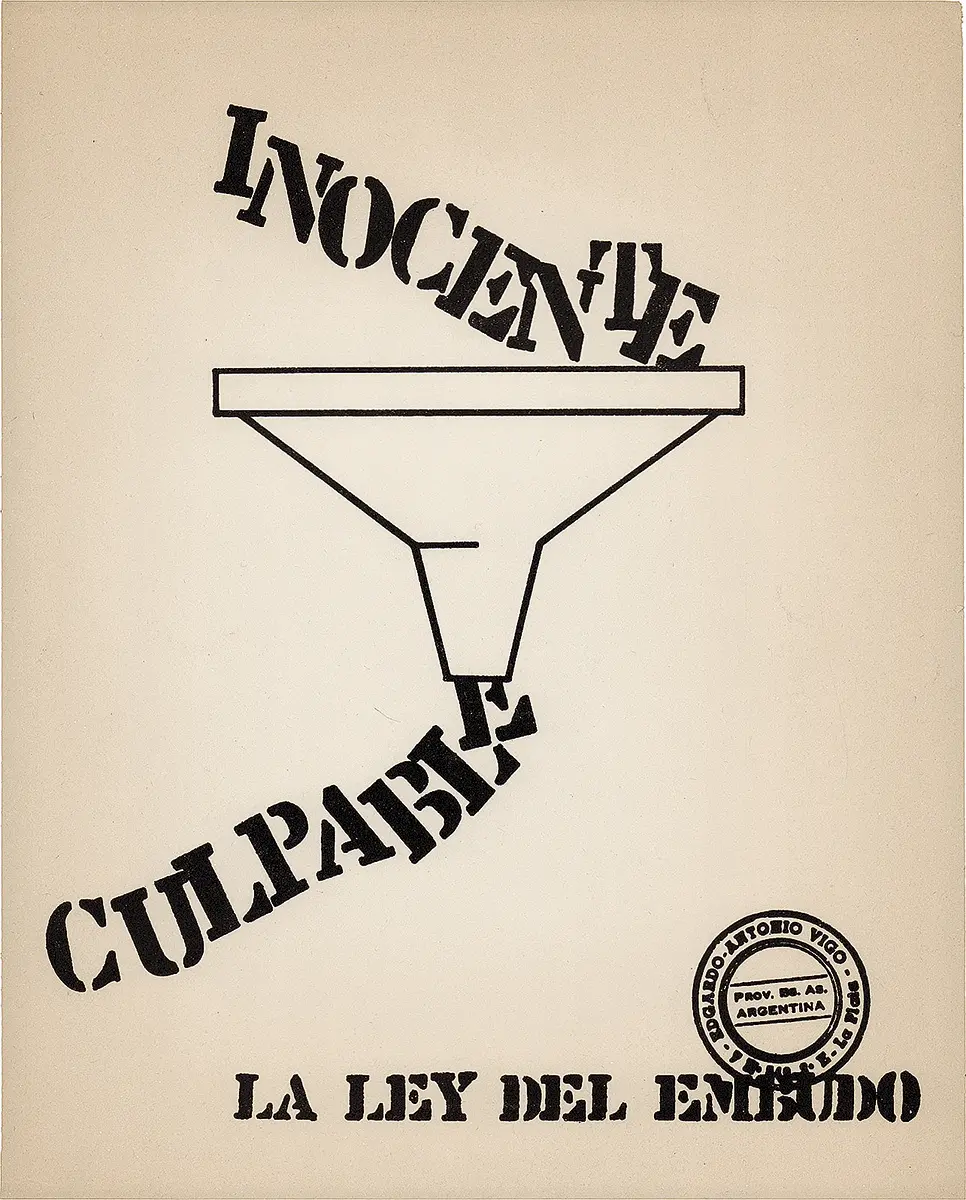
Edgardo Antonio Vigo (1928-1997) was born in La Plata and graduated as a drawing teacher from Universidad Nacional de La Plata’s School of Fine Arts. In 1953, as was almost mandatory at the time for Latin American artists, he traveled to Paris and had his first contact with the avant-garde scene of the period. Oulipo, the Letterist International, and Jean Tinguely must all have made an impression, judging by the “mathematical poems” and the early projects and designs for “useless and impossible machines” Vigo created upon returning to Argentina. In the 1960s, he built two of the latter: Bi-tricicleta ingenua (Naïve Bi-tricycle) and the Palanganómetro mecedor que no se mece (Non-Swaying Swaying Washbowlmeter). He dedicated them to art critics of the time, in a gesture of both disdain and irritation at the scarce or nonexistent attention paid to his work, or at the way it wasn’t understood. Also, during that period, Vigo began to explore printmaking and xylography, which would prove much useful in later periods of his career. Yet, the exact point of inflection arrived in 1962, when Vigo launched the journal Diagonal Cero. Devoted to experimental poetry, it allowed him to deploy his talent as a visual poet expansively alongside his efforts as an editor. It was seen as a work of visual poetry in itself in each one of its issues: Poetry freed from historical genres, from the letter, and even from the constriction of the page, to better unfold as a polysemic visual event in collages, postcards, artists’ books, and assembled journals. In other words, in what would become the preferred set of contents for Mail Art, a field where Vigo was to become a protagonist of the highest order.
This exhibition was organized into four chapters or sections. The first section was devoted to original materials, from the journals Diagonal Cero (1962-1969) to Hexágono´71 (1971-1975), probably the first assembled journal in Latin America and among the first of its kind in the entire world. With Diagonal Cero, Vigo set in motion the network of international contacts with artists and visual poets in the Americas and Europe that would allow him, among many other things, to organize in 1969 the Expo/International of New Poetry at the Torcuato di Tella Institute.
Hexágono ´71 helped Vigo expand his network of contacts and collaborators even further. At the same, time it provided him with an opportunity to engage in his work social and political subjects that resonated with the climate of the era, marked in Latin America by the emergence of guerilla movements and in the international scene by May 68 and the Vietnam War. In that sense, journal pages like “Souvenir de Vietnam”(Vietnamese Souvenir), “El ojo del Che” (Che’s Eye), and “El artista es el opio del arte” (The Artist Is The Opium of Art) were especially eloquent.
The network generated by these publications became particularly useful for Vigo in the second half of the 1970s, when he began to focus on Mail Art. In the exhibition, the documents form this period were presented under the title “International Book and Our International Book of Postage Stamps and Postmarks.” In those two projects, Vigo had a large group of collaborators, among them Vittore Baroni, Jean François Bory, Ulises Carrión, Herve Fischer, Bill Gablioni, Graciela Gutiérrez Marx, and Clemente Labin. In both instances, Vigo created, along with his works, sets of stamps and postmarks.
The third section was devoted to “Mail Art and Experimental Poetry journals with which Vigo collaborated, ‘taggings,’ and graphic works.” Among the journals were Ephemera, a monthly journal of mail and ephemeral Works, edited by Ulises Carrion; Libellus, an art journal edited by Guy Schraenen; DOC(K)s, published by Julien Blaine, and Ghost Dance: The International Mag of Experimental Poetry, edited by Hugh Fox, which devoted its 18th issue to one of Vigo’s “taggings,” consisting in extracting the juice of some lemons and then reinjecting them with it.
Binging the exhibition to a close, the fourth section was “Vigo and Xylography,” devoted to a technique that Vigo engaged in response to his concept of art as the generator of reproducible works, easy to circulate and affordable to possess. Vigo established the Museum of Xylography in 1967, in la Plata; it currently holds more than 3,000 items, many donated by artists. It is an itinerant museum, with no fixed location.
CARLOS JIMÉNEZ