An array of strident greens, reds, and blues was reflected on windows and sidewalks at the Place des Vosges, in the historic heart of Paris. All spaces, real and reverberating, were invaded by the chromatic vibrations of “Visual Dynamics:” the solo show by Venezuelan Darío Pérez Flores (Valera, 1936) at the Mark Hachem Gallery.
As a young man in his native country, the artist studied at the School of Fine Arts in Valencia, where he made abstract pieces with found materials; subsequently, he studied literature at the Universidad Central of Venezuela, without abandoning his work in the figurative line of art. At that time, the University City of Caracas—currently a heritage site of Latin American cultural history—was built. It was in this place that artists such as Calder, Léger, and Vasarely profoundly marked the spirit of several generations of artists towards modernity.
In the sixties, Pérez Flores exhibited a series of sonic and mobile hemispheres in chromed metal at different salons and the Actual Studio of Caracas. In 1970, he obtained a scholarship and settled in France, where he studied Art History at the University of Vincennes and studied under Frank Popper. His collaborative experiences, his work with diverse materials, and the influence exerted by the Bauhaus legacy opened new conceptual doors. By establishing a system based on his early intuitions, Pérez Flores began to reflect on kinetic art and devoted himself to geometric sculpture in Plexiglas. In 1972, he participated with Carlos Cruz-Diez in an exhibition at the Venezuelan Embassy in Paris, where his work aroused public interest.
This show exposes the artist’s clear intention to explore and integrate movement as an essential element of the works. There is a predominance of horizontal, vertical, black and white lines, achromatic backgrounds, and subtle movements produced by motor-powered devices. And then, optical effects and a range of strident colors take precedence over the mechanics. All the elements have been articulated in a logical system.
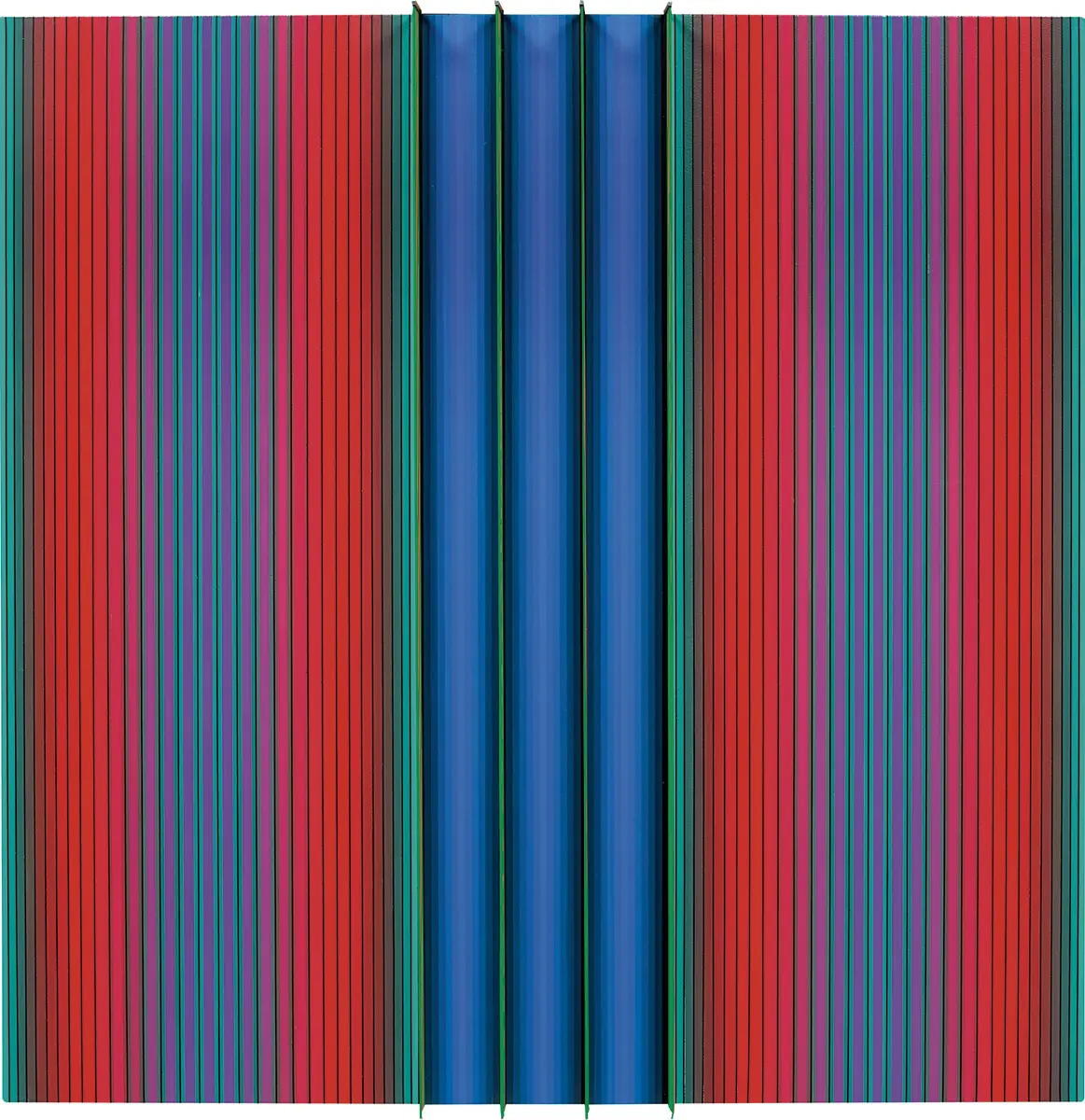
From the 1970s, he starts to create his Prochromatiques, in which vertical lines come to the fore: slender colored rods are superimposed on an interplay of lines in the background. The overlap of these structures produces an almost virtual effect. In this way, the predominant vertical lines appear suspended on the pictorial surface. The protruding relief creates unique chromatic atmospheres. The gallery highlighted some twenty crucial pieces for their number and importance, made between 1987 and 2019.
His Chromatic Dynamics series is notable for its originality. For example, a central rectangle surrounded by two triangles forms a void, which, when integrated into the wall, allows the artist to question the support. The cut-out and arranged forms, painted on canvas, on wood, and on protruded volumes, produce new structures. Embossed and interacting with each other—separate and also connected—these forms are pure abstractions. A new element thus appears dimensionality, which in turn determines perception and represents a new transition: an interaction and a rereading according to the situation, like a musical score where silence creates an ambiguous zone, but with vibrations. In these eight pieces, made between 1993 and 2017, the regular rhythmic game has been ruptured, offering a new solution to the Gestalt or the appearance of the forms.
Another notable aspect is how the artist introduces an ambiguous feature that results from the interplay between continuity and rupture. The elements developed spatially are innovatively adapted and combined. They allow not only for a different perception but also the play between interaction and chance. The achromatic sculptures in deep black, white and half-tones make us think of the atmosphere of photographic negatives, and also of the striking dyes of the colored prints of yesteryear. They could be childhood reminiscences, such as when he worked on images in his family’s photography workshop.
Through fragmentation, the artist points to unresolved phenomena, as in Sculpture (1982) or Column (1996), of large dimensions. Four aseptic and minimalist mobiles are launched into space while conditioning it.
The spectator perceives a subtle sensation: between surprise and the intrigue of wanting to discover the secrets of the work. And this is a characteristic of this artist’s talent in all his stages. All features are developed to make the observer-visitor continue to reflect upon and construct a philosophy about his oeuvre and the world.
SUSANA SULIC