
Cristina Piffer was invited by the OSDE Foundation to present a retrospective exhibition in its new Art Space, located in Arroyo Street in Buenos Aires.
Piffer’s work demands and puts into focus the established stories of Argentine history through images and texts belonging to different episodes of its political plot from the 19th century. Curator Fernando Davis describes the historical context to which the artist alludes in her works: “clashes between the Unitarian and Federalist parties, the organization and establishment of the national State, processes of concentration of ownership of productive lands after the genocide of indigenous peoples during the so-called Desert Conquest, and the slavery and physical exploitation of the natives.”
The artist designs inscription media, developing devices that retain those memories and stories through printing procedures, photographic registration, draft, and transfer, using materials such as fat, meat, dehydrated blood, metal, and glass.
Titled “The Unruly Heritage of Specters. Works by Cristina Piffer,” the exhibition represented twenty years of her career by bringing together pieces created between 1999 and 2019. Some titles of the series on display are “Trenzados” (Braided), “Las marcas del dinero” (Money Stains), and “Argento.”
One of the central strategies of Piffer’s art is the appeal to a balanced synthesis of ideological and political origins, and the treatment of the materials themselves, which allude symbolically to these historical programs; for example, beef or animal fat mixed with paraffin. On the other hand, she appeals to the conceptual opposition of the elements she bonds together, such as a plaque of animal fat and paraffin with the inscription “Brutality is cursed,” presented on a bare, stainless-steel table that could allude to a dissection table.
Piffer works with history, with what is said and written, but also with the silenced stories, questioning Argentina’s official history and evoking the need for other interpretations.
Two Hundred Strong Pesos (2011), from the series “Money Stains,” refers to a nineteenth-century banknote. A silkscreen print made with pigment and dehydrated bovine blood on glass and steel represents a herd of cattle and sheep from which pigments are released and fall to the ground, alluding to a pool of blood, which in turn refers to animals going to the slaughterhouse.
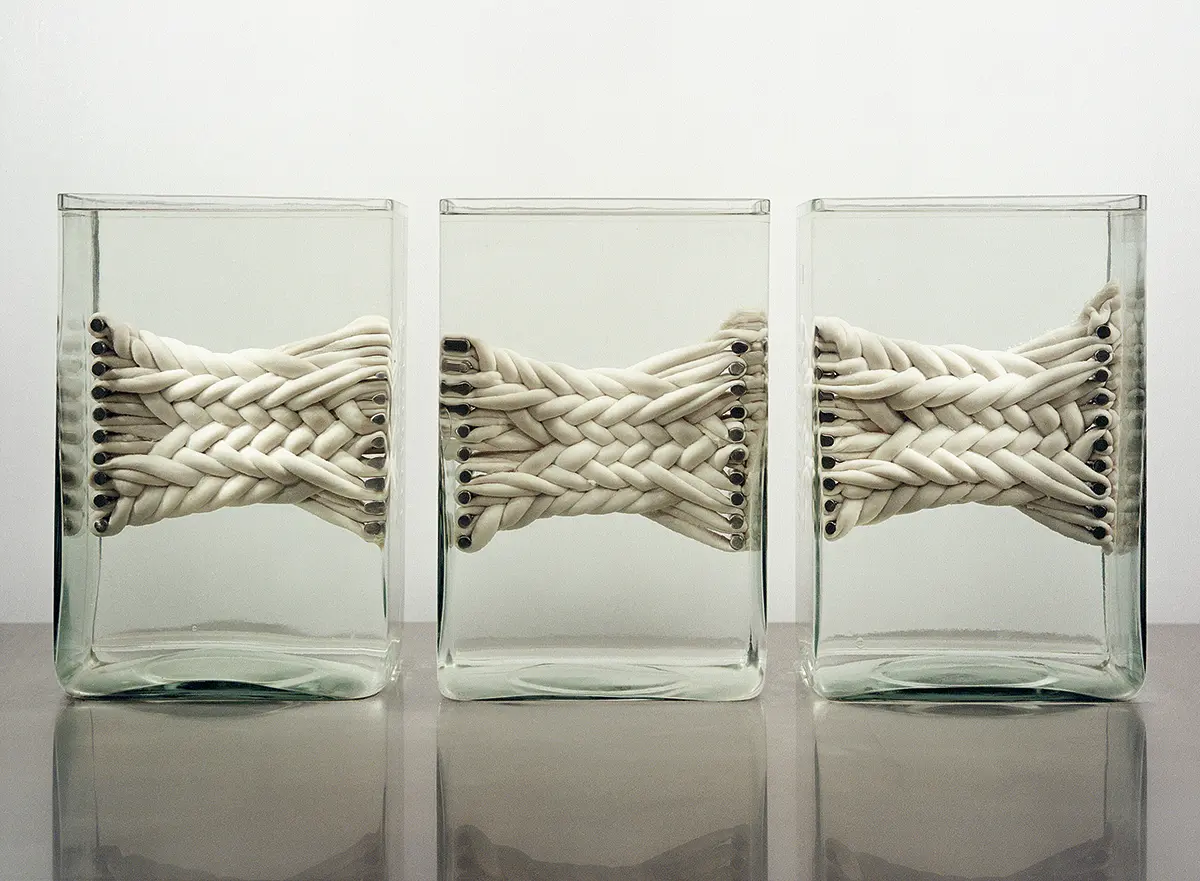
One of the works that has most identified the artist’s production is Untitled (2002), from the series “Braided.” Three glass jars contain cow intestines that have been processed, braided, submerged in formaldehyde, and placed on a stainless-steel table. Braiding is a handicraft typical of urban and rural areas throughout the country. Some of its products are ropes to handle cattle and specific garments for ranchers.
Three Hundred Certificates (2018), from the “Argento” series, is a more recent piece. It is a work done in silver metallic sheets shining polished on glass. The primary material evokes the image that inspired the name of Río de la Plata (“silver river”) and the Viceroyalty. The artist worked with the first three hundred baptismal certificates—which she transcribed one by one—from Martín García Island, where a former detention center stood and where thousands of indigenous people were confined. According to the artist, “these records show the affiliation of the baptized, the place of geographical and community origin. They also document the ages of the baptized person and their racial status, their Spanish names, posts, or taxes, and the original and Spanish surnames are mixed. These records illustrate the flow of prisoners on the island. “
Braceros (Workers, 2018), also from the “Argento” series, is composed of ambrotypes in acrylic. The braceros were Araucanians who had been imprisoned during the Desert Conquest commanded by Julio Argentino Roca, and who were taken to the Museum of Natural Sciences in La Plata to conduct studies with them. Several of these individuals ended up under the slave regime in the lumber yards of northern Argentina. Piffer’s pieces were made from originals belonging to the Photographic Archive of La Plata Museum.
The tension of opposites situated in this scenario has been nourished by the country’s history and “structural imbalances,” which led to the “administration of violence,” in the words of Juan José Saer. Authoritarianism, the exorbitant management of power, implicit violence, are the emerging simulations of a tacit main channel: being Argentinian.
MERCEDES CASANEGRA