
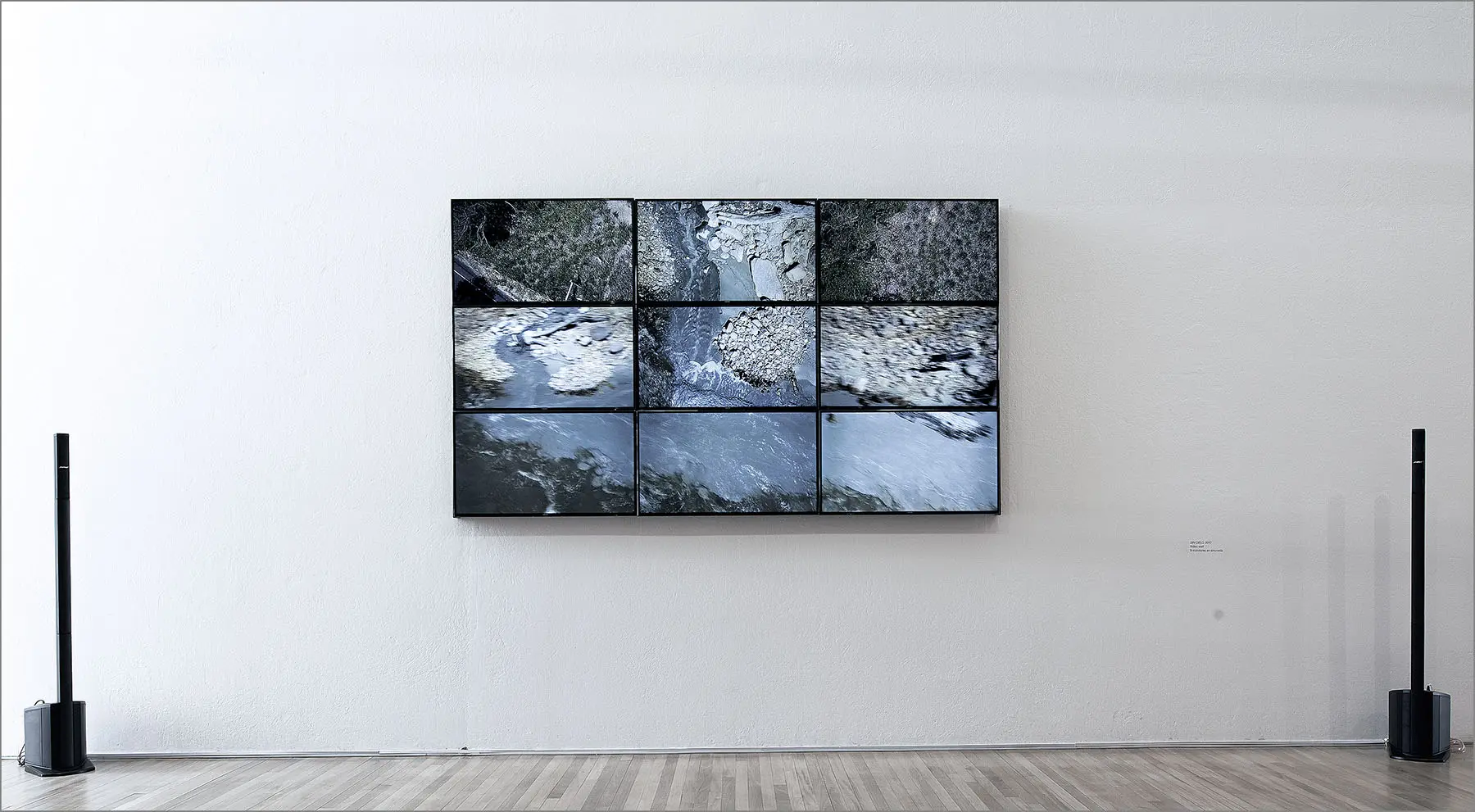
The work of Clemencia Echeverri (Salamina, Caldas, 1950) sustains a unique relationship with nature and its occupants, accumulating unpredictable connections and delving into non-institutional archives, individual memories, non-places where all that can be discovered is the spectral trace of past inhabitants. Indeed, in the situation that has marked Colombia for more than half a century, there are many cases where, given the neglect and silencing to which the victims of violence are subjected, all that is left is a vulnerable space and the memory of those who suffered.
Echeverri began her activity as an artist with significant production in painting and sculpture. Still, in the 1990s, after finishing a Master’s degree in Sculpture at the Chelsea College of Arts and Design, in London, she started to create installations using a variety of resources, like video, sound, painting on paper, and photography. Digital video and sound are two of the key media she uses, immersing her viewers in a visual and auditory space that forces them to move, to circulate, thus becoming an integral part of the work. The viewer’s body plays an essential role, since how space is used, the deployment of screens and sound, drives them to stroll and traverse, and to be who synthesizes the experience.
Echeverri’s installations keep their distance from the directness of the images with which the mass media familiarize us with violence and confront the viewer with what lies behind, what remains, that which is not spoken. This is why she moves away from the predictable document and proposes an angle of approach that seeks to go beyond mere media-based information to bring to the fore, the experience of anonymous protagonists, and the need to work through mourning and bring processes to closure.
The subject of the violence generated by Colombia’s extended armed conflict became the epicenter of Echeverri’s investigation. Staring with real events, she seeks not to document, but to compose her images as an exploration of their implicit emotional complexity. She invites observers to construct from their perspective the reality that the work engages.
An issue is how to understand the complex context that results from everyday events that are traversed by war. The use of a symbolic language emerges as echoes that appeal to the senses, to memory, operating based on a non-linear narrative.
It is not a matter of presenting modes of violence based on images of corpses, mutilated victims, destroyed fields, but to bring forth those hard realities based on metaphors, with images that seek to memorialize grief and ruin without making them explicit.
Echeverri’s political intention is to produce sensations that affect us inwardly; her images move us and invite a respectful silence. The political character of her work is not separate from her concern with creating art, artistic experiences and situating her viewers in an emotional and affective space.
How Echeverri uses space is overwhelming. Viewers are submerged between giant screens and inescapable sounds. The idea of an audio-visual acquires particular significance for Echeverri, and if the image impacts, sound operates as an uncontestable reference and plays a key role; the relationship between the two creates sound-image units that are not intended as explanations of events. Echeverri works based on fragmentation; there are no single conclusions, and the observer must complete the puzzle. As the artist puts it: “The issue is to develop an assemblage that supports the meaning of the work and prompts the viewer to imagine.” 1
We are confronted with spaces containing images and voices that bring us closer to other people’s stories. Motivated by her interest in exploring contemporary political and social problems, Echeverri’s research and fieldwork are deep and help achieve an intensity of image and sounds that involve her viewers in darkened, troubling spaces, and drive them to become the nexus where the different stimuli received are articulated, the person who decides how to relate to the tension posited by the work.
Echeverri’s 2019 exhibition at the Museo de Arte Miguel Urrutia (MAMU) in Bogotá was the occasion to interact with some of her most significant works. The curator, María Margarita Malagón-Kurka, titled it Liminal, a term gleaned from the work of psychologist Brenda Elliot and particularly well-suited to the experience proposed by the artist, according to Malagón-Kurka’s keen observation. The curator notes that “As suggested by Brenda Elliot, the concept of the liminal implies at least two lived experiences: one of possible transition, change, and transformation, and one of an intermediate, amorphous, undefined stage that precedes the former and generates disorientation, tension, and a desire for resolution. (…)
As the works are an ‘expression and record of experience and movement through the liminal,’ it is possible to assume, in the particular case of Echeverri, that the liminal is not only given in the viewer’s relationship with the work but also and above all, in the interrelation between the artist, her Colombian environment and the construction of the work.”2
The relationship established between events of the present and past stories, the presence of non-explicit violence and the characters that accompany it, the victim and the victimizer, provide a space for reflection in which a path of questions makes us think about current realities and look for answers without forgetting that the issues that the artist formulates are uncomfortable and questioning. The answers end up relating to the position of the observer. Victim, victimizer, and duel become a trilogy that runs, from various perspectives and situations, several works by Echeverri.
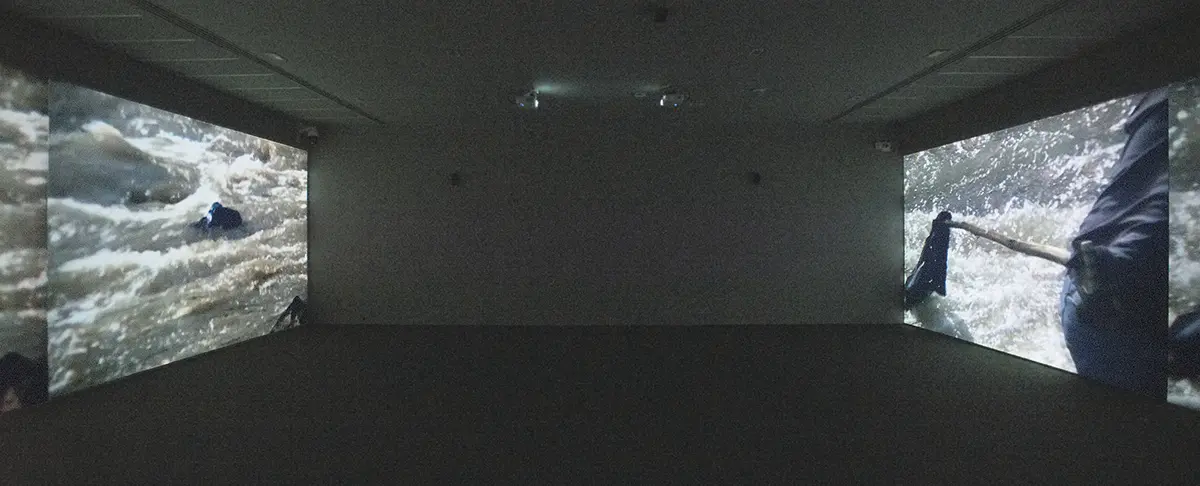
The term Treno (Threnody, 2007) refers to an archaic Greek lyrical composition, executed as a funeral lamentation for the absence of the dead. The setting for the audiovisual of that title is the Cauca river, which became the mass grave for many of Colombia’s disappeared whose bodies were thrown into the current, making mourning impossible against such events of forced disappearance.
The viewer, situated between the giant screens, contemplates the two riverbanks and is overtaken by the power of the river. Its volume is engorged, and we hear the rumbling of the waters, as well as the sounds of crickets and frogs. The noise is thunderous. It swallows everything in its path, even the bodies of the dead. Suddenly, we hear voices saying names, calling them from one side to the other. There is no answer, only silence. The river turns red, and clothing items start to appear, the possessions of those who are no longer there. The mourners search for the remains of their loved ones in those clothes, transformed into traces of an absent body.
“With Treno, I develop a sound and video installation from two riverbanks. A sad, wailing call. A visual and auditory space that searches from an echo. A circular narrative fusion. Local, continuous, recurring scream falling in a vacuum. Silences dragged by the Cauca River. Colombia. A familiar cry that finds no answer. The voice that calls and invokes from one shore bounces on the other as a connecting sound circulating in space, scraping the walls, seeking to arrive. A matter that finds its support in the flow of the waters and the revolt of the cry.”3.
The Cauca river appears as the river of the disappeared, where anonymous voices tell of impotence in the face of horror.
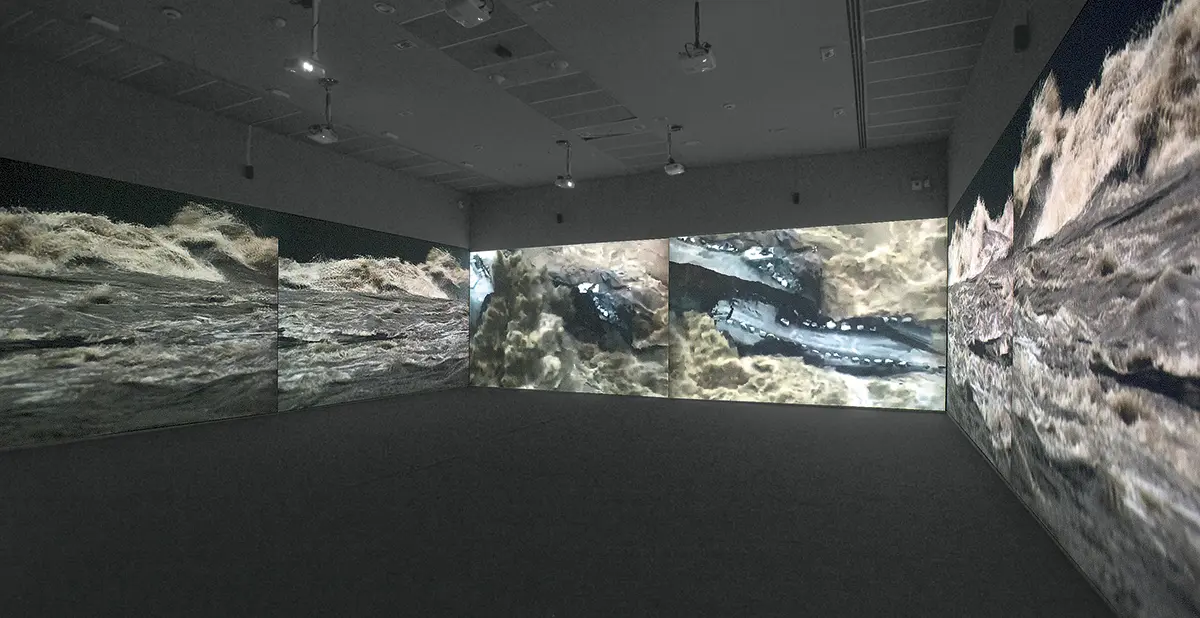
This use of the river as engulfing corpses prompts a further reflection on the destruction of nature. In Sin cielo (Skyless, 2017), the landscape of Marmato, a territory in Caldas, becomes the site of a gold rush, a makeshift extractive activity carried out by illegal mining operations. What we see is a gray, wounded landscape, made toxic by the use of substances that harm the mountain and the water; the sky is hidden behind the gray dust that comes from rock consumed by acid. The river itself becomes a corpse as a result of improper mining and the contamination to which it is subjected. The resources of those communities that survived thanks to the sustenance it provided are exhausted.
Río por asalto (River by Assault, 2018) explores sections of the Cauca and Magdalena Rivers, challenging us to watch a torrent flow in six screens, letting its voice roar in the complicated relationship between image and sound that amplifies the power of the waters. And while rivers can penetrate and nourish the earth, they suffer from the effects of the damage caused by those who cut trees indiscriminately or dump organic residues on their waters, not to mention those mammoth engineering projects that force their course to change.
In the three works mentioned above, the river takes on different roles as the protagonist: the site where corpses are dumped and disappear, murderers seek impunity, and streams see their very existence threatened by the human action that invades them with detritus thrown into its flow. As spectators, we observe the aggressions suffered by their current, and we are invited to share their resistance capacity, but also, to understand the disaster that implies for the territory to convert them into dying bodies.
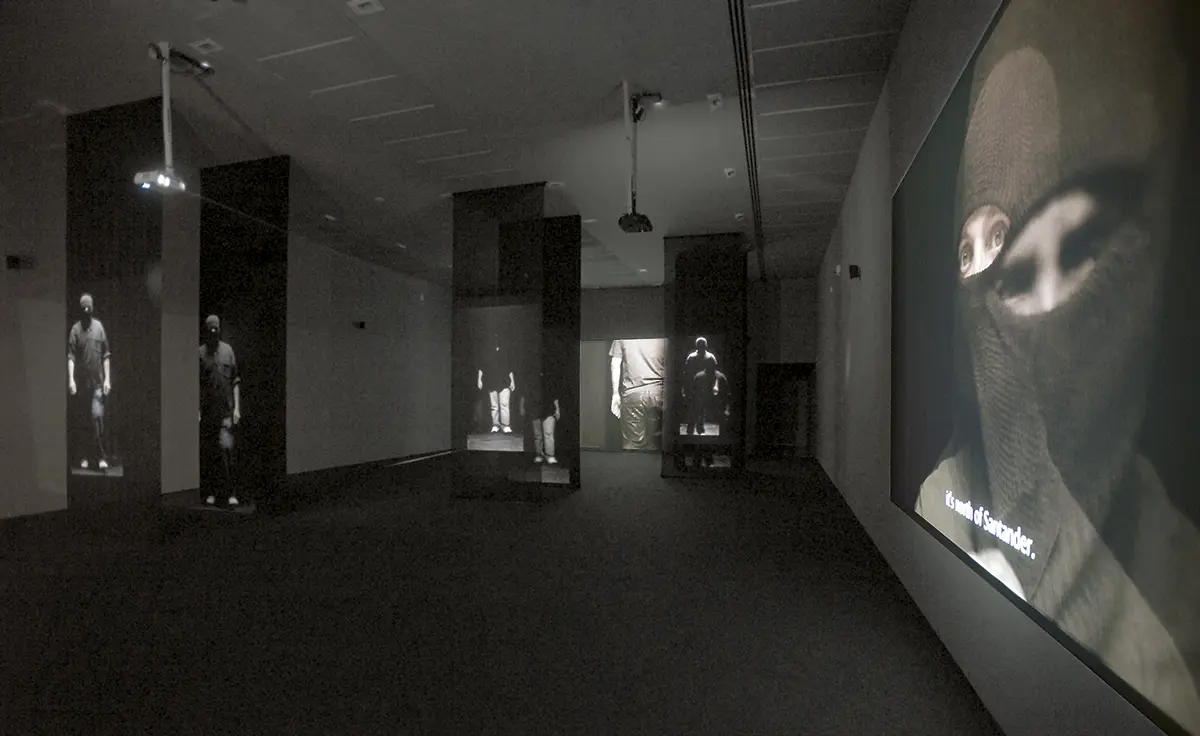
The presence of the human body in Echeverri’s video installations appeals to the evocative, to the trace, to spectral figures. In Versión libre (Free Version, 2011), it is not the victim who speaks but the victimizer, based on narratives collected by Echeverri in interviews with demobilized combatants. When asked about her position in regards to the complex gray line between victim and victimizer, the artist responds: “In this work, I travel through the voice, through the ghost, through the unknown, through the limits and the question. It is a time past and freighted with stories that are difficult to tell, with hidden truths, with episodes of our barbarism in layers of victims and victimizers. An aggregation of implicated persons that includes the viewer when she feels interpellated while standing in front of the artwork. And this interpretation is made along different pathways: from the victimizer to a possible victim who could be the viewer, or when by her very discourse the viewer reveals a state of vulnerability, she becomes the victim of the very groups to which she belongs.”4
The viewer is confronted with a collection of ghostly figures, their faces partially covered, projected onto canvases that hang throughout the gallery. Voices are heard alluding to the narrative of their personal stories, concerning their participation in armed groups. The observer also hears. The words are addressed to those who traverse the space, intent on having us face their narrative.
Sound, image, and circulation space bring us face to face with other protagonists of violence in Colombia. Echeverri says that: “Rather than directly touching the opposite places we believe ourselves to occupy, I opened up a thick, overloaded space that had been submerged in obscurity. An artist in such instances seeks to touch deep wounds, run risks, and envision an encounter with the human condition.”5
Without a doubt, the gamble proposed in this Version libre is risky and has the undeniable value or positing a different approach to the complex line sketched between victim and victimizer.
Echeverri’s installation Nóctulo (2015) is comprised of four canvases that hang from the ceiling to the floor, forming a cube onto the walls of which the video images are projected. The viewer enters a dimly lit space where perceptions are initially auditory and must progressively adapt to the darkness to discover the images.
Again, conflict and memory come together in Colombia’s remote rural areas. The abandoned house is populated by sounds, phrases, ghostly presences that are dispersed continuously by the constant wing-flapping of the bat colony that now inhabits it. Echeverri has worked with the subject of the house as a site filled with symbolic connotations before, showing how violence destroys its usual function as a zone of protection, of shelter. And the house becomes a blocked space, occupied by the memory of figures that have disappeared, or that they have no other perspective than to wander.
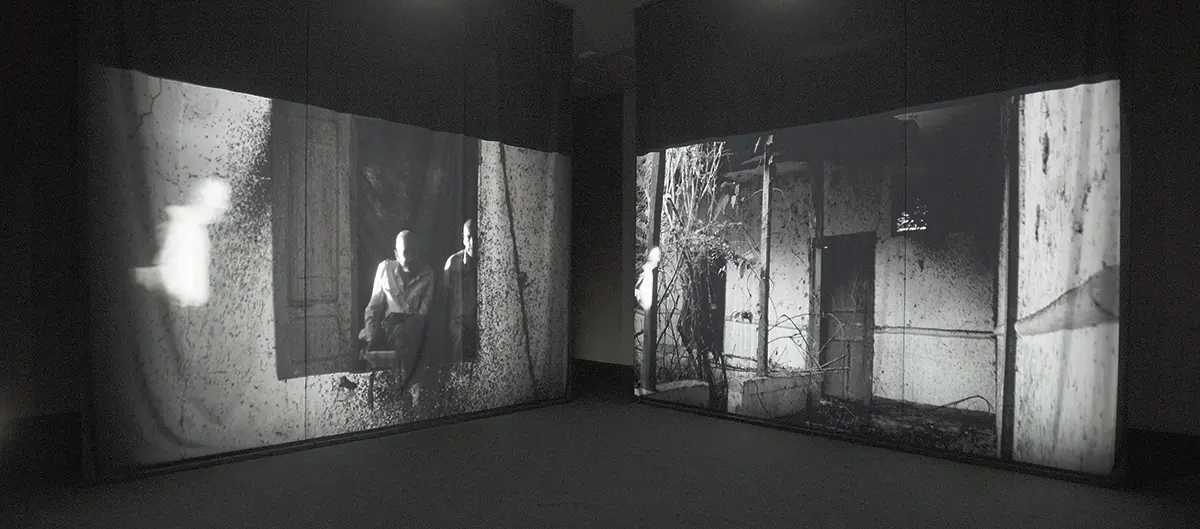
This work is articulated in two levels: the strategy of the bat that flies and produces sounds that the human ear can’t perceive, which allows it to move in the dark, and the presence of the spectral sounds of the former inhabitants. The supersonic sound of the bats is recovered and rendered audible, in combination with their constant flapping of wings. It is as if Echeverri were attempting to salvage that memory of what we can’t or refuse to hear, demanding that someone listens, that visibility is granted it.6 The narrative emerges from the cube, seeking to recover a memory that accompanies us but is difficult to reconstruct. Voices demanding to be heard that remind us of their pain, fear, and neglect. Those who pronounce the phrases are older people, witnesses who possess a memory, but are losing it. The voices become an echo that tells stories, and the sound envelops the viewer, who hears fragments that scatter and dissolve.
The central work is accompanied by a series of drawings on printed paper that record the excrement stains left by the bats on the walls and the barely audible phrases of the installation. “I was terrified;” “She was taken, and she disappeared;” “It was thirteen years ago;” “I’d never seen anything like it;” “Why they had us in such neglect, we did not understand;” “The girl went with the guerillas.”
That dark space of images that fuse into one another, with a persistent sound that shrouds and mixes an echo of voices, wings flapping, and the ultrasonic vocalizations of bats, there emerges a shower of seeds that reveal the presence of a luminous nature, shown as the possibility of glimpses of expectations of change. And it is the very figure of the bat that is allowed a chance to penetrate the darkness and can come out again, spreading seeds that help fertilize barren fields; in the face of horror, to open a longed-for space for hope.
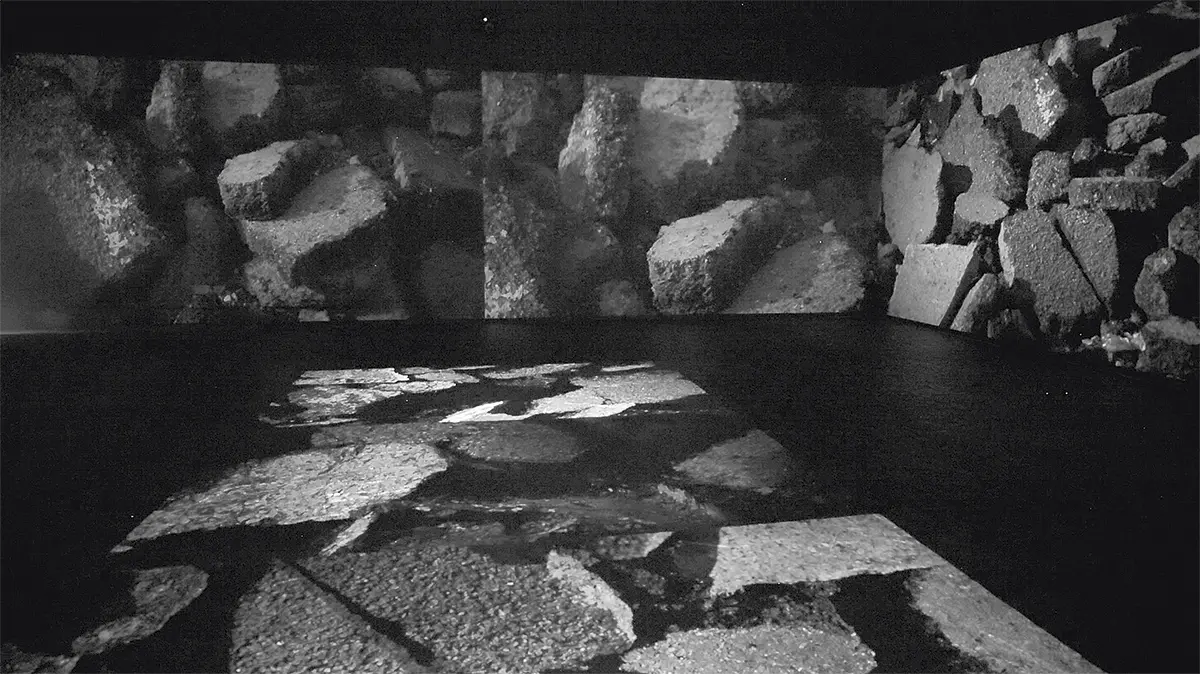
Echeverri’s most recent work is Duelos (Mournings, 2019), located in a new space called Fragmentos7. As the artist puts it: “Duelos is a video installation of nine images in synch that, joined to three levels of sound, embrace the exhibition space and evoke the unending grief that continues to be felt in Colombia because of the forced disappearances.”8. The issues engaged here have a precedent in Elegía (Elegy, 2017), which already alluded to what took place in the context of Operation Orion, a military action in the city of Medellin that occurred on Comuna 13, a working-class neighborhood, in 2002. A still undetermined number of youths from the area died in the operation, accused of belonging to the guerrilla. According to witness statements, their bodies were dumped in a zone known as La Escombrera, where the debris from demolitions throughout the city is customarily discarded. In more than 15 years, the waste has formed a mountain; the remains of the victims are presumed to be under it.
When in 2015, the prosecutor’s office, pressured by the legal actions of the victim’ relatives, finally agreed to search for the bodies, Clemencia Echeverri was able to access the site. It was a fruitless search, more a symbolic victory than an actual possibility of exhuming bodies buried under piles of debris.
Echeverri’s work intends to explore the meaning of unfinished mourning; going beyond the individual who suffers the loss of a loved one, there is the attempt to explore a collective memory, muted stories that move us. Thus the images of steadily falling materials and the sound that at times becomes the murmur of voices of victim’s mothers, only to explode later in the deafening roar of the debris as it falls.
The unfinished mourning caused by forced disappearance makes it impossible to bring the cycle to a close. The way in which the place of events is visualized leads to evoke, to understand the drama behind these images and those sounds, making it difficult for the viewer to remain indifferent to the pain of others.
NOTES
1. Mariángela Méndez interview with Clemencia Echeverri. 43rd National Artists Salon, Medellin, 2013.
2. María Margarita Malagón-Kurka, Clemencia Echeverri: Liminal, Museo de Arte Miguel Urrutia (MAMU), Bogotá 2019.
3. Clemencia Echeverri, Sin respuesta, Villegas Editores, Universidad Nacional, Bogotá 2009.
4. Cited by María Margarita Malagón in Clemencia Echeverri: Liminal.
5. Clemencia Echeverri, Errata # 13 Human Rights and Memory, Bogotá, 2015.
6. Ivonne Pini, Clemencia Echeverri, Art Nexus Magazine # 97, June-August, 2015.
7. Fragmentos is a space conceived by Doris Salcedo as a "counter monument" in what used to be a colonial house in downtown Bogota; she created sculptural tiles to cover the floor with the molten metal of the weapons surrendered by the FARC in the framework of the peace agreements.
, Salcedo created a sculpture to cover the floor of an old colonial house in downtown Bogotá, in the form of tiles made from the recovered metal. The space will host interventions like the one proposed by Echeverri when she was given the Creativity Award 2018, commissioned by Fragmentos, Espacio de Arte y Memoria.
8. Clemencia Echeverri, Duelos, exhibition catalog, Bogotá 2019.
IVONNE PINI