An artist who investigates the history of art and explores himself at the same time. This is what the recent exhibition Carlos Vergara - Prospectiva (Carlos Vergara – Prospective) revealed in the Museu de Arte Moderna do Río de Janeiro’s Monumental Space, as it journeyed through the celebrated artist’s production. The show featured a range of works dating from 2003 to the most recent or never before exhibited, such as Vergara’s large-format paintings (the largest he has made so far). Artist-curated (hence, also, its self-reflective character), it sought to outline an expressive trajectory marked by matters connected to the ancestral.
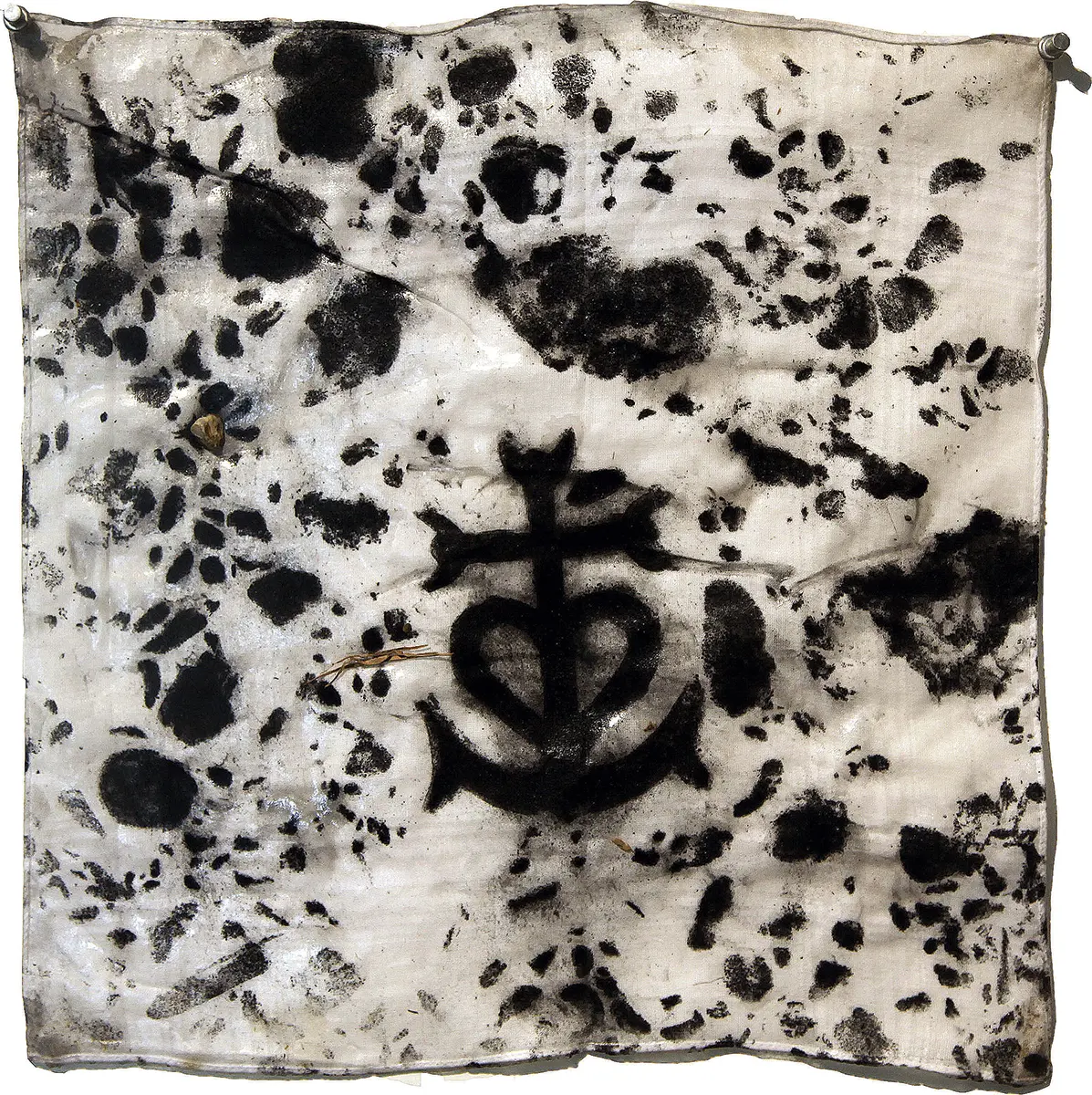
It is not an issue of religion, as Vergara himself notes: “This is not a Christian or an anthropological project.” Nevertheless, in transforming the paths he has followed into art, Vergara gives rise to his own mythology: “All those sites contain signs of the ineffable, of the sacred. I am not a seeker after religion. These are pathways of the sacred, signs of the sacred.” Vergara’s large-format paintings, for example, were created based on monotypes made at the Valongo Wharf (the port area that was the point of arrival for enslaved Africans) and along the trolley routes in Santa Teresa, the Rio neighborhood where the artist’s studio is located. Other works that stand out in the exhibition are the new entries in the Sudário (Shroud) series. The monotypes were inspired by Vergara’s trip to southern France last May, when he completed the Sacred Feminine pilgrimage that supposedly retraces the footsteps of the three Marys: Mary Magdalene, Mary Jacobe (mother of James), and Mary Salome, along with Sara, the Egyptian slave who fled from the Romans and became the patron saint of the gypsies.
The action of bringing the image of the outside into the museum—a move contrary to contemporary art’s tendency to occupy the urban landscape—turns Vergara into the demiurge of art history as such. He is an artist who reconstitutes both his own myths and those of history, revealing in that way an autonomous, infinite circular motion of the historical and the artist within himself. The displacement of canvas painting in the direction of the streets finds in Vergara a reassertion of the endless possibilities that art can offer. Beyond his expressive plastic play of luminosity, transparency, contrast, etc., Vergara reinforces art’s powers of reinvention.
All of the above can be verified in this large-scale exhibition. It featured four major groups of works: Sudários (Shrouds), Natureza Inventada (Invented Nature), Prospectiva (Prospective), and Empilhamento (Stacking). The show was accompanied by a series of actions, including meetings and talks, as well as extending outside the museum, interventions by the artists Lynn Court and Xadalu.
The Natureza Inventada section featured ten steel sculptures and two paintings, measuring 3 x 6 and 2 x 6 meters, set around a large sculpture table, also in steel, with twelve chairs created by Vergara in collaboration with designer Zanini de Zanine. This was a space for encounters activated in along with the public, based on open actions and interactive talks.
The series that gives the exhibition its name, Prospectiva, comprises three recent, never exhibited large-format paintings—the largest produced by Vergara so far in his career, 5.40 x 5.40 meters each—. It is based on monotypes made at the Valongo Wharf archeological site—recognized by Unesco for its historical significance as the site where 900,000 enslaved Africans arrived in South America—.
Vergara speaks of the importance of the trolley as well as of paths and crossroads. “The rails always signal a dual action: bringing and taking away,” notes the artist, who in Rio Grande do Sul visited Restinga Seca, the birthplace of artist Iberê Camargo (1914-1994), whose father was a railroad lathe operator. “I made then a monotype on the rail that took him to the world outside. An image of rails is always eloquent for me.” The exhibition’s final section presented Vergara’s re-reading of his iconic work Empilhamento, a large column made from stacked kraft paper and corrugated paper dolls, like a Babel tower reaching up to the museum’s third floor.
Vergara was born in 1941 in Santa María, Rio Grande do Sul, and has lived in Rio de Janeiro since adolescence. His most recent solo exhibition at MAM Rio was A Dimensão Gráfica, ten years ago. His current production is characterized by a personal inquiry into the boundaries of the pictorial code, and by a confrontation with the physical and cultural realities of the country that provides his registers, the indicia of his real existence, distant from the art institution and its circuits.
Explaining the title of his exhibition, Vergara said: “My idea is to look ahead, to live in the present, and to propose, through the work and the encounter with the audience, new possibilities, and perspectives.” In this way, he fulfills his goal of dialoguing with the past while looking towards the future. Such restlessness is a constant presence in Vergara’s art, an urgency combined with the insistence in execution; hence his obsession with rails: he is always traveling on them in search of aesthetic solutions. This is how Vergara continues to take himself and art’s very pathways by surprise.
ALESSANDRA SIMÕES