The exhibition “Cities of the Mind,” curated by Carol Damian, presents a new facet of the pictorial work of the Cuban American artist Carlos Estévez. Inspired by the Havana of his youth and the trips made in the United States and Europe, Estévez expresses a symbolic and personal vision of the city through complex, large-scale compositions that refer to cosmological maps and diagrams, mythologies and stories about the origin of the world through time and space.
The nine paintings included in the exhibition are the result of experiences lived during his participation in different artist residences he participated in in recent years. Traveling and visiting new sites allowed him to meet people, cultures, and learn stories that inspired this series. The first work, “External Vision of the Inner World” (2017), is based in Carcassonne, a medieval city located on top of a hill in southern France. In the Middle Ages, the cities were surrounded by walls for their protection and functioned as independent entities at an economic, political, social, and cultural level. Walking through its streets, Estevez felt part of that universe. It was there that he had the vision of cities as microcosms, metaphors of the inner world of human beings, and projections of the mind that contain elements around which human existence revolves. When he left and saw the citadel from afar, he was shocked to see how it had been frozen in time. According to the artist, the painting “External Vision of the Inner World,” with its circular shape and its complex gears and geometric designs, symbolizes human creation as a whole.
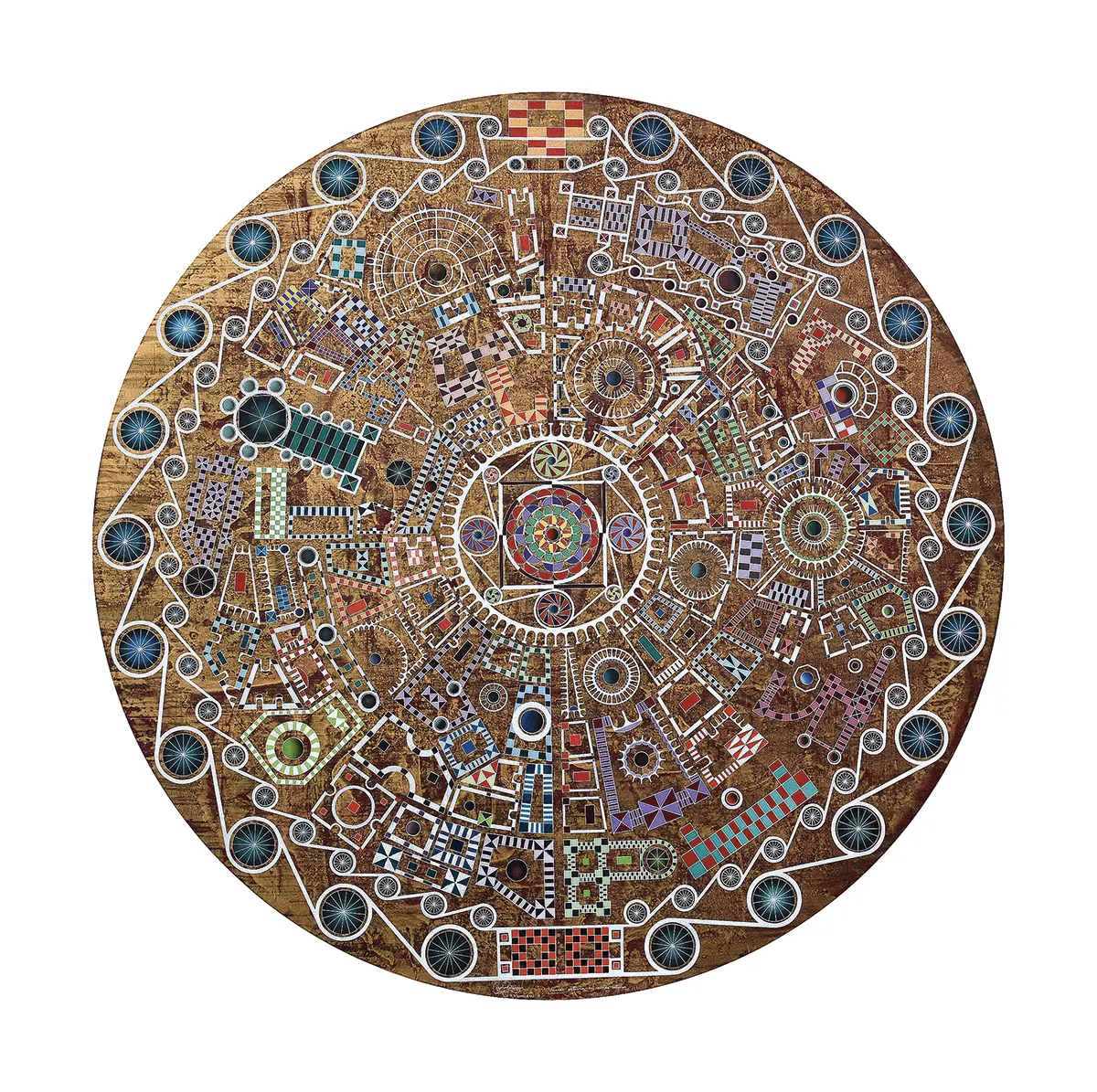
Its counterpart, “Internal Vision of Outer Space” (2017), is inspired by Prague’s astronomical clock known as “Orloj.” The circular canvas serves as a background to a complex composition of circles of different sizes that recall calendars and faces of elaborate clocks and represents the obsession of the human being to study and discover the mysteries of the cosmos through inventions such as telescopes and celestial maps. According to Estévez, observing the universe as a whole is practically impossible and, nevertheless, it is a task that man insists on performing. Another work that is inspired by the passing of time is “Clock City” (2018), a painting that represents the detailed mechanism of a clock with its golden gears, springs, and oscillators on a black background. The work visually represents the temporal relationships that occur in a specific space as if they were pieces of a complicated apparatus that moves to the rhythm of the inhabitants of the place.
The blueprints of different urban centers inspire several paintings in the exhibition, as can be seen in “Savannah” (2019), which, as the name implies, is based on the rectilinear map of this city of the state of Georgia, one of the oldest in the United States. It is also the case of “City imaginable” (2018), a monochromatic piece inspired by the ruins of Athens, Corinth, Delphi, and Lindos, which, according to the artist, synthesize various disciplines of human life such as architecture, music, philosophy, politics, mathematics, and astrology. In the case of “Thera” (2018), the work refers to Santorini, in the Aegean Sea, in particular to the houses dug in the cliffs facing the sea. In “Citadel (Alcázar)” (2017), Estévez is inspired by the fortress of Ávila in Spain, the semicircular towers, and their famous doors. In the painting, they become an anthropomorphic urban map.
The religious architecture of Istanbul, in Turkey, inspires “Sanctuary city” (2019), a canvas decorated with labyrinths and designs in blue and aquamarine tones that recall the game “Spirograph”—used to make hypothyroid and epitrocoid geometric figures—. During his visit to that city, he was struck by the Byzantine art of the Hagia Sophia Museum and the Islamic art represented by the Blue Mosque. He was particularly struck by the spirituality that Islamic art transmits through forms, light, and space. Through his work “Sanctuary City,” he intends to create a space for contemplation and meditation, and at the same time a meeting place that transcends the differences that may exist between those who observe and admire it.
Estévez is passionate about astrology and astronomy and that is why it is not accidental that he has been inspired by maps and celestial cartographies for the realization of “Celestial City” (2017), a work that, according to him, “is a tribute to the imagination and human creation.” From its origins, man has imagined shapes in the sky, and, in this painting, he creates his own constellations. It is an urban map with streets and avenues as if it were a map of an earthly city but located in the sky. For the artist, “this work symbolizes the human will to reach the unattainable.”
The exhibition “Cities of the Mind” illustrates Estévez’s interest in the social projection of the human in the urban context in the broadest sense of the word. Each painting is an approximation to the concept of the “city” resulting from the universal need that man has to make exchanges. The individual works as long as he belongs to a community. We all, in one way or another, have something to offer or exchange. In each of the magnificent paintings, the “urban” expresses this message in an elaborate and almost hypnotic visual form.