Drawing and the body are the two epicenters of Carla’s art, conjugated with time and space in context. Chaim’s work materializes as a series of unfolding unique and concentrated universes: a specific enclosed space, the surface of a paper, the fragment of a landscape, or a moment in time, all transformed by the actions of her body. There are stillness and deceptive simplicity in each one of her works, and this is one of the key reasons why Chaim’s work is so unique in the context of today’s contemporary art scene. Her work is intimate, though not emotional; its unstable even though it appears controlled; it has no end though it may be a performed action; is not narrative even though is driven by temporality; is profoundly bodily though it relinquishes the protagonism of the performing body, by dispersing it centrality into space, drawing, and process. It is thus tempting to think of her work as embodying a series of dichotomies: black vs. white; rationality vs. subjectivity; control versus chance; body versus geometry; specific versus universal; apolitical vs. political; negative versus positive; monumental versus anti-monumental, conceptual versus formal, and so forth. Nevertheless, to read Chaim’s work as opposing concepts is to miss her interdisciplinarity and the multiple levels of meaning and material reality that coexist in her art. The artist herself describes the dialogical nature of her work in bringing apparent contradicting realities, as to be the creation of “(…) a third signifier, an object, and a question that is beyond one and the other, beyond a choice.” She further explains: “I believe it to be an act of magnetism, an act of bonding, one that also repels, but transforms and shows us another universe, another dimensionality of aspects of life.”1
Some of the authors that have analyzed her work warn us that we should be careful to highlight too much the role that geometric abstraction plays in her art or propose her apparent ‘neutral’ (not highlighting gender or the personal) performing body as the embodiment of a universal body. Fernando Cocchiarelle, who has written insightfully about her art, highlights the notion of the multiverse in Chaim’s work, based on the artist’s object-book titled Multiverso, nevertheless cautioning us that the “artist’s projects are not a formal invention, but rather the spatial formulation of fields of experience.”2 Multiverse is a great notion for thinking of Chaim’s work, by embracing not only its conceptual and symbolic aspects but also its materiality, its aesthetics, where body, drawing, performance, space, and concepts are all coming together as a shared experience, without separation or hierarchy.
It makes sense that drawing and the body are the pillars of the artist’s work. Drawing is the experimental medium par excellence, a medium that is associated with the inception and conceptualization of ideas, with experimentalism, with the rebellious notion of the unfinished, of process, of intimacy, and also with the defiance of the objectified idea of art with capital A. The body is a political, organic, living entity, with a powerful history of transgression of the status quo, particularly since the 1950s. It is no surprise that some of the artistic references for Chaim are artists with a strong body of work such as Helena Almeida, Chris Burden, Lucinda Child, Lygia Clark, Merce Cunningham, Antonio Dias, Hudnilson Junior e Janine Antoni, Dora Maurer, Ana Mendieta, Robert Morris, Lygia Pape, and Yvonne Rainer. The body performs multiple realities, and as such, it embodies contradicting realities and a multiplicity of possibilities.
It is fitting to see Chaim’s work in the context of the philosophical field of phenomenology based on the centrality of experience: temporal, self-awareness, spatial awareness, awareness of others (intersubjectivity), etc. Specifically, French philosopher Maurice Marleau-Ponty focused on the role of the body in human experience: kinesthetic, embodied action, the spatiality of the body, and so forth, emphasizing the role of the body in human experience. Importantly, for Marleau-Ponty, the body is permeated with consciousness, resisting the traditional Cartesian separation of mind and body that characterizes the dominant Judeo-Christian hierarchical belief of rationality over subjectivity and embodied experience. The experience of the body does neither lie solely in the mind, nor in the physical realm. As Merleau-Ponty writes: “Rather, my body is, as it were, me in my engaged action with things I perceive including other people.”3 The body in Chaim’s work is immersed with consciousness and subjectivity; her work is an embodied form of subjective cognition, whereas it is manifested as a performance or a drawing, or both simultaneously. Furthermore, the artist is especially interested in Baruch Spinoza’s opposition to mind-body duality, defending their inseparability, and also in Michel Foucault’s notion of the controlled body. This latter notion is especially important in the context of today’s Brazil’s new politically oppressive situation. Chaim writes: “I think (talking about the controlled body) that my interest in the social field is the manipulation that can be exercised in a society and that we often do not realize. The breaking of individuality, the reification of the subject, bothers me a lot. I think a lot about this controlled body (…).”
Chaim is a trained dancer, and this informs both the knowledge and the discipline, as well as the expansive notion of the possibilities of the body in space, to intimate gestures such as the folding a piece of paper or covering gesturally its surface - from small to large size- with black oil stick, for example. Every action is informed, empowered, and embodied through this awareness of the body. Drawing becomes a materialization of the body, often a reconstitution and extension of itself beyond the body itself. I believe that this is one of the key drives of Chaim’s engagement with abstraction. It stems from the body and space, and it’s not reducible to a limited reading of abstraction as a modernist notion of geometry, but as an expansion, a different manifestation of the body’s action in space, in architecture, on the floorboards configuration, on the page; on all the daily elements that determine so much of who we are, how we act, and how we imagine the world and the space we occupy in it. Chaim dispels without ‘violence’ or self-consciousness any absolutism that may be related to geometry: the dominance of the aesthetic tradition of Brazilian modernism; or the way geometry predetermines and contains the body and its imagination (architecture, math in daily life, space, etc.), and as a realm of possibility, as something that may be rendered vulnerable, subjective, personal, expansive (itself but something else too). The dialogical relationship of the body and geometry in Chaim’s work is both a form of inhabiting and also a form of dissolution and a subjectifying of the concrete.
It’s important to point out that Chaim avoids an over-controlled or rational situation when materializing her ‘thought actions’ in video performance. Even though in most cases the artist repeats the action several times, she often chooses the first cut, because it is in the first attempt, when the body is still not able to perform the thought-action entirely or has difficulty in doing so. For a moment, the body and mind are somehow together but autonomous from each other. This has nothing to do with the Cartesian division of mind and body, but with the coexistence in a moment in time of several simultaneous realities –bodily, mental, conceptual, aesthetic, and subjective.
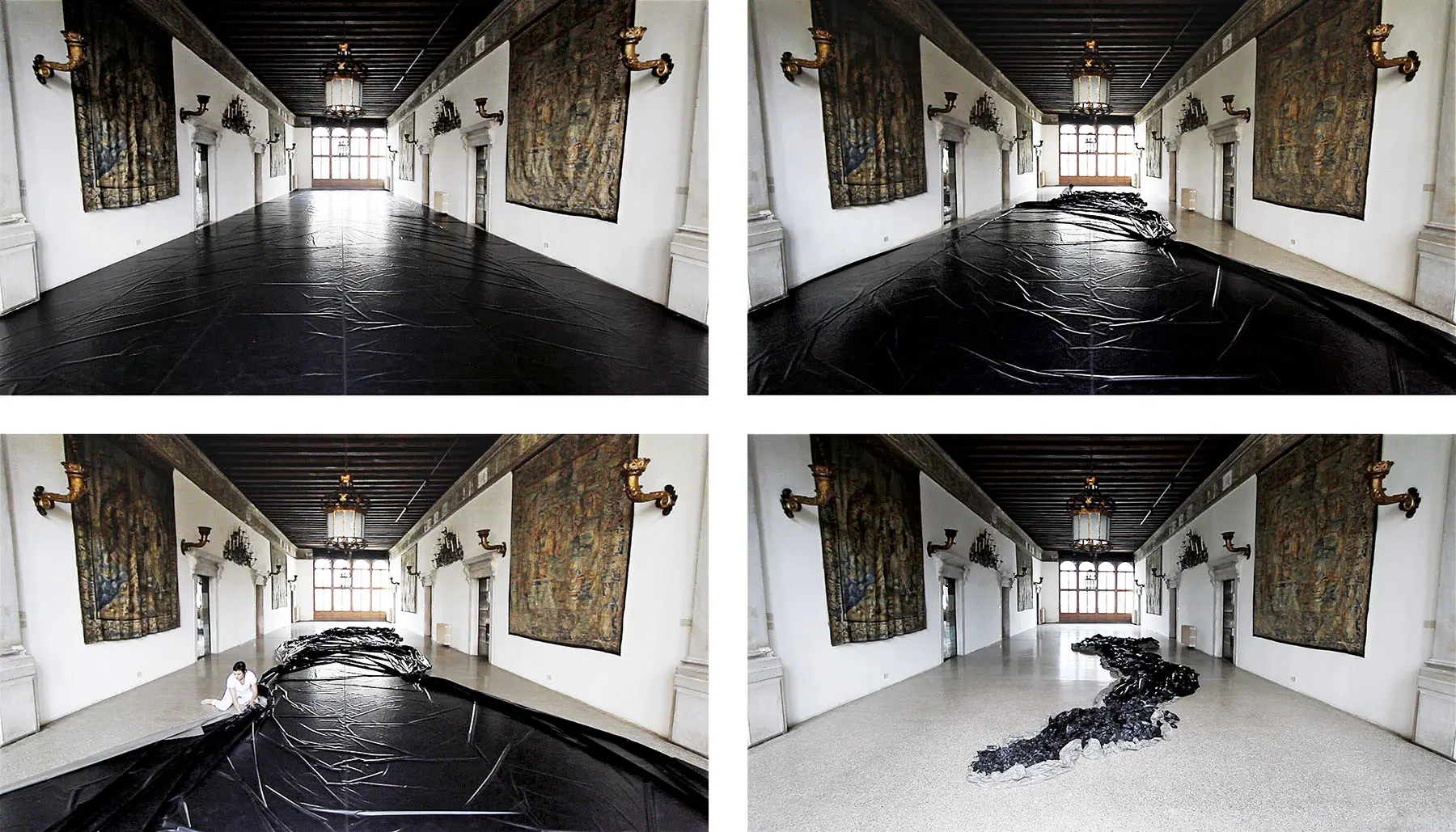
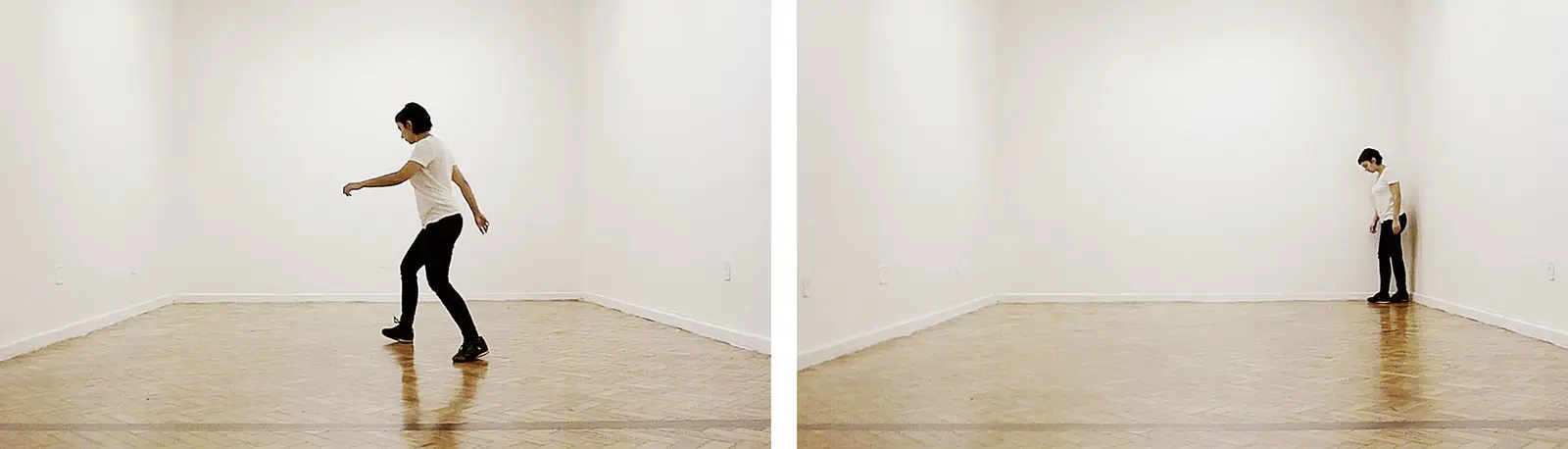
For example, in Espinha de peixe (Herringbone), 2016, the artist moves in space following the flooring zigzag-style pattern with her feet, creating a sort of dance that seeming predictable becomes a meditative and playful exploration of space beyond the flooring pattern. As Chaim turns one way and the other adding complexity and unpredictability to the movement in space, its geometry becomes organic, relative. Something similar occurs with Projeto para alinhar o corpo (Project to Align the Body), 2018, as the artist walks backward and forwards, following the darker alternating vertical lines that compose the pattern of the floor. The video frames multiple geometric elements: the room, the windows, the floor, and the baseboard. At the same time, the artist’s body slowly, in concentration, moves within the boundaries of the space and its geometric configuration. The video’s mainframe shows three black vertical windows centered on the back wall, echoing the upright figure of the artist also dressed in black. The fragmentation of the symmetry discreetly takes place, through the affirmative organicity of the body, its free will, the gentle thumping of the feet on the floor, all contradicting and expanding the rigidity of the overall spatial configuration. The body in these two videos questions, without violence, the status quo of the architectural space, creating a form of poetics of the space, inhabited by the body in ways that contradict the Cartesian model of modernity –duality mind-body- that is at the heart of the modern ethos. These works bring to mind Analivia Cordeiro’s M 3x3, 1973, a video based on computer dance research and Laban Movement Analysis created during the dictatorship in Brazil. In this piece women, dancers wearing suits with geometric patterns move mechanically in a grid structure marked on the floor. Despite the systematic movements, the bodies in their organicity defy the very structure that determines these movements. It follows that this work was presented for the first time in Brazilian public television, becoming a metaphor for the impossibility to control a human body, no matter how constrained it may be politically or physically. We can observe how Chaim inserts, again and again, contradictions in a given space or situation, thus calling into question a totality or fixed notion of the body, time, and architecture. This is further evident in her project To Resize the Room, 2017, Future Generation Art Prize 2017, presented as a collateral event of the 57th Venice Biennale, where Chaim covered with precision with carbon paper, edge to edge, the floor of a large hall flanked by tapestries and chandeliers of the Palazzo Contarini Polignac. After the space was transformed with what looked like a shiny negative space instead of the white marble floor, she proceeded to peel the carbon paper off, starting from the furthest point of the hall towards the camera. The act of removing the plastic was no longer commanded by the geometry of the space, but by the body of the artist, creating an irregular shape, an uncontrollable mound, which further transformed the space, this time by making it inform. The black material acquires its own life, and it becomes an amorphous shape in the middle of the hall shaped by the efforts of the artist’s body.
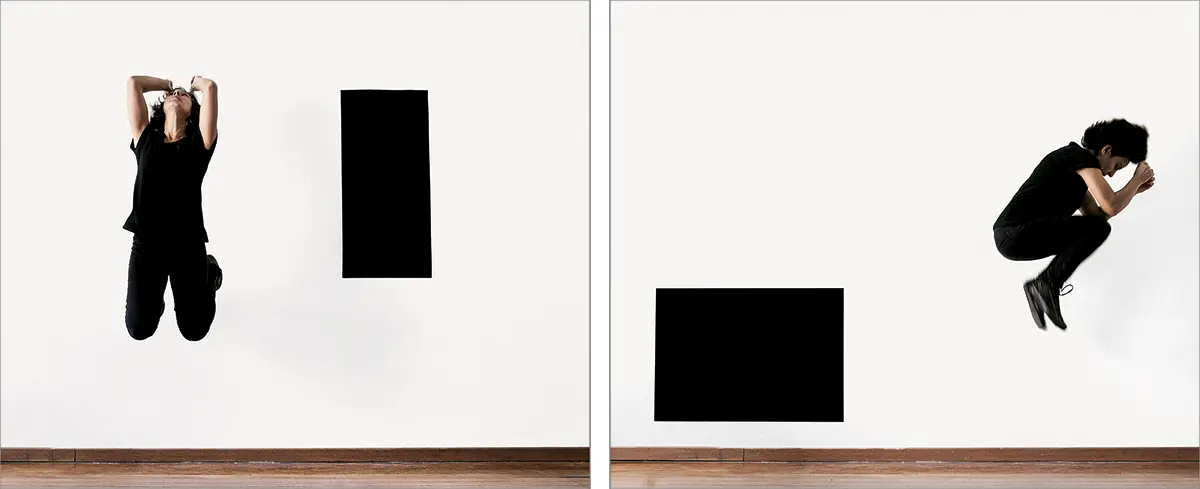
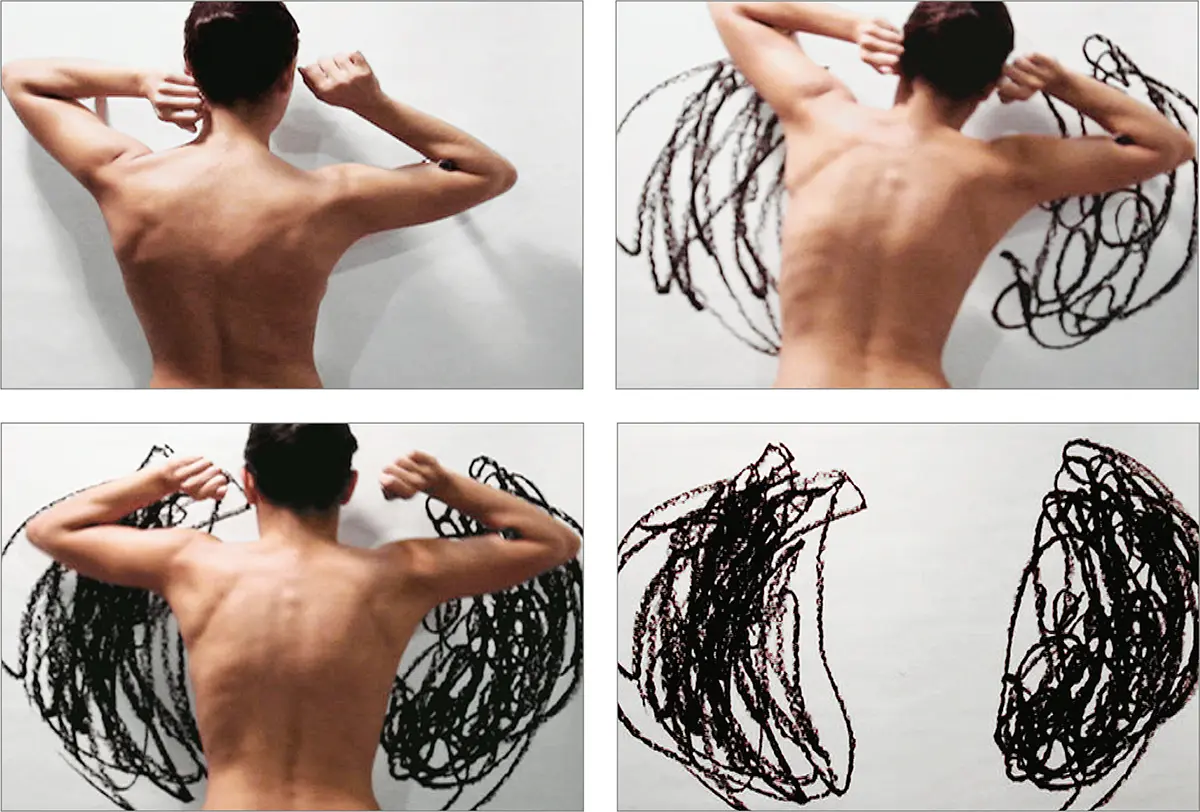
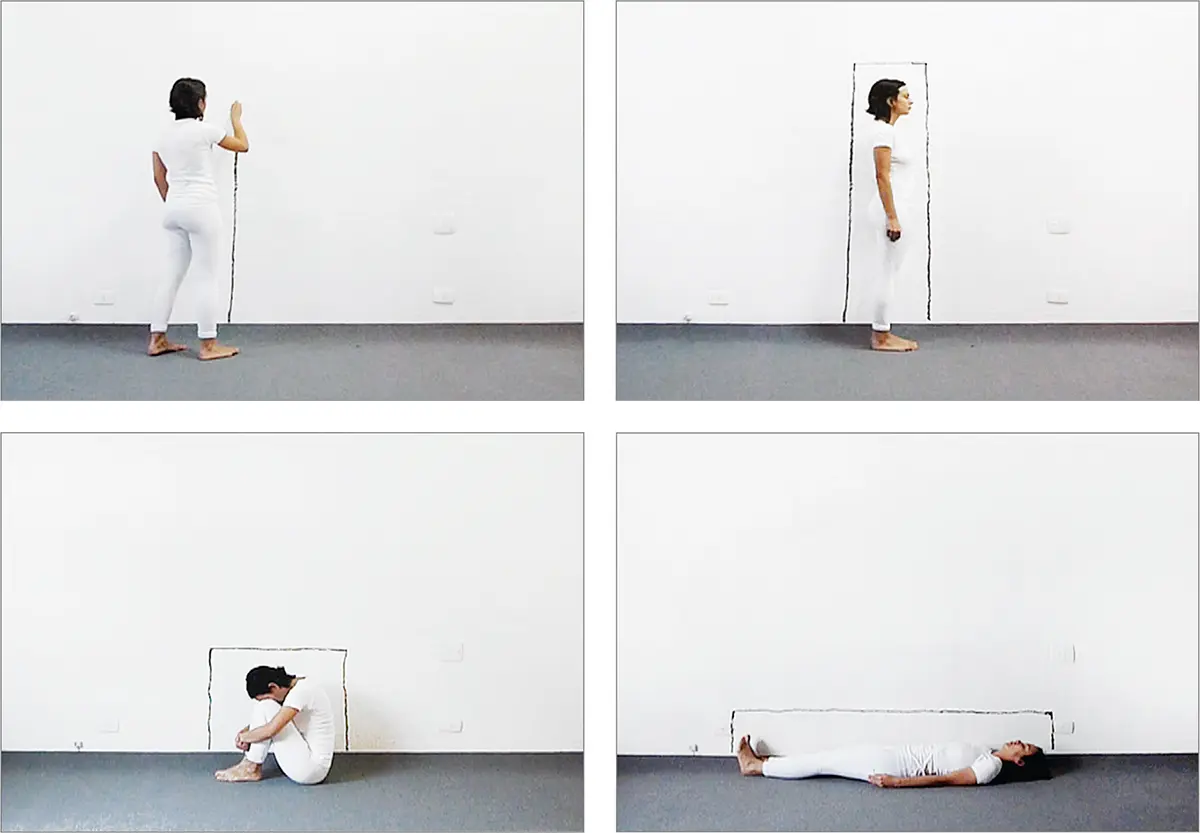
Everything the artist does intrinsically involves notions of drawing. The three performances mentioned could additionally be analyzed as an engagement with elements in space as forms of embodiment of invisible or visible acts of drawing. In some videos, the artist documents the process of drawing. For example, in Movimento Singular do Verde para seu Complementar no Tempo Desaparecido (Singular Movement from Green to its Complementary in the Disappeared Time), 2008, we observe the artist from behind, naked waist up, drawing with oil sticks tied to her folded arms, instead of using her hands. The work is presented as a video monitor, flanked by two drawings product of the action. The drawings show semicircular organic, messy, and tangled lines that contrast with the methodical circular movement of Chaim’s body. Instead, Tropics, 2011, a three-channel video projection, shows the artist dressed in white against a white background. She measures the wall to draw three geometric shapes that contain and circumscribe the body in three different positions: seating, standing, and lying down on the floor. The first video materializes the body’s organicity and uncontrollability, even under disciplined movement. In Tropics, it portrays the body circumscribed and controlled. The artist explains that “often the geometry is there to perceive the body, the organic, as in the photo performance series Pesar do Peso, 2014.” In these photographs, we observe the artist dressed in black, air-bound, performing movements that echo the black rectangles on the wall in a vertical or horizontal position. While we see the relationship between the body and the geometric shape, we also sense the tension between the organicity of the body and the rigidity and steadiness of the rectangles.
The interplay between control and freedom, between the organic and the geometric, between mind and body, permeates all of Chaim’s work. For the artist, Spinoza’s notion that that body and mind have the same matter and are inseparable is crucial. She comments: “Everything that happens to the body is felt by the mind in the form of emotion and thought, just as what happens to the mind, the body perceives it. One is responding to the other all the time, cyclically, talking, and acting in the world.” It follows that for this reason, Chaim is careful not to give more power to the mind over the body or vice-versa. Chaim, who was trained as a dancer, can control and express with the body; the same way she reads and writes profusely about conceptualizing each work. Ultimately, it is the body that is given the role to materialize with intuitive and processual freedom, the thought actions without translating the artist’s ideas rationally. What the artist describes as “the confluence of the mind/body relationship,” could be described as an act of coexistence and intense specificity –of the mind and the body- as these coexist without oppressing each other. The artist writes: “I think that when the body is trained and rehearsed, the mind exerts the most influence on gestures and movements, and that does not interest me. I am interested in a body that responds ‘more’ autonomously and more spontaneously. They are interconnected, and I am aware of how each expresses and acts in the world. One depends on the other and is a cyclical conversation.”
This interrelation is clearly articulated in Chaim’s notion of embodied drawing. Projeto para curvar o Corpo (Project to Bend the Body), 2016, is an interesting example of how the artist chose to follow with her body an organic form, framed in ways that the landscape become a vertical realm, containing the verticality of the body that, when walking along the curvy line where water and sand meet, is eventually dissolved in space. For the artist, “the framed action and the walking body are the same as her drawings; a filmed drawing, a time-based drawing, a visual drawing.”
Key to drawing are the notions of temporality and process. Chaim often creates a particular form of temporality, generally meditative, slow, uneventful, purposeless in most cases (we don’t know where she is going and if something will happen). Even when it is up to the public to manipulate and explore, for example, the artist’s folded books such as Multiverse, 2014, or works on paper, the temporality of the spectator needs to be slow, delicate, concentrated. In this regard, she explains that “the drawings are about process, and the videos film this process. (…) They are time-based actions. There is a concentration, a contemplation of the action of the present body. (…) I work by trying to create a layer that is directly related to the process, over time, and not just accomplishing something I know what its final shape will be like. Like a self-boycott.” Chaim relates this ‘lack of knowing’ to the idea of breaking the rules and losing control not only as something personal but also as related to the way people in Brazil are used to deviate from the norm. Process and temporality are thus not only related to a specific extended timing but about diminishing the importance of the final result.
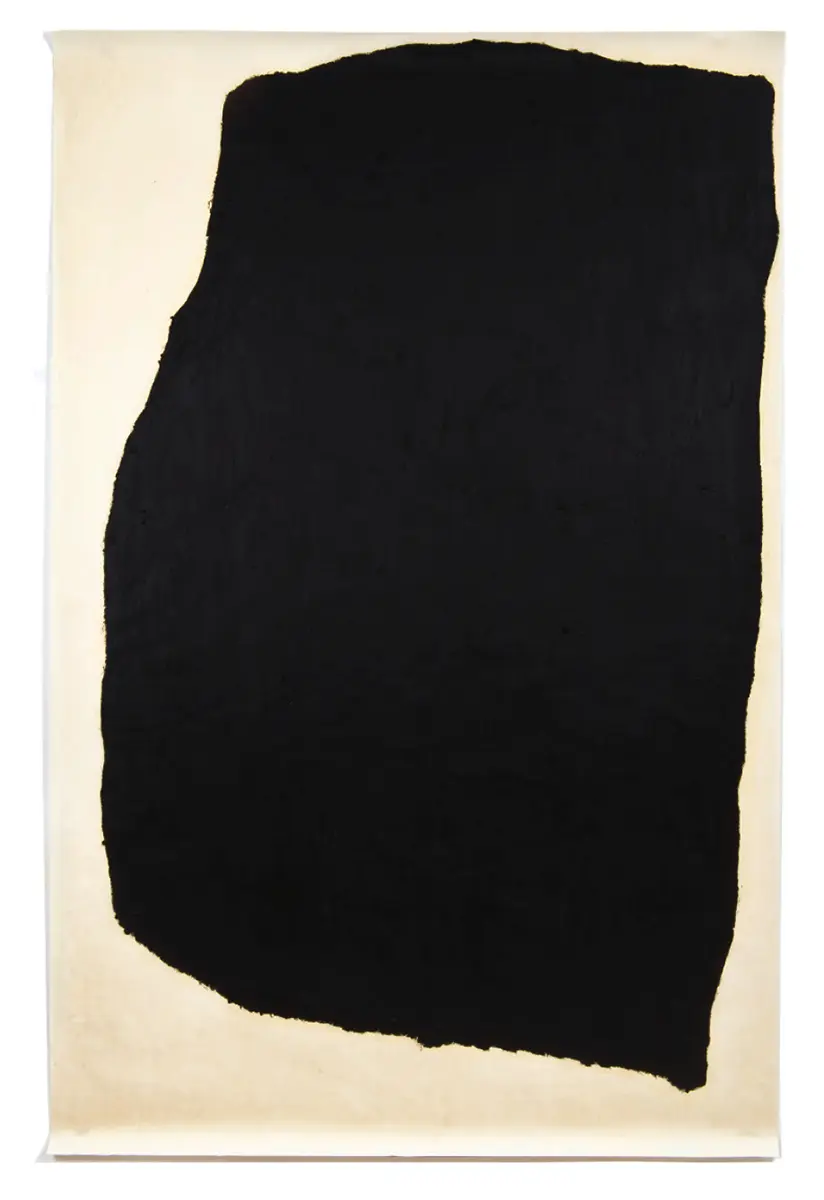
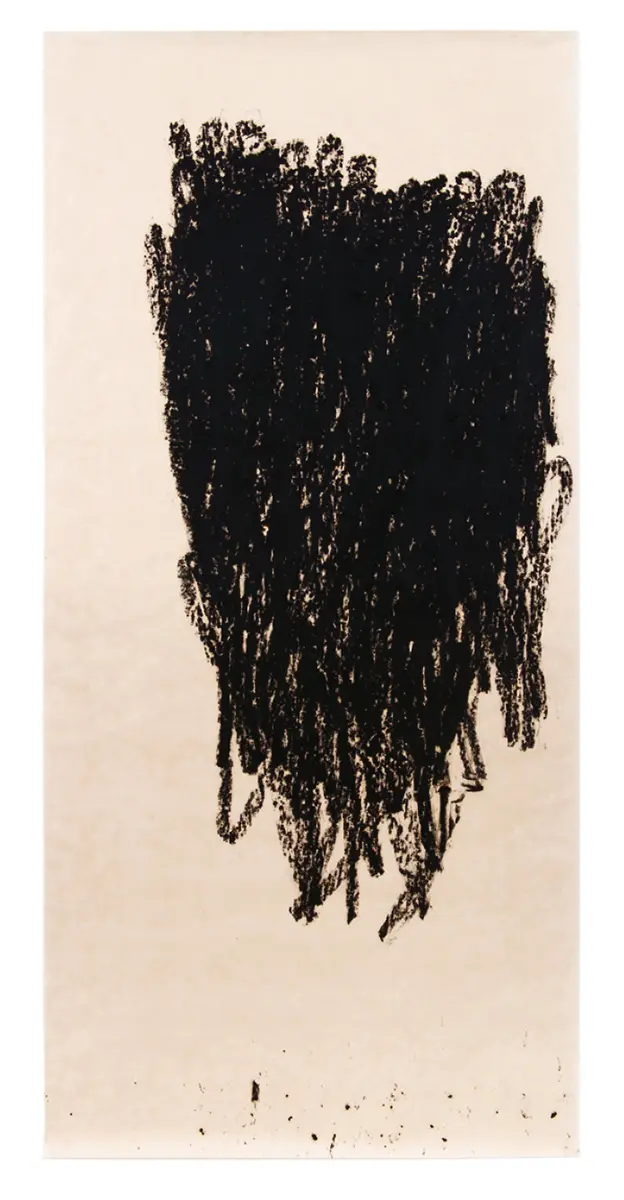
In some cases her drawings come to life in front of our eyes in a video, in others, they take the form of a large space intervention –such as in Colapso de Onda (Wave Collapse), 2014- in others, it may be an intimate drawing on a folded paper, with multiple sides and much complexity –such as in Multiverse, 2015-. In some drawings, she uses graphite, such as in Risco, 2019. In this work, the lines are chaotic and intense, exploded; in others such as Rabisco, 2019, made with black oil stick on Japanese paper, the materiality is powerful and profound coupled with the potency of the traces of hand and body intervention. These drawings are large, some the size of Chaim’s body, made by placing the paper on the wall and drawing with intense gestures in nervous and fast movements. These drawings embody the vestiges of the artist’s body restless gestures, to stand ultimately for the absence of her body. In drawing such as Mole I, 2019, made with black oil stick on Japanese paper, the form is irregular, but the individual strokes and lines coexist in a single intense black plane. According to the artist, the Mole series is made on a low table, her body above the paper, creating a lake of color, a black form that when walking around the paper, the shape changes, with no right side while it is still in the making. For Chaim, “These drawings are a moment when the shape has been frozen in time. (…) They are shapes that expand and contract; they are drawings/body.”
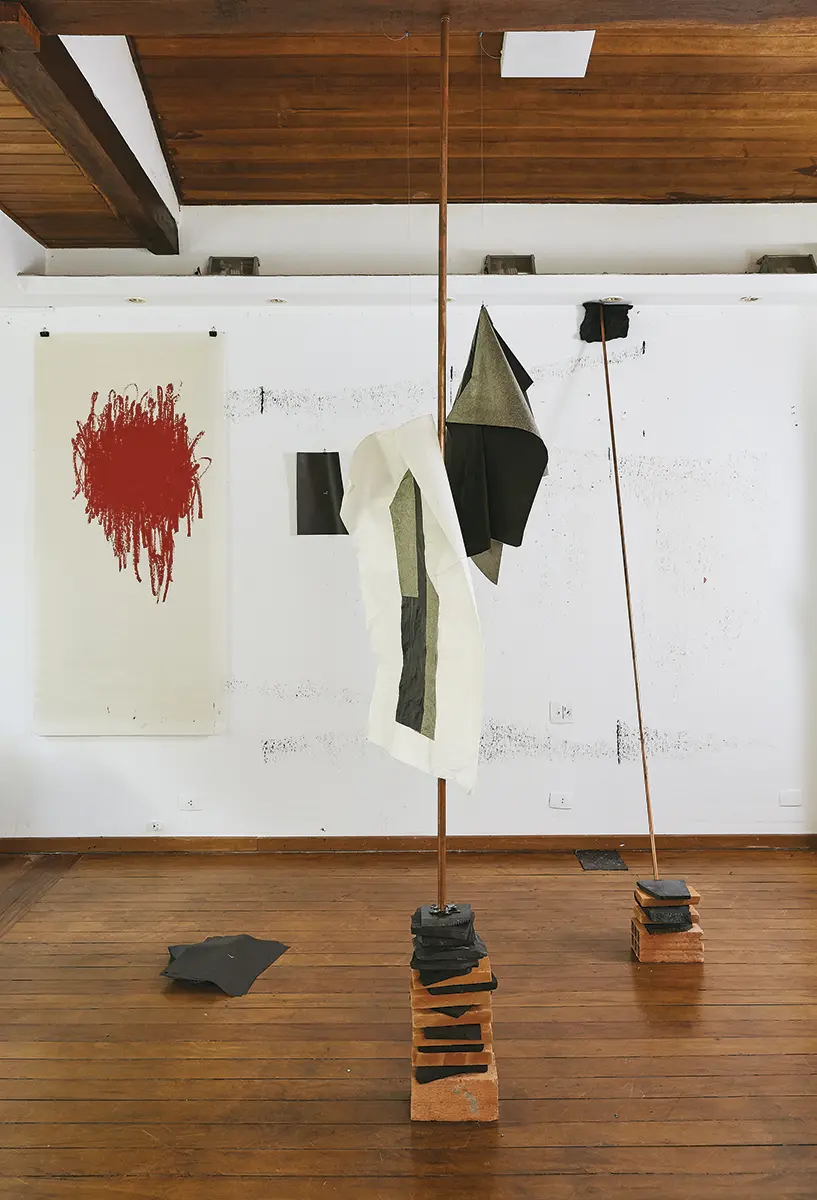
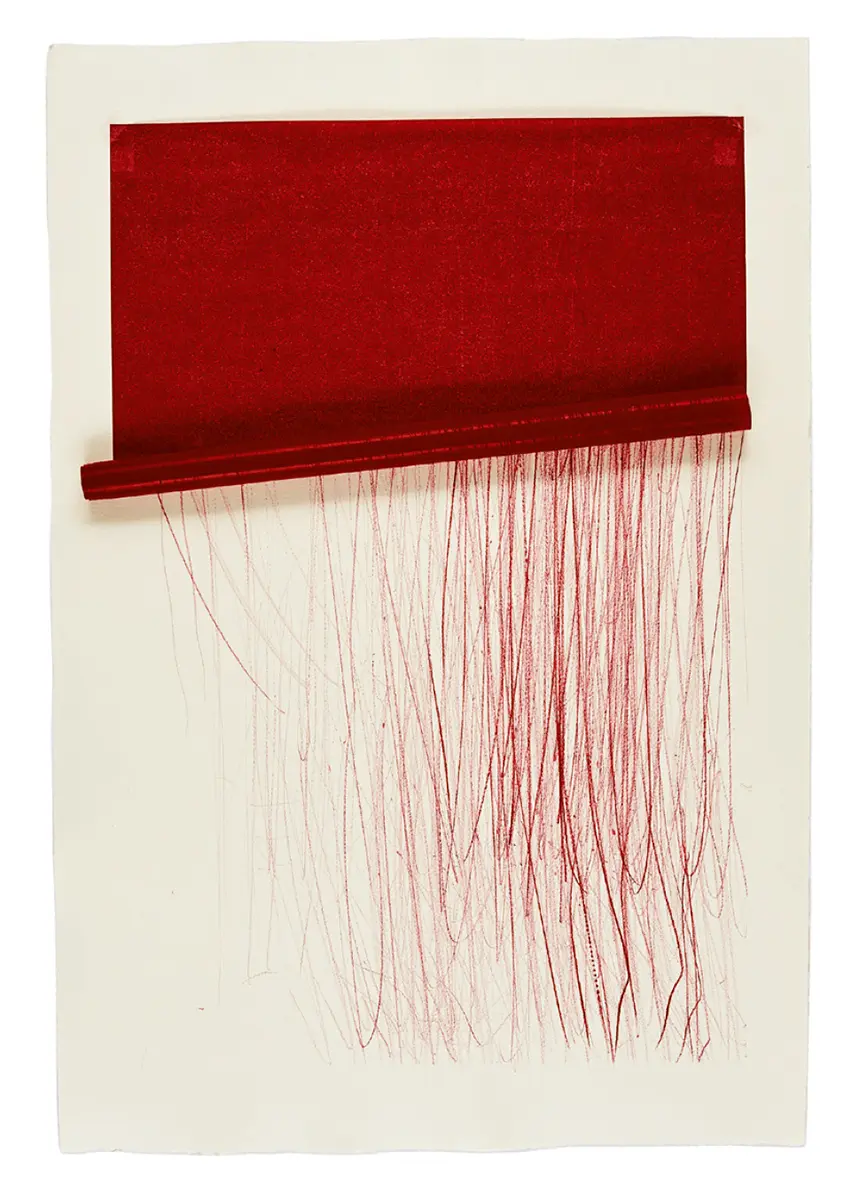
The artist’s work is characterized by its monochromatic coloring, either black or white; nevertheless, recently, with the political situation in Brazil, she has introduced the color red and comments: “I use red as a political color. Like a scream, like a bomb.” In her recent installation Terra, ouro, palha [Earth, Gold, Straw], 2019, she conjugated a large gestural red drawing on the wall with the arrangement of fragile black flags in space made with carbon paper and supported with thin wooden sticks. These are from the series He Wanted to Be a Flag, 2017-, which are both abstractions and also flags associated with the recent street protests in Brazil. For the artist, they are a way of deceiving abstraction “(…) It is an anarchist flag of a collective ritual. It is not an institutional flag; it is fragile and present, started in 2017 as an answer to what we are going through here in Brazil. (…) It is also a black flag of mourning.” Chaim’s work does not deal directly with objects. Still, as it proposes multiple levels of coexisting material and symbolic realities, these flags are both flags standing for bodies in the street, or their absence, and also standing for geometry and negative spaces in architecture. They exist as themselves concerning space and the Brazilian social and political context.
The title of Chaim’s recent show “The Little Death” at Galeria Raquel Arnaud in 2018, refers both to an orgasm and to mourning, to desire and resistance in the face to the mounting oppression in Brazil. In this exhibition, Chaim exhibited the black flags (flags of anarchy and mourning), together with the video Somatu, 2018, where the artist directs a choreography of three dancers that join and morph into a single body and separate again. Both the choreography and the flags embody a dialectics of the struggles of overcoming and freeing the “controlled body.” As with all of Chaim’s art, in her recent work, coalesce the presence of the body-mind in drawing, -as the artist considers the act of directing the scenes also an act of drawing- within a multiverse notion of interrelated and simultaneous apparent contradicting realities. Chaim describes her recent work as visceral “coming from a stronger will, a more latent, deeper, more intense, intrinsic and violent form of expression, also coming as a response to the situation in Brazil,” and also increasingly deeply personal. It is the dialectics of the engaged, situated, and intimate (drawing/)body, that is permeable to the other, that is so transformative and unique about Carla Chaim’s work.
NOTES:
1. Written interview between Cecilia Fajardo-Hill and Carla Chaim between October 9 and October 20, 2019. All quotes by the artist are from the exchanges during this period.
2. Fernando Cocchiarale, “Colapso de Onda,” in Freitas, Douglas ed., Prêmio CCBB contemporâneo: exposições: 2015-2016. Rio de Janeiro: Tisara and Centro Cultural Banco do Brasil, 2016. Pp 74-75.
3. Stanford Encyclopedia of Philosophy, Entry for “Phenomenology,” https://plato.stanford.edu/entries/phenomenology/
CECILIA FAJARDO-HILL