Alejandra Laviada (Mexico City, 1980) presented her most recent creations in her second exhibition hosted by this Parisian gallery. While studying in the United States, she acquired a double training in painting and photography, which in turn has given birth to an original body of work with sources in construction and geometry. Simulated cut-and-fold games, chromatic or light, and shadow contrasts, and three-dimensional illusions in this last series center on the aesthetic quest towards a correspondence between geometric shapes and the infinite possibilities that may result by associating the photographic act with pictorial creation, or with installations and assemblages.
For several years now, Alejandra Laviada has been practicing this “construction-deconstruction and reconstruction” (in her own terms) in space and from space itself, by combining various objects and materials—chairs, armchairs, tires, etc.—and then photographing these arrangements, which sometimes evolve in random or irrational ways. In her previous series, entitled “Geometry of Space” (2014), Laviada alternated photography, painting, colors, and objects made of wood in a symphonic succession of forms. A gesture in space—which at once brings together and divides—seems to act in an infinite domain freed from the original borders. A few years before that, her search for abstraction got her interested—with her very successful “Broken” series (2010-2011)—in glass plaques that were cut, broken into a thousand pieces, or merely impacted, to observe, in the contrast between the areas of shadow and light, the emergence of an almost calligraphic “drawing,” a poetics induced by the accident, by the unforeseen or by chance, which photography fixed and brought into existence as if the accidental image were to disappear.
In Latin America, painters and sculptors linked to the MADI movement also interrogated the geometric limits of the frame, committing all kinds of bold gestures. But what distinguishes Laviada’s work from those purely spatial and pictorial experiences, is the introduction of another gaze: that which photography adds or imposes on space; thus, activating another dimension, both aesthetic and material. This last exhibition in the Bendana-Pinel gallery presented eleven works arranged in a single room. The formally and visually harmonious series reveals a coherence in her technical, conceptual, and sculptural pursuits.
The visual impact of the polychromies (made with primary colors) in Painted Geometries is noticeable at once, evidencing Laviada’s preoccupation with the relationships between painting, sculpture, and photography. Indeed, the artist’s research is guided by questioning and perhaps a redefinition of the role of photography and the place it occupies in contemporary art. Let us not forget that the colorization of photography and documentary films in black and white has been practiced for almost a century, although for a different purpose.
To photograph painted wooden objects and paint the photographs generates a whole process of exchanges between techniques, whereby thanks to a skillful device, the “real” disappears giving rise to the “artificial” without it being essential that the visitor try to separate what is painting from what is photography; and therefore ensuring not only an intellectual reaction but also a physical feeling. The artist cares not about limits and tangles the clues of knowledge, inviting us to experience a “primitive enjoyment:” one that produces color and form, both in the retina, in the emotions, and all the senses. Sun Salutation (2019) offers a dialogue between the colored photographic work hung on the wall and the painted metal elements placed on the floor. The latter alludes—without being exact or inverted replicas—to the figurative forms of the upper part. We no longer know where the “true gaps” and the “true fillings” are; we imagine that the forms on the floor “got unstuck” from the wall frames, and we start to dream of an impossible transference. And so, with the comings and goings of the gaze, we begin to experience the pleasure that these-crafted and playful works can offer.
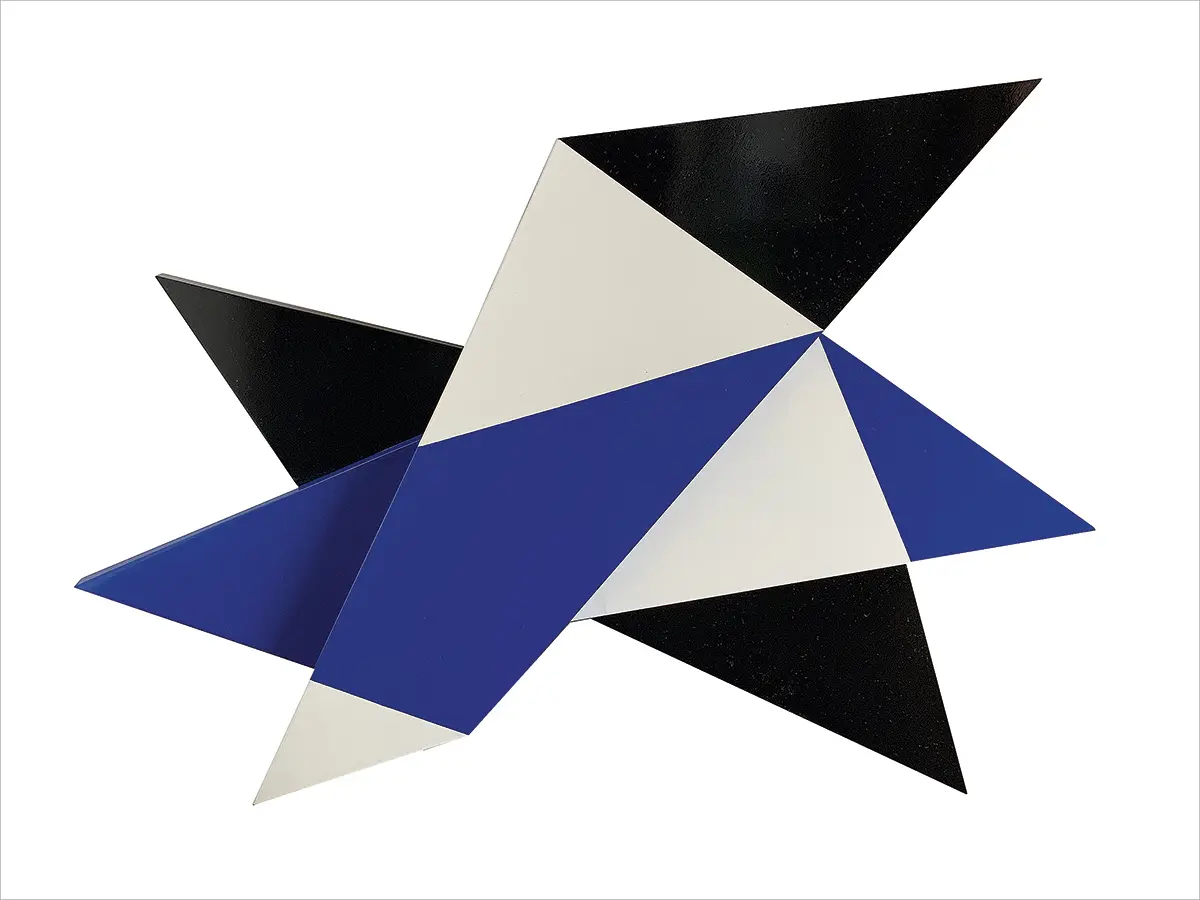
From the entrance, our gaze is drawn to the right corner of the piece described above; two triangles have been painted directly on the walls, forming a kind of open pyramid. The museography works as an installation and brings together five paintings (in acrylic on photographic prints, 2019) of different sizes and colors (yellow, black, and white; red, gray, and maroon; blue, gray, and black), arranged on the two corner walls, both inside and outside the red space. This architectural ensemble, with spaces in space, has been energized not only by the dazzling vermilion but also by the vigor that the accompanying structures give off, creating additional complicity through the dominant triangularity of these pictorially intervened photographs. Other works, such as Floating Origami in Blue (2019), are accompanied by virtual images created by the light reflecting these colored triangles on the windows.
Alejandra Laviada’s exploration in the field of photography, pigment, form, and color is in full evolution. Her exhibitions allow us to follow the advancement of a young artist who has managed to find a unique place in a Mexican context where geometry lived its glory days during the 1970s, when Mathias Goeritz, Manuel Felguérez, and Helen Escobedo opened this path, followed by Federico Silva, Hersúa, and Sebastián. By renewing the pictorial and formal discourse inherited from her elders, the artist offers us a contemporary look at the links between geometry, photography, and color.
CHRISTINE FRÉROT