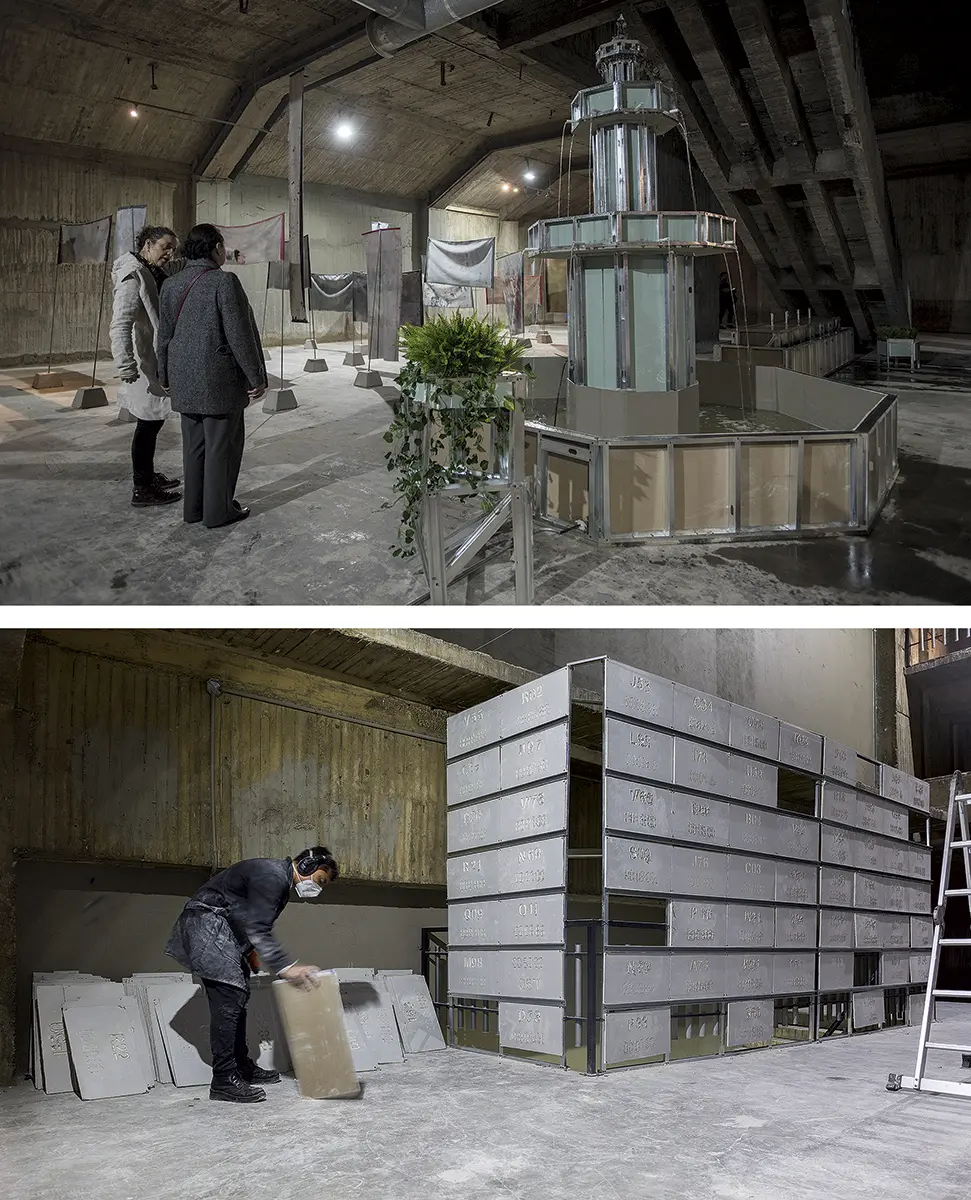
On the first floor, flags turned into rags, soiled, where one could barely distinguish the symbols of so many socialist revolutions. At the back of the space, the staircase that took me to the second level, where I was greeted by a “functionary” very much in character. He gave me a ticket with a number indicating my turn to be received, and took me to a waiting area. I sat down facing a sharply defined, hypnotic, black-and-white video of an industrial process: machines repeating their routine right in front of my eyes. After a few minutes, an authoritative voice called my number: 53! I answered and went up a second staircase. Another functionary greeted me and verified my number, while, with a serious expression in his face, finished carving “53” on a gravestone. As dust flew around us, he invited me into a separate space and calmly bolted the gravestone—my gravestone—next to those of other visitors. For this work, Gabriel Zea used the entirety of the space, presented symbols in crisis, used performances by a group of young individuals as a tool to sharpen my experience, and made me part of a system where I was actually an excess, a useless remainder; a system that chews and spits all of us out. A capitalist system that, it seems, absorbed all other possible alternative ideals and leaves human remains in its wake as it continues to function. The title of the work was Monumento al tornillo desconocido (Monument to the Unknown Bolt).
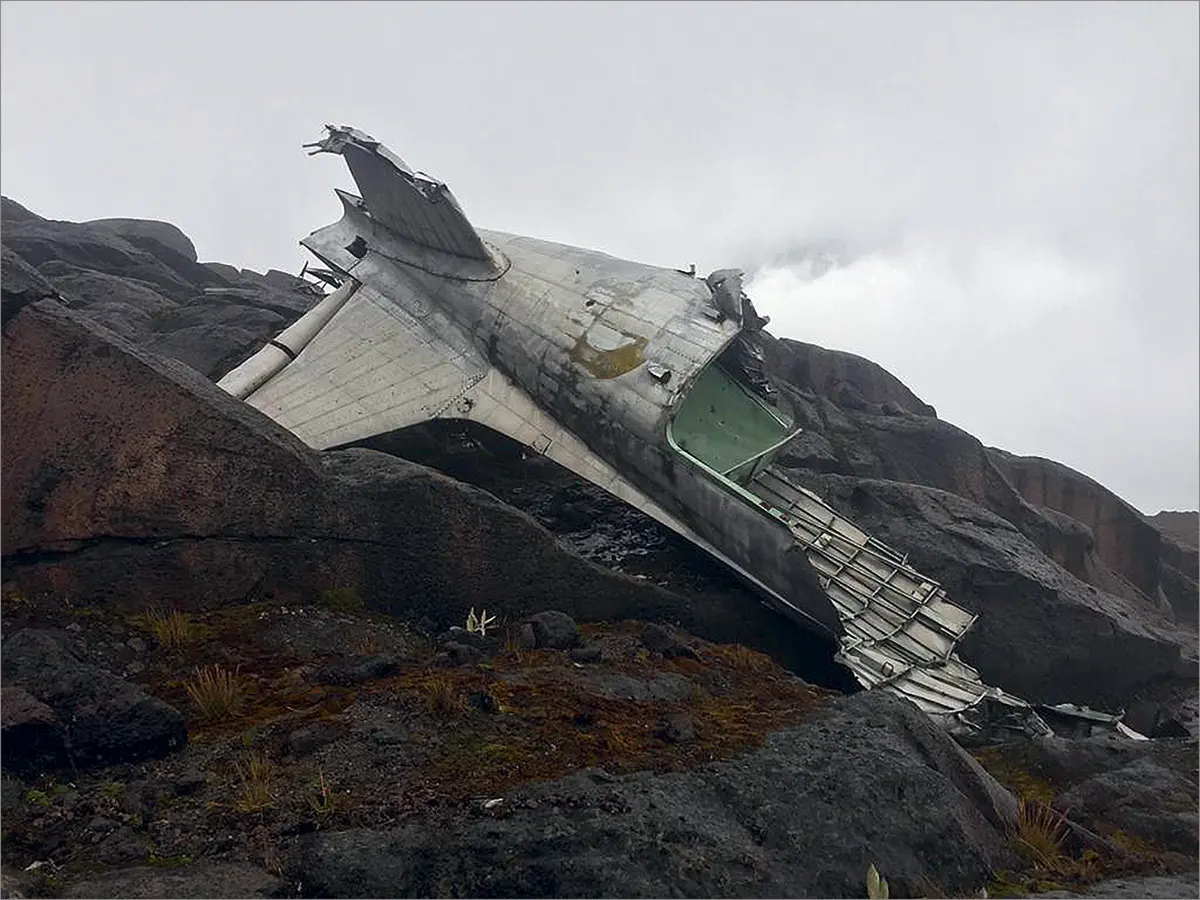
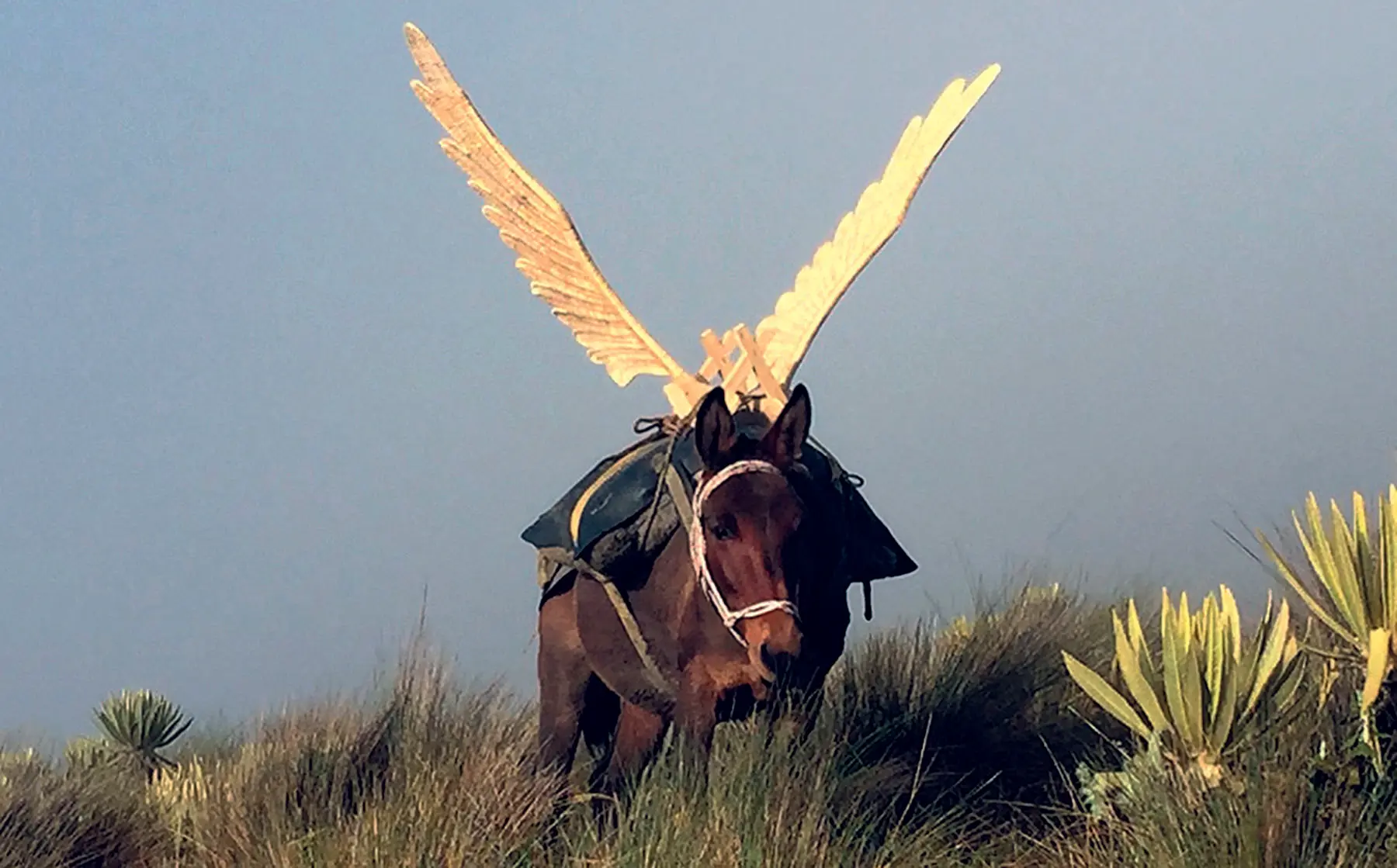
In the same space, dimly lit and seemingly under perpetual construction, I also saw a selection of videos that will be not easily forgotten. These were videos of air traffic disasters, the crashes of two DC3 planes, of the type known as Douglas, those hardy airplanes of the 1940s. I saw fuselages abandoned on the landscape to this day. Oh, how I like videos where nothing appears to happen: just those broken, still airplane bodies, recast by the fog, the rain, and the light. The space lit up with two videos displaying the partially dismantled structure of a DC3 fallen on the beach at Solhaimassendur, in Iceland, in 1973, and another one, broken in half, that crashed at Nudo de Paramillo, Colombia, in 1983. These videos were set to dialog with others, of a mule that wandered around the heath at her own leisure, outfitted with prosthetic wings, in truth a kind of saddle transformed into wooden wings that resembled Leonardo’s drawings for his flying devices. Occasionally, the mule used her leg to probe the entrance to the plane at Nudo de Paramillo. The title of this work was De la mula al avión (From Mule to Airplane), and it was presented by La Decanatura, a group formed by Elkin Calderón and Diego Piñeros. These images sufficed; no additional object was required to prompt reflections like Alejandra Sarria’s about the permanent failure of a stable Modernity in Colombia. La Decanatura found a way to speak of that impossibility by means of an indifferent mule who, at a pace rather different from acceleration, carried a set of wings that provided a plastic view of the Colombian moorland’s wetness, rather than any desire to fly. I don’t intend to quote Kant, of course, but there are times when the imagination jumps forth and presents what Reason has long been saying without being heard.
I have a powerful memory of these two works of art. I saw them in late 2019, when we didn’t yet know of confinements or pandemics. The streets had not yet died, as happened in 2020. The streets of Colombian cities, with their neglected poor and their four million unemployed. Both works intervened the same space, the Monumento a los Héroes (“Memorial to our Heroes”), a kind of hollow building crowned by an equestrian statue of Simon Bolivar, situated in the midst of Bogotá’s abundant car traffic. It is good for art to intervene and interrupt dereliction and hero-worship.
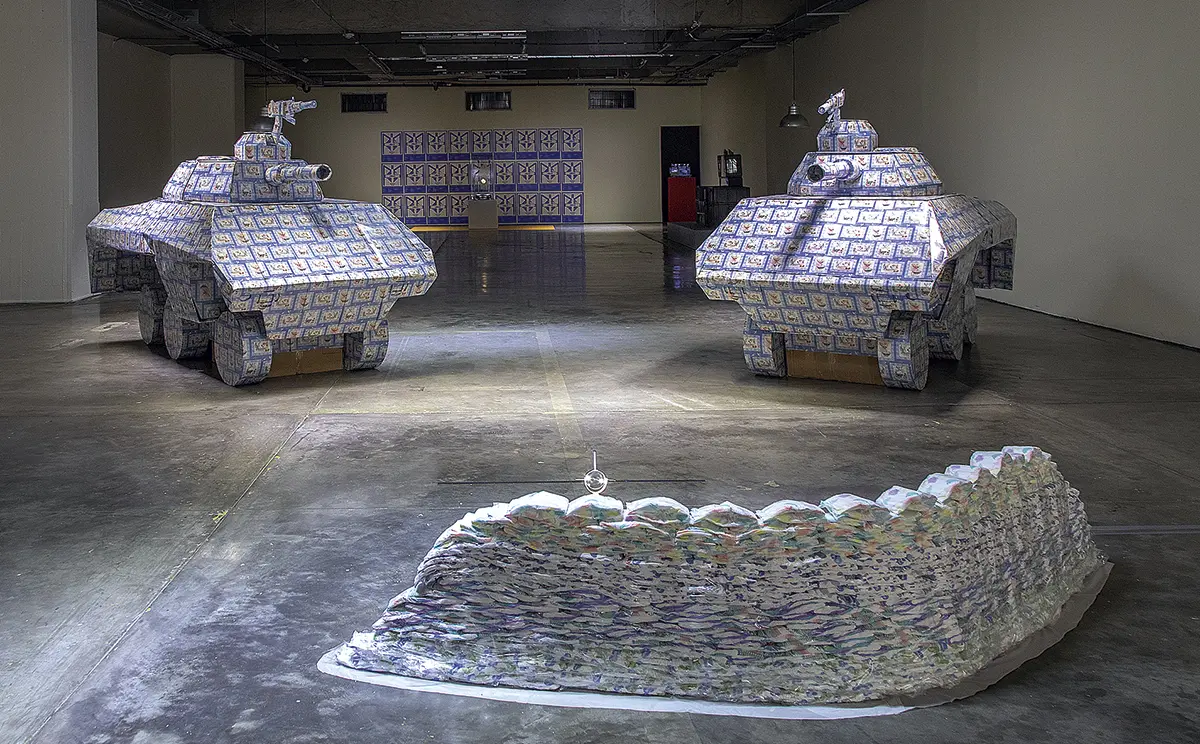
But today I also remember Carlos Bonil’s Suelo turboso (Peaty Soil), displayed in the Luis Ángel Arango Library. “The word turboso has become relevant in my work as an artist,” Bonil says. “It describes a jumble, a profusion of disparate objects and matter in a pregnant state. A turboso soil is composed of dead organic matter on a humid location. The gases that are expelled in such conditions corrupt the oxygen and slow down decomposition (...). The difference is that the material I use is inorganic.” This quote describes the work well: hodgepodge pileups of industrial objects and technological refuse that occupied the space following no formal rules, revealing only the shape of entropy, of agglomeration, but—as Bonil says—an agglomeration that expects to be gathered, to be thought. A work of tensions like those in an apocalyptic film. But neither can I forget a giant object, a military tank wrapped in gift paper with folk images of the kind uses to commemorate a First Communion. Suelo turboso: a work of art on the whirlpool-like perception of history, a promiscuity of objects at various levels, of memories and unredeemable industrial objects. “Death is the only industry that survives,” Bonil says.
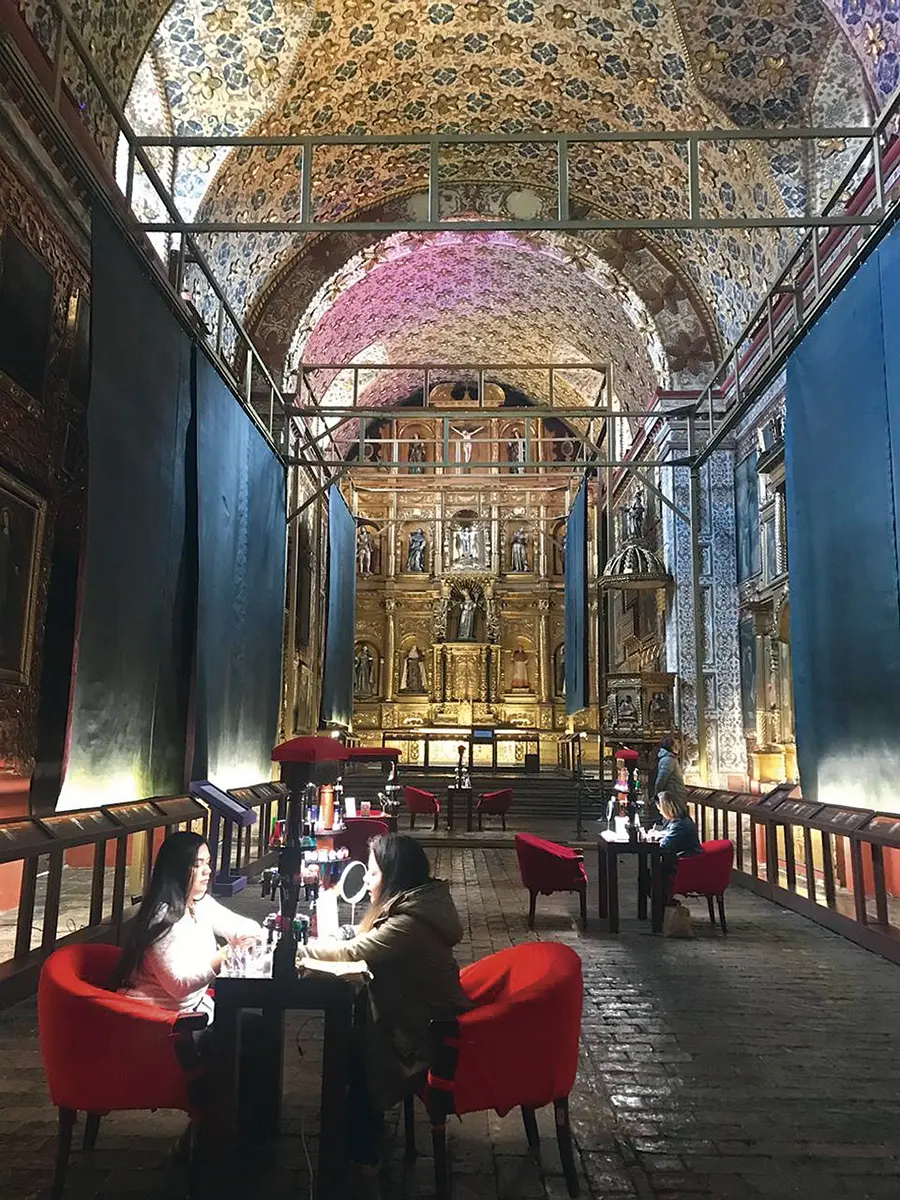
I was also left pensive and “touched” by my visit to the Church of Santa Clara, in Bogotá, a Seventeenth-Century construction of florid Baroque splendor, filled with religious images that the artist hid partially behind curtains. I went into the main nave and found a number of small spaces for manicurists, all focused on tending to my needs, concerned with my comfort and the most appropriate coloring for my nails. They took pity on the dryness of my hands and recommended the best oils. I understood that the story was intended to inscribe these women’s spot-on discretion as they touch others and initiate conversations. Eduar Moreno’s Provocar el archivo (Provoking the Archive) sought, then, to include the excluded in History, along with the emotional situations they touch.
Speaking frankly, these four works were for me the best of the 10th edition of the Luis Caballero Prize, for the way they gave themselves not to any known formalization intent, but to chaos, to disaster, to the process of dispossession and accumulation, and to the warm proximity of attentive individuals whose services should certainly matter. All these processes dictated the form and reminded me of Robert Smithson’s dictum, which I’ve cited many times before: “The future is lost somewhere in the dumps of the non-historical past.”
It must be said at this point that the Luis Caballero Prize is a competition open to Colombian artists 35 and older, established in 1996 by the government of the city of Bogotá and its Cultural Affairs department. The projects selected for the Prize occupy various spaces around the city; the support provided to the participating artists, and the spaces themselves, result in increased opportunities for experimentation.
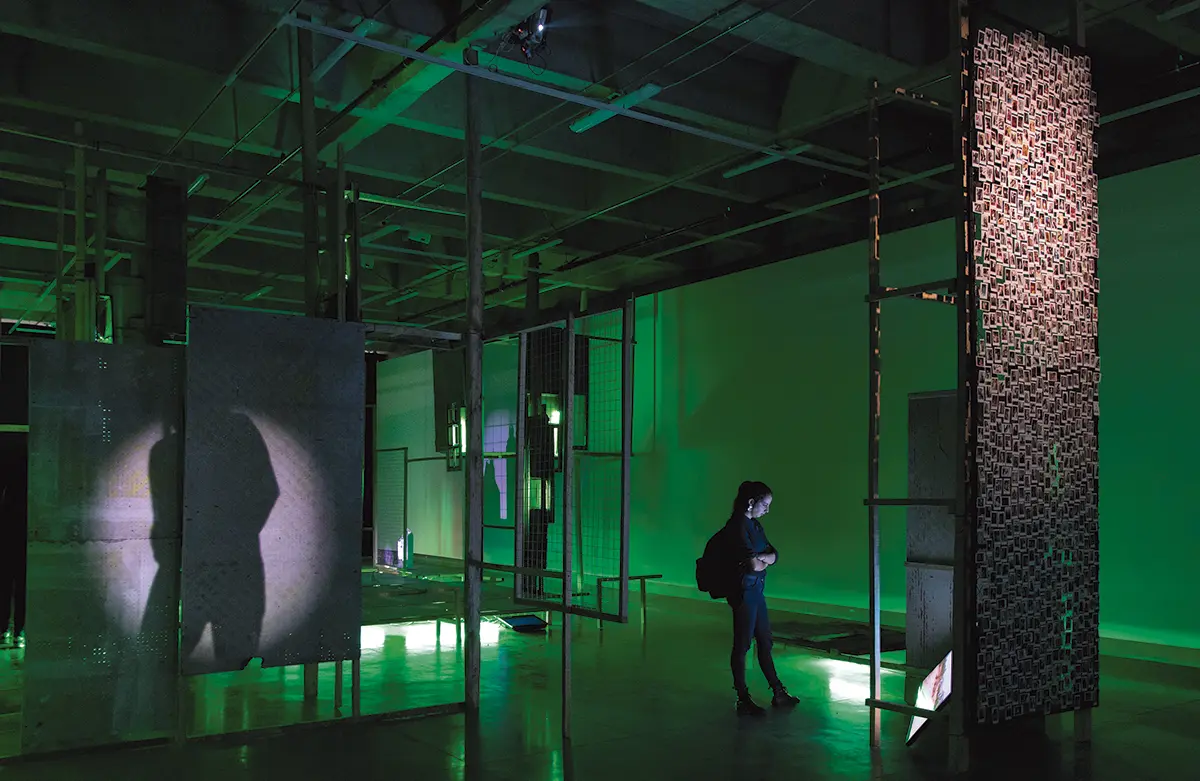
The winner of this edition was Edwin Sánchez’s Torcido (Twisted). It is yet another archive, but in this case one in a sociological vein, focused on life in the marginal city in the midst of the globalizing forces of tourism and the market. It is unclear why the municipal governments of many Latin American cities promote the painting of façades in their poorest neighborhoods in festive colors, which in places like Bogotá, Medellin and Rio turns those areas into a background for tourist selfies. The first section of this work was precisely an elegant denunciation of this phenomenon, with giant video placards that read, in white lettering against a black background, UPDATING THE CITY´S SHAPE TO THE PROFILE OF GREAT CITIES OF THE WORLD… and a video of smiling tourist extending their hand, with a silent Bogotá as their backdrop. The second section was the unfurling of an entire archive of people, construction materials, and documents of life in the Santa Fe neighborhood, located in a strategic area of Bogotá and transformed into a zone of prostitution. Presenting this archive seems to me a way to warn of the threat that “revitalizing” market forces pose for Santa Fe, which could meet the same fate as the streets of The Bronx or Bogotá’s own Cartucho, the renewal/cleanup that swept away most of their denizens or left them adrift. Despite its good intentions, however, this work exalted a scopic regime that, as Ana María Lozano would say, need to be exposed for its contributions to our scission from nature and from others.
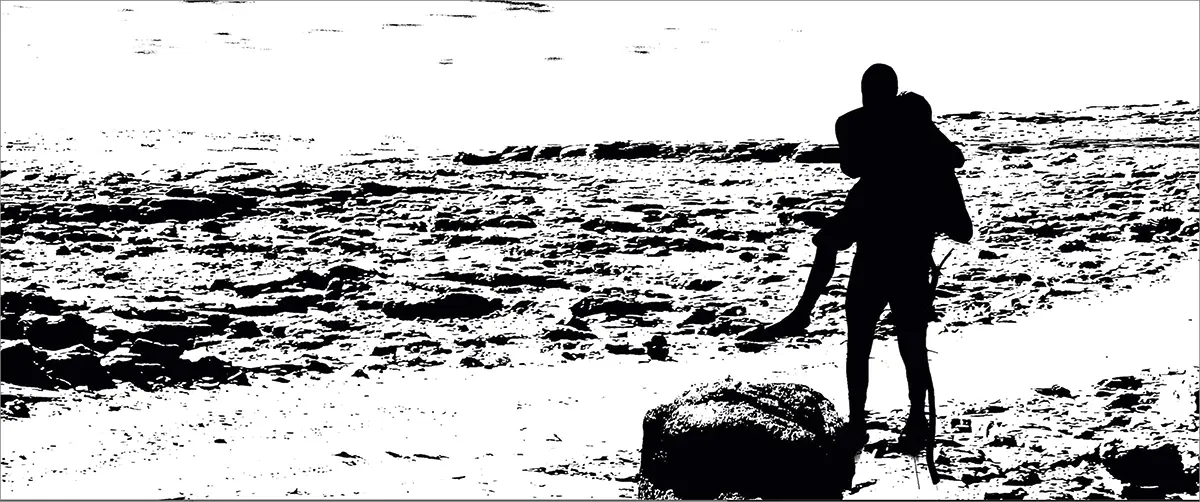
María Elvira Escallón also chose to explore the country’s political realities, an arduous decision that this time around took the shape of a brief, symbolic video narrative. En el fértil suelo - La travesía (On the Fertile Ground - The Journey), the figures of a disabled man and a blind man leaned on each other, like a parable of the mutual support that human frailty requires in order for life to recommence in the aftermath of war.
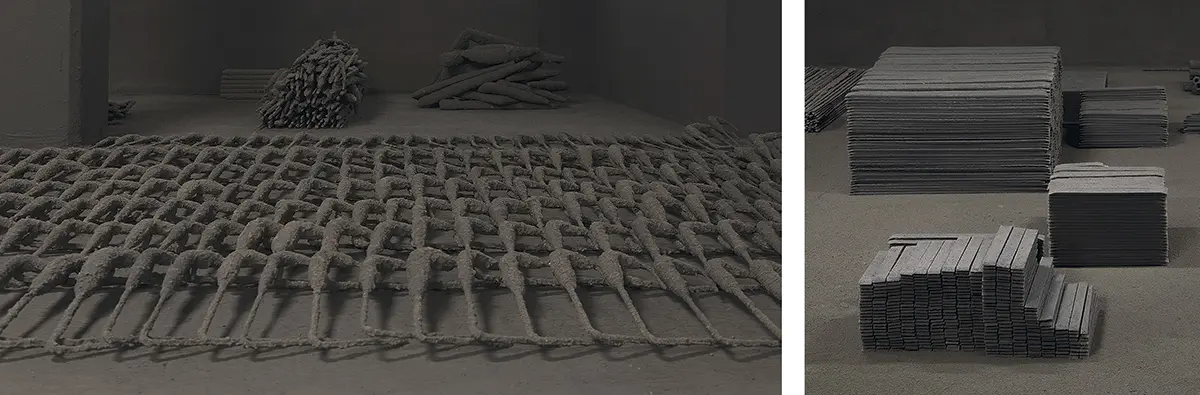
On display in other spaces were works that paid greater attention to formal aspects. These were works where we also intuited the plunder that can sometimes be glimpsed in the news and is quickly hidden, and biodiversity was equally present, but such realities were presented in, and even designed for, a proper museum experience. I am of the opinion that the work of art actually conceals experience when it takes it to so orderly a formal plane; the voice of a limpid configuration, which certain spheres of modern thought designated as art, ends up gaining the upper hand.
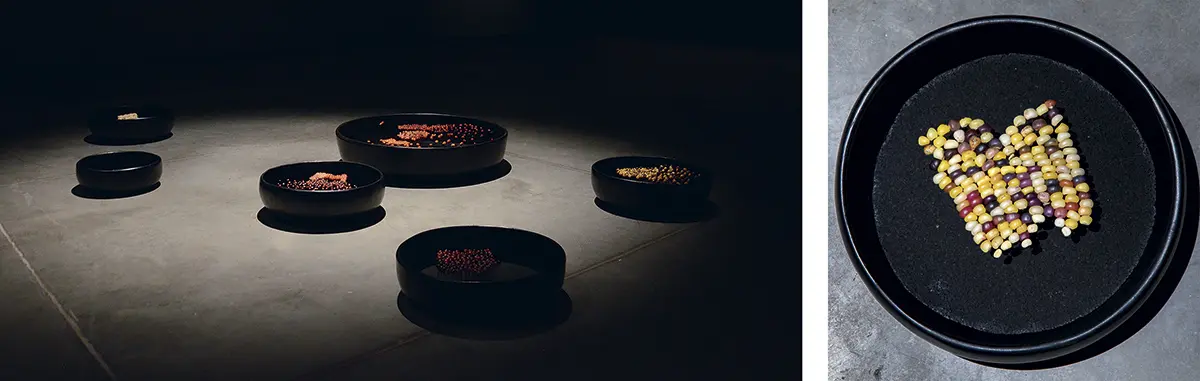
Delcy Morelos’ Moradas (Dwellings) transformed Santa Fe gallery into an impressive dirt room, the impeccable floor and walls covered in dirt, with fragments of building, of doors, of waste perhaps, buried away from our view and our understanding. Also at Santa Fe gallery, taking advantage of the nearby La Concordia market, María Buenaventura presented Alguna vez comimos maíz y pescado (We Once Ate Corn and Fish). This work salvaged seeds that the artist describes as infinitely diverse: “Diverse and varied seeds in shifting colors, spots, patterns, drawings, textures, and shapes are maíz gato, pajarito, dominó, rojo, arroz and porva corn from the seed guardian Fabriciano Ortiz, and native pira corn from the July 20 market. The spots in them are the expression of restless, playful genes that guarantee variability and adaptive potential.” To confront a world of small things intentionally hidden from view and of peasants who play a central role yet are deprived of voice, the artist arranged and carefully illuminated her seeds on plates, wrote short texts to explain her intention, and organized feasts as a complementary activity with activist artists and organizations of river defenders. Perhaps the beautiful word festín (feast), at the center of it all, could have provided an account of ecosystems in the plural and of nature’s variability.
This version of the Luis Caballero Prize left me thinking in the middle of a paradox. Even though I believe that art must help us see what the system hides, we must reflect on how much reality “art” can take in before it becomes sociology. Yet, on the other hand, we must also reflect about how formalism can become obsequiousness. We must think through the regimes of seeing that grant power to vision alone, and, perhaps, build spaces that reflect reality, but with the freedom of our imagination.
*Courtesy: Archivo Galería Santa Fe.
NATALIA GUTIÉRREZ