The constant hum of machinery saturates the environment. It comes from the aeration and irrigation equipment that keeps the large coca-plant lab created by Ximena Garrido-Lecca for the Proyecto AMIL galleries in working order. The lighting—low fluorescent lights installed along the pipes used for the watering and hydroponic cultivation of the coca plants—reinforces the laboratory-like feeling.
Lecturas botánicas: Erythroxylum coca (Botanical Readings: Erythroxylum coca) alludes to a life cycle—the plant’s—materialized in the configuration of the installation itself: as we move further into the space, the plants become larger, from young shoots to stronger stalks, suggesting the idea of development; at the same time, the metallic plumbing system that contains and irrigates the plants no only extends through the exhibition area, but at times traverses its walls (bringing to mind Garrido-Lecca’s 2015 project Arquitectura del humo [Architecture of Smoke]); finally, there are stairs above the irrigation structures, making it possible for visitors to walk around the exhibition in its entirety, and for gardeners to tend to the plants.
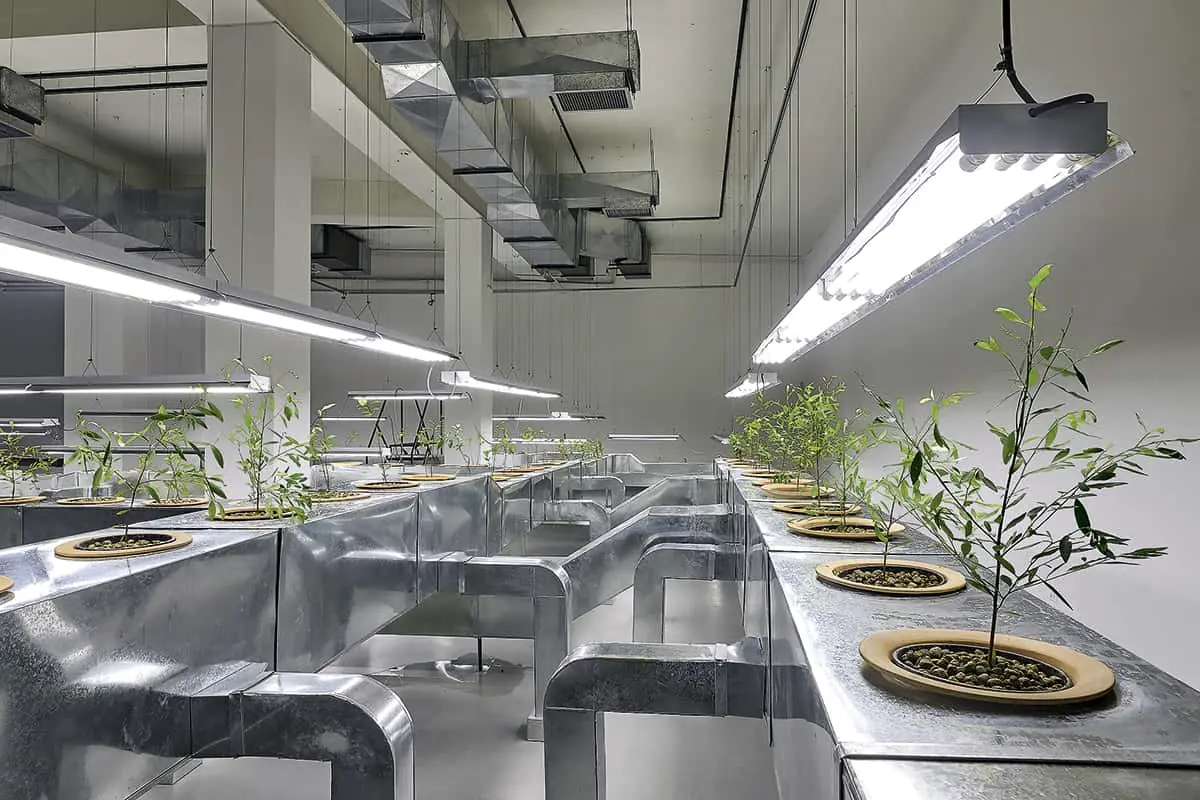
The location of the gallery—Proyecto AMIL is in a basement—prompts associations of seclusion and hiding, which sets in motion imaginings of clandestine drug laboratories. But, against the image of a chemical lab, what is in play here is some kind of high-tech gardening, as the artist experiments with hydroponic cultivation.
However, the leaf processing cycle implemented by Garrido-Lecca differs from the agricultural as much as it does from the chemical/pharmacological; rather, it sets in motion a mystical and esoteric reference that infuses the entire project, and even names it: the “botanical reading.” The reference is to the reading of coca leaves, which is literally done through a program of soothsaying sessions conducted by a research team from the Metaphysical Eastern Sciences Institute in a room specifically reserved for that purpose.
The leaves used in those readings are processed in a separate space by lab-coat-clad students from the National Agricultural Sciences University, who use the material to create a botanical sampler. This peculiar herbarium is also a catalog of the questions that guided the leaf-reading sessions. In that way, these documents bring together Western scientific discourses (connected to the study and cataloging of plants), ancestral mystical traditions from the Andes (through divination practices), and the present-day realities of local peoples, via their desires and anxieties, and the uncertainties in their lives which the reading of coca leaves attempts to answer.
The cumulative aspect of the process of creating those herbariums opens the project up to other interpretations, of a more sociological bent. The samples form a botanical cabinet where they are cataloged according to the concerns that underlie each reading: romantic relationships (predictably, the largest number of entries), work, money, family, marriage, divorce, children, health, projects in general, real state, travel, business, and school and training, among others, giving rise to an expanding botanical-mystical archive of everyday life.
But just as Garrido-Lecca’s work explores people’s life cycles, these trajectories are necessarily mediated by the coca leaf. In that sense, the overarching question posited by the artist revolves around our way of relating to the plant, which emerges simultaneously as a cultural symbol, a product, raw material, and a living being that demands care.
Garrido-Lecca implies a historical timeline reaching back to the pre-Columbian past and extending, through the isolation of the alkaloid in 1855 and its use as an analgesic in the late nineteenth-century, to cocaine’s boom years as an illegal drug. This timeline makes it possible to establish a continuum between the coca leaves chewed by Andean peasants, the lines of coke sniffed by a Wolf of Wall Street wannabe at any party, anywhere, and the leaves used in a divination session (for instance, one held during this exhibition), thus articulating together ancestral beliefs and traditions from pre-Columbian times, savage forms of capitalism and necro power, and our existential concerns.
Ximena Garrido-Lecca opens, then, the question about the transfers between science and belief, modernity and the premodern past, and life and death. And in a country like Peru, both in the history of the nation and in the small daily dramas of its people, the ancient coca plant seems to always appear far away on the horizon.