“What I Really Want to Tell You”, the phrase that gives this revealing exhibition its title, comes from a song by Chico Buarque, Meu Caro Amigo, debuted in 1976 in a climate of uncertainty, twelve years into a military dictatorship that would last through 1985 in Brazil. The show explores sociocultural tensions and paradoxes in the images of identity in Brazil and, by extension, Latin America. Curated with intelligent sensibility by Jennifer Inacio and Flavia Macuco, What I Really Want to Tell You places its visitors in the state of expectation that the phrase, as intimate as it is social, implies. Buarque recorded the song and sent to a friend—the playwright Augusto Boal, then in exile in Portugal—who had been asking about the situation in the country; the phrase concludes with a popular expression: “…is that things around here are black.” The adjectival use that identifies blackness with badness is among the ways in which perceptions of class and race are socially constructed throughout the continent.
The conceptual-art pioneer Anna Bella Geiger also used the song’s refrain as a background in her videos Mapas elementares (Elementary Maps) I and II, of the same year (1976), where she is seen from the back, drawing maps while the song tells about people yelling “Goal!” and mentions the usual rainy and sunny days, yet insists on things being “black” in Brazil. Geiger draws maps in order to subvert social imaginaries; she knows maps to be “the representation of the world, with all that implies in terms of control and domination.” In Brasil nativo/Brasil alienígena (Native Brazil/Alien Brazil), Geiger deconstructs cultural stereotypes by means of a parallelism between postcards depicting activities of indigenous communities in Brazil, and photographs where she and other urban denizens attempt to replicate them. Geiger embodies the role of the artist-anthropologist and uses her photographs to appropriate the soul of her own culture, exorcizing all manner of hegemonic, stereotype-making gazes and, above all, the exercise of exclusion. Similarly, Gabriela Mutti deploys maps as a resource, representing them in fragments of an old medal in Partidos brasileiros (Brazilian Parties), from 2017.
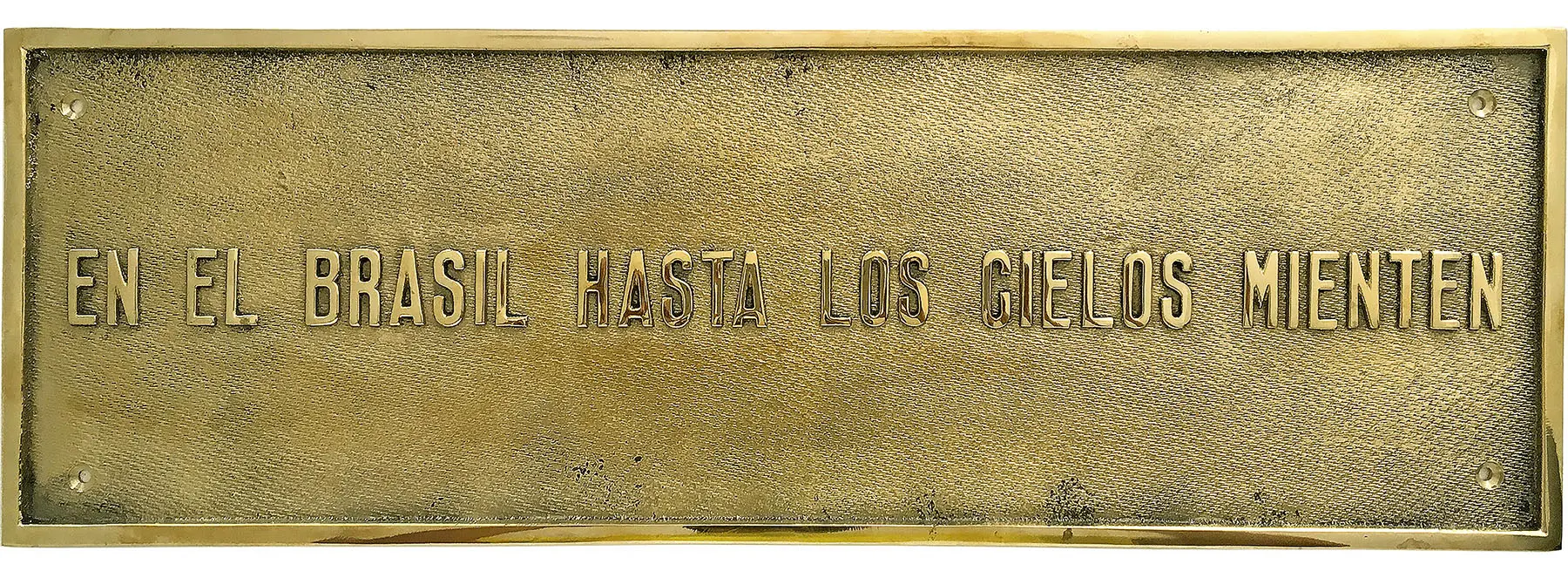
Two contiguous works by Ivan Grilo extend the commentary about the dictatorship era into the contradictions of the present. From his series of relieves with texts in bronze plaques, one of the most striking statements is featured in the exhibition: “In Brazil, even the skies lie,” 2017. Next to this still-current quote from a Seventeenth-Century sailor, we see a painting of the sky with twenty-two stars and a plate containing five more transparent stars. The latter are a reference to the number of states that were dissolved and taken down from the country’s flag during the military regime. Painting and installation are here the mechanisms for a poetic action invoking a common memory.
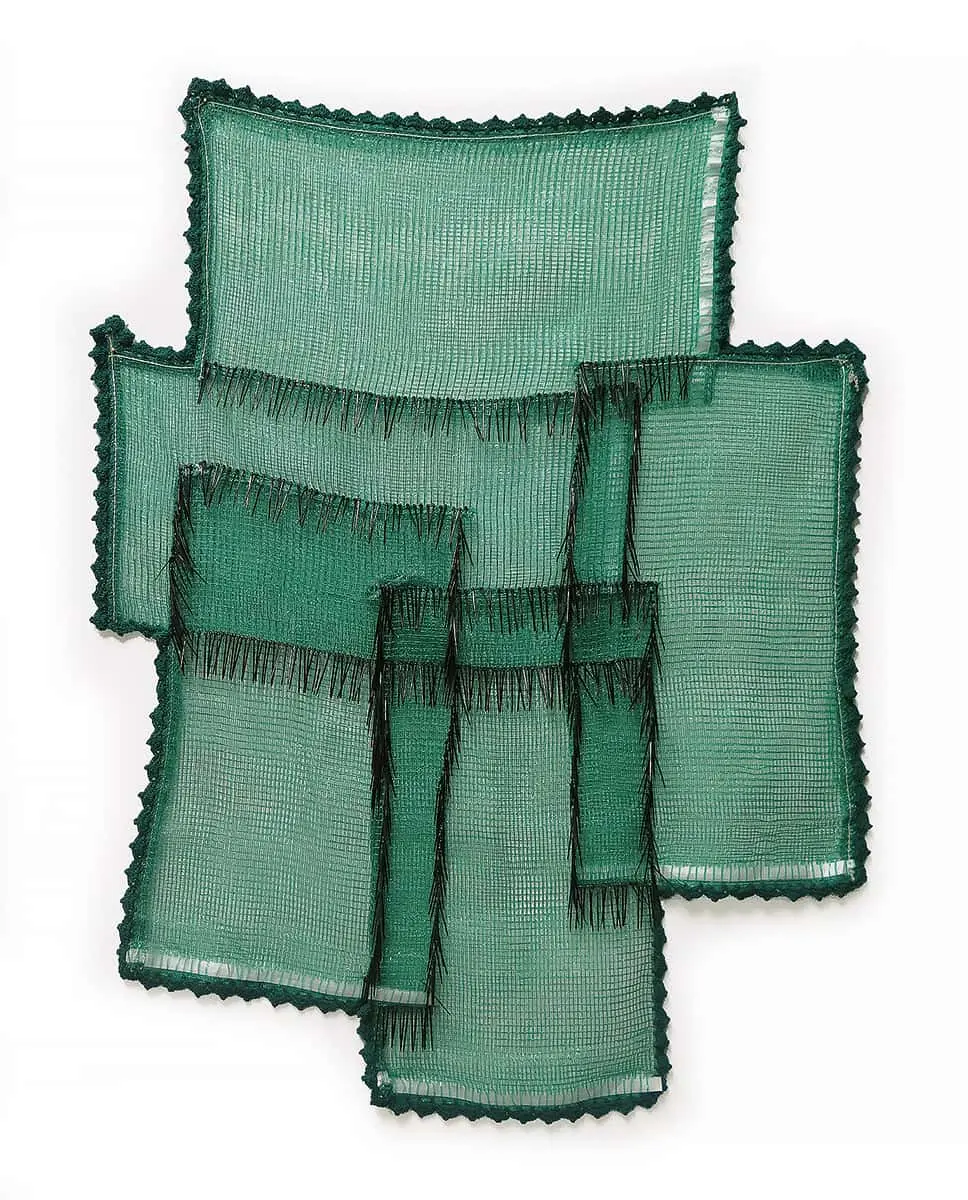
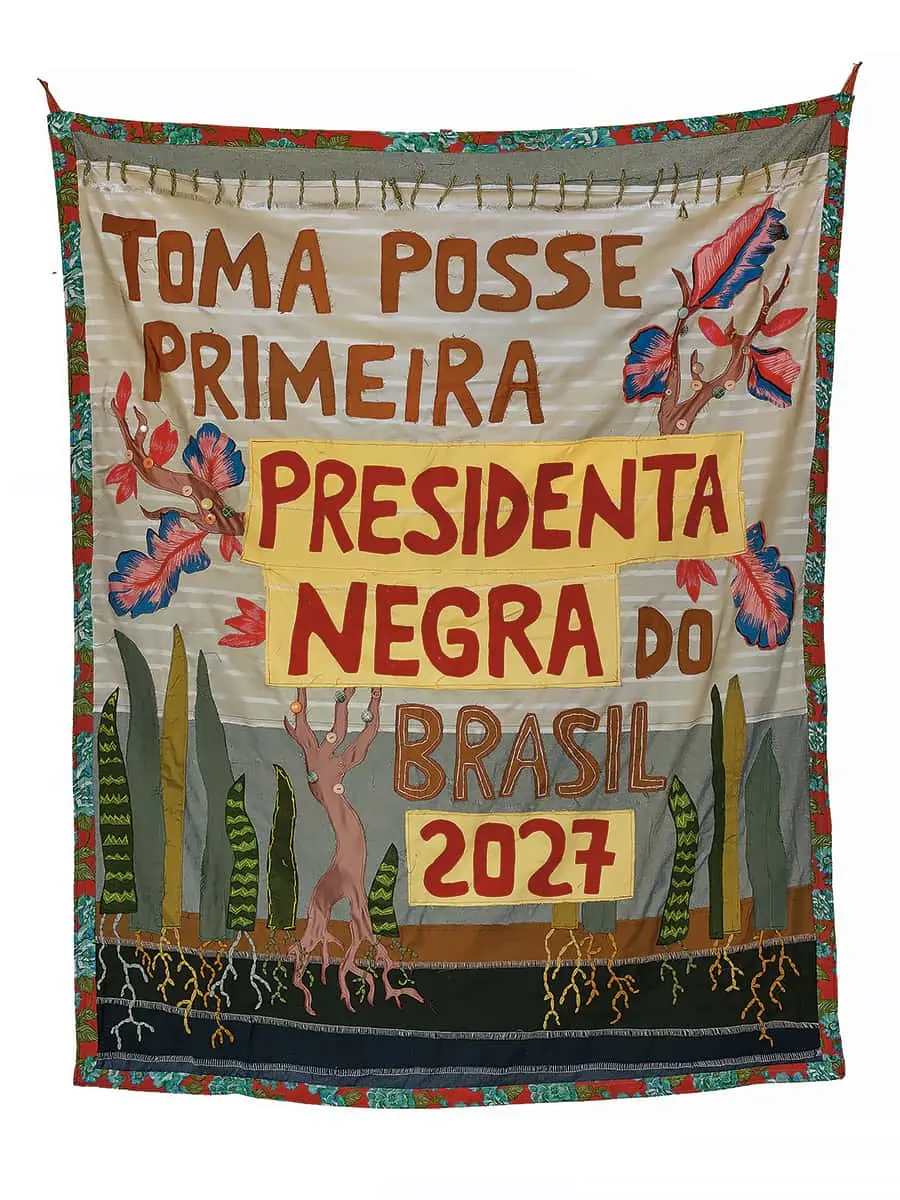
Mano Penalva uses materials like packaging plastic to parody the “order and progress” of a geometry that in Brazil was initially associated with a dream of modernity. One of his panos, or cloths, displays the colors of the Brazilian flag with white feathers. The circulation of objects that move from the market to the art sphere and are charged with critical, yet never grandiloquent meanings is key in Penalva’s art. Humor, and the dismantling of stereotypes through the use traditional techniques and folk materials that bring them to the fore, are active elements in several of his works. Randolpho Lamonier’s Profecias (Prophecies) series attacks the abyss of present-day social imaginaries from the standpoint of a speculative future. Two sewn and embroidered rugs announce such events as the inauguration, in 2027, of Brazil’s first black female president.
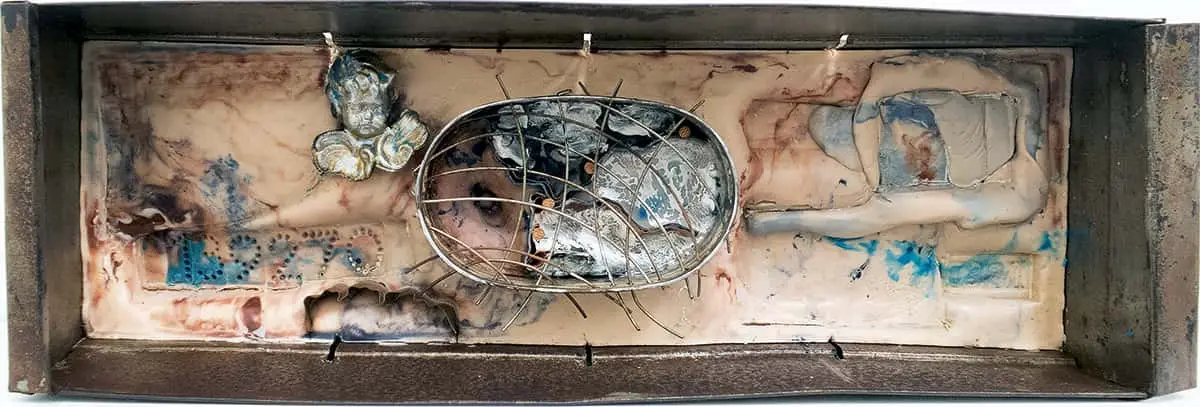
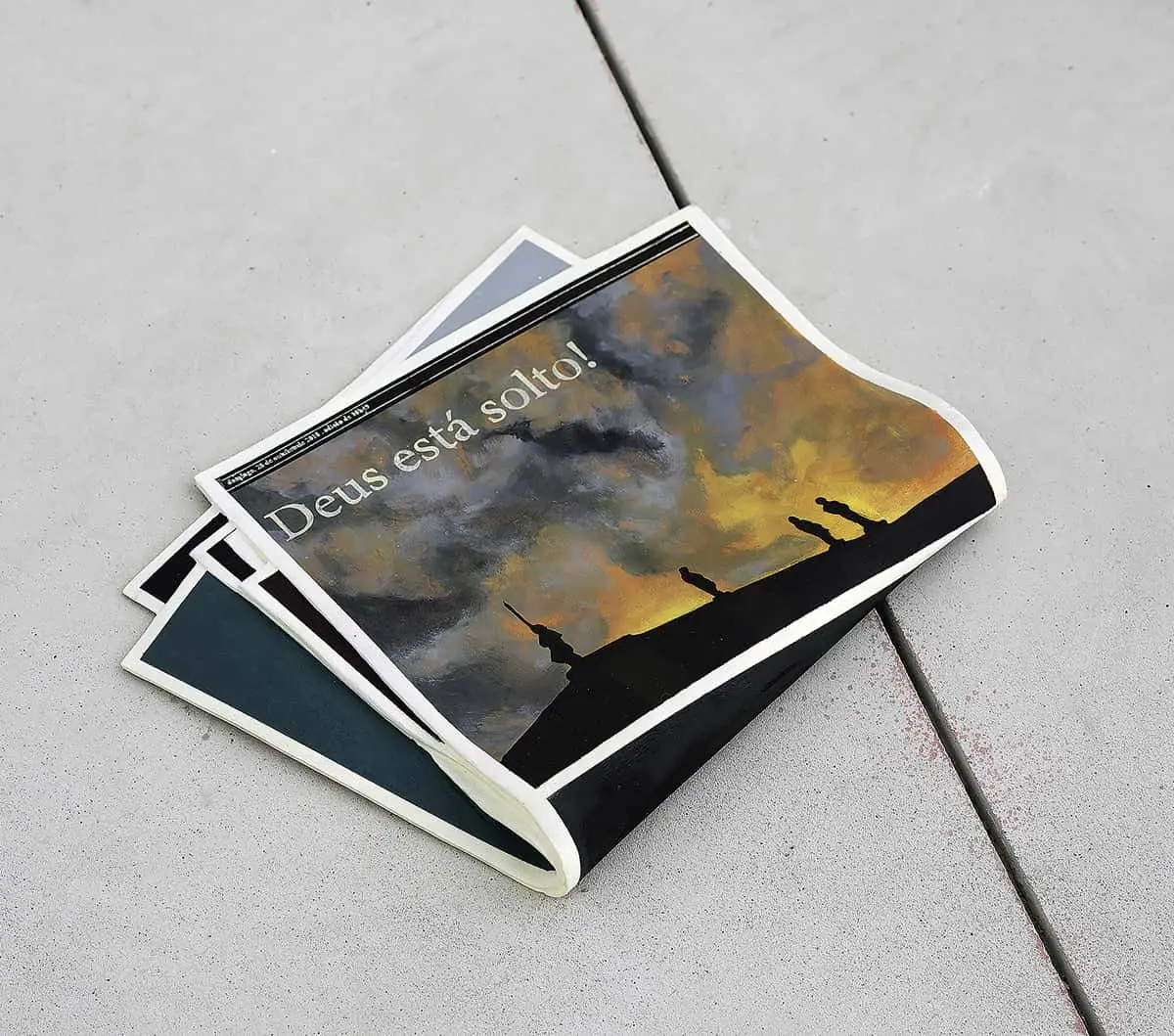
The exhibition includes a historical work by Paulo Bruscky, a pioneer of mass media-based conceptual art, who documented in images his own death and burial as an analogy of the end of artistic freedom under censorship. Vanderlei Lopes extends the strategy of the false advertisement, but in this instance the incendiary newspaper left on the floor with an apocalyptic image proclaiming that Deus está solto! (God Is Loose!), from 2018, is a trompe l’oeil: it is made in bronze. And, along with text-based works that refer to the legacy of concrete poetry—also a constitutive element of Brazilian identity—in Sem cruzeiros (Without Cruzeiros), Almandrade uses geometric conventions to signal the degree-zero of the national currency. Liene Bosquê reconstructs the beautiful architecture of her Museu Nacional (National Museum, 2019) using black silicon carbide dust, which evokes the recent fire that devastated the titular building, next to clay remains from a pre-Hispanic culture. In that way, she connects two moments of cultural loss.
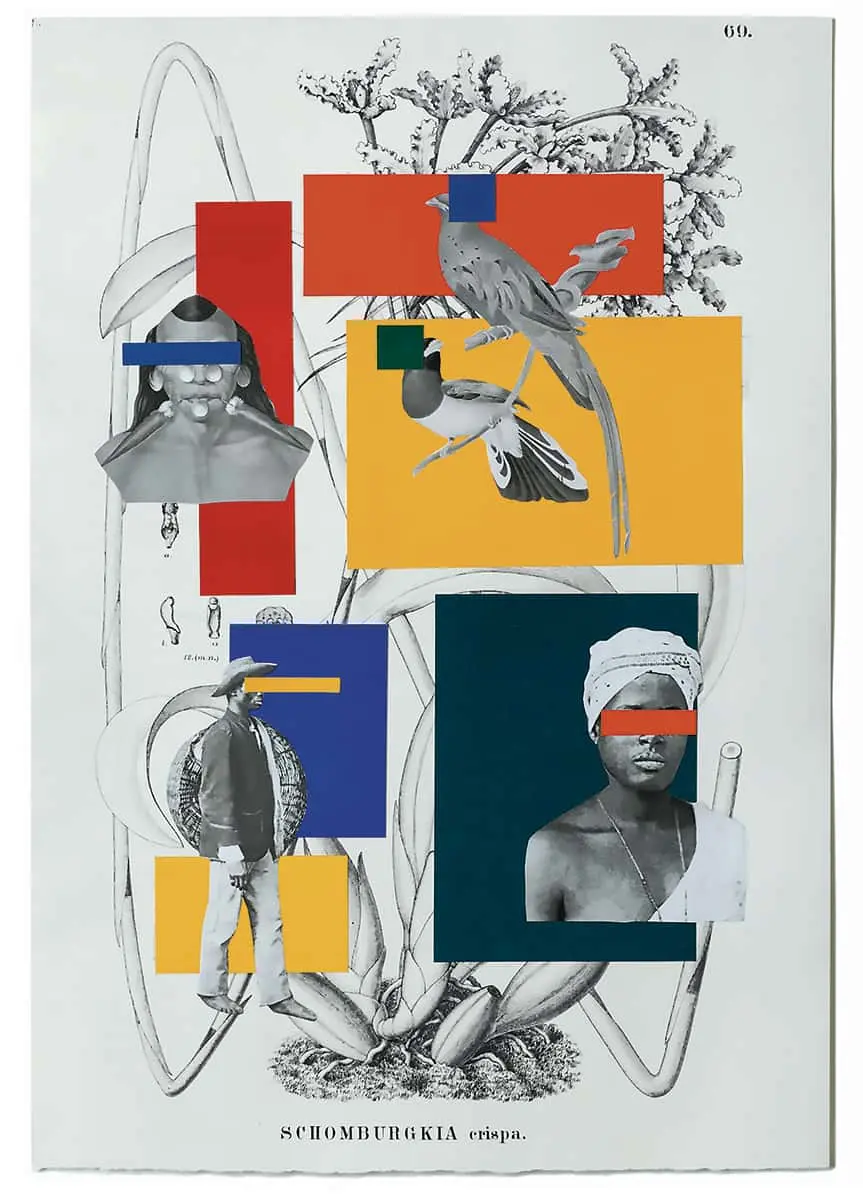
The technique used in Rosana Paulino’s 2018 series Geometria à brasileira chega ao paraíso tropical (Brazilian Geometry Arrives At Tropical Paradise)—digital printing and collage on monotypes—responds to the superposition of several levels of silence and allusion both in the construction of national history and in her own art. Paulino revisits the racial segregation that is tattooed on skins and the exotic gaze that associates it with the notion of the tropical, previously “cannibalized” by Hélio Oiticica in his Tropicália (1967); she retells it all, like the Neo-concrete artist did, through references to exotic birds and foliage, and by contaminating the primary-color rectangles with the foregrounded inscription of the memory of images of the black body, which is also hers. In Musa paradisiaca (Paradise Muse), Paulino deconstructs the negative of a digital image, this time sewing, embroidering, painting, and transferring the omnipresence of African descent onto the narrative of history. The phrase “Yes, nos temos” (Yes, we have), in reference to the bananas of the image, repeats in red letters; the hands appear as in an X-Ray plate; and the face is covered by a white kerchief. Regina Parra’s conceptual representation of a battered woman is, in turn, a neon sign proposing a radical dichotomy in the face of violence, made explicit in the phrase Manter-se aterrorizada, Tornar-se Terrível (Remain Terrorized, Become Terrible), from 2016. Rubens Gerchman’s A Bela Lindonéia (The Beautiful Lindonéia), from 1966, is a landmark in tropicalismo’s attempt to counter attacks from the extreme right by embracing folk narratives. The mulatto woman who dies without having known love, represented here in a manner that cannibalizes Pop styles—Warhol has already painted Jackie O in 1964—is part of an avid, anthropophagical mode of resistance. In this instance, Gerchman’s work inspired a song by Caetano Veloso.
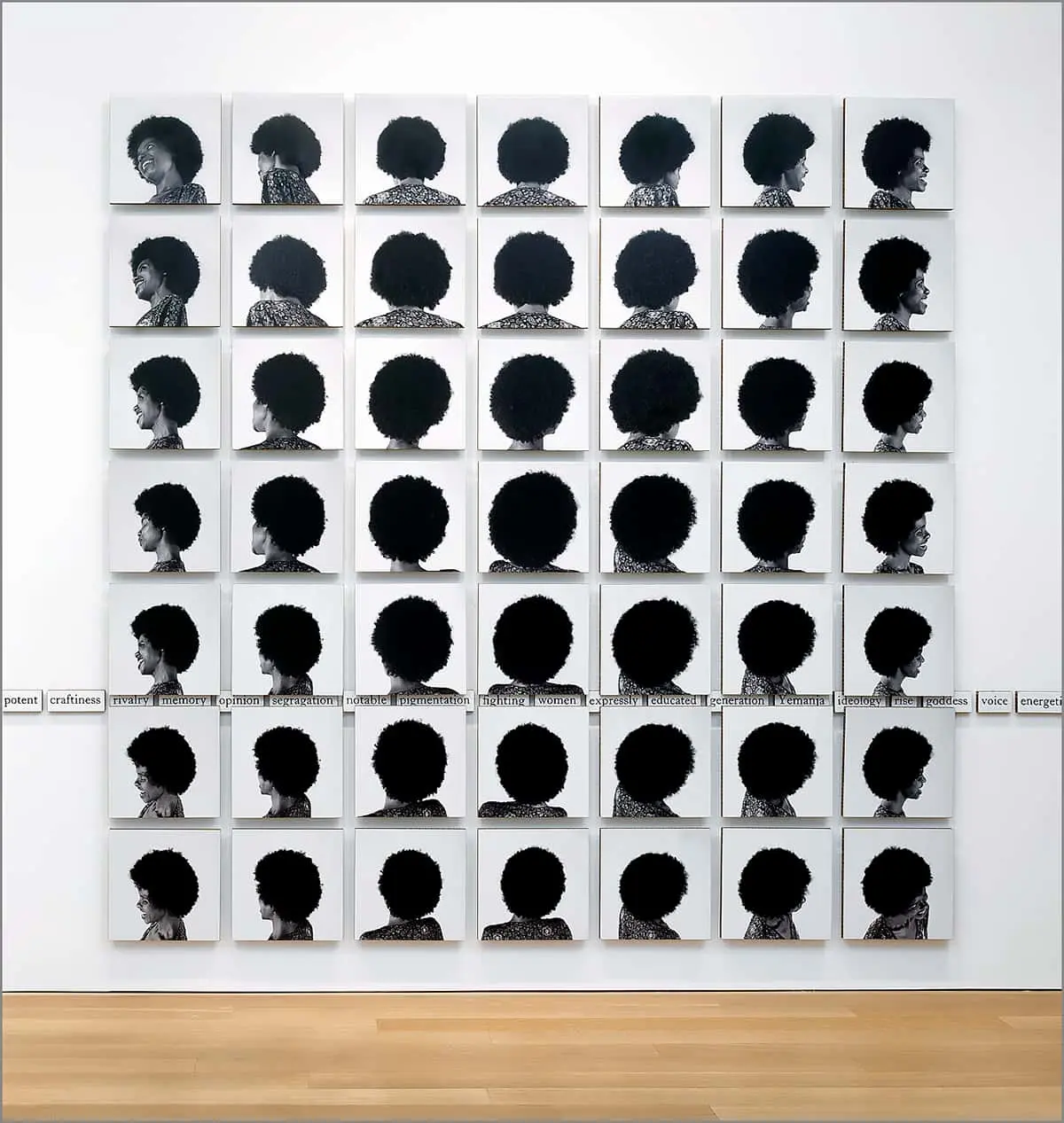
To confront the shameful drive to “whiten” the pigmentation of an entire continent subconsciously still attached to an implicit proportion—the darker the skin, the lower the position in the social ladder—Jonathas de Andrade deploys 49 black-and-white portraits of an afro-descendent model, with her astonishing curls outlining a sinuous circle. The portrait repeats in seven horizontal rows and seven vertical columns, starting with the model in profile and recording the gradual turn of her head, shot by shot, until the face reappears, half-turned. There is also a line of racist expressions, taken from a study of race and class in rural Brazil conducted by Unesco and Columbia University in the 1950s. By way of resistance, the strategies of formal beauty and repetition name and conjugate the title of this 2017 work, Eu, mestiço (I, Mestizo), as a reassertion of the country’s racial realities, in the most mestizo continent on Earth: Eu, mestiço is the first conjugation of a noun that thus acquires the condition of an affirmative verb.
ADRIANA HERRERA