Vasco Szinetar has carried out a sustained exploration of the process of portraiture in its most profound conceptual dimensions. It is an issue that runs through the photographic medium and becomes a meditation about the face as a source for the reading of historical, cultural, and social contexts. More than closed artworks, Szinetar builds open investigations with infinite, inconclusive interpretive possibilities, always attentive to allowing relationships that connect different situations. The validity of Frente al espejo (In Front of the Mirror), has remained intact over the years and has solidly positioned it as a classic instance of the representation of the self-portrait. Although it has been described as a predecessor of the selfie, its greatest significance resides in the double interplay of gazes it posits (between his face and that of the guest facing the mirror, both seeming to look out at the viewer). After some time abroad, Szinetar returned to Venezuela with a haunting reflection about the decay of public spaces, faces, and bodies. That inspired “Cuerpo en exilio” (Body in Exile) and “El ojo en vilo” (The Eye in Suspense), recognized by the Internatiomal Association of Art Critics as the best exhibitions of 2013, and “Caracas Postcards, últimos apuntes” (Caracas Postcard, Last Sketches), in 2018. These exhibitions traced the path of an agonizing approach to the prison of a vanished country.
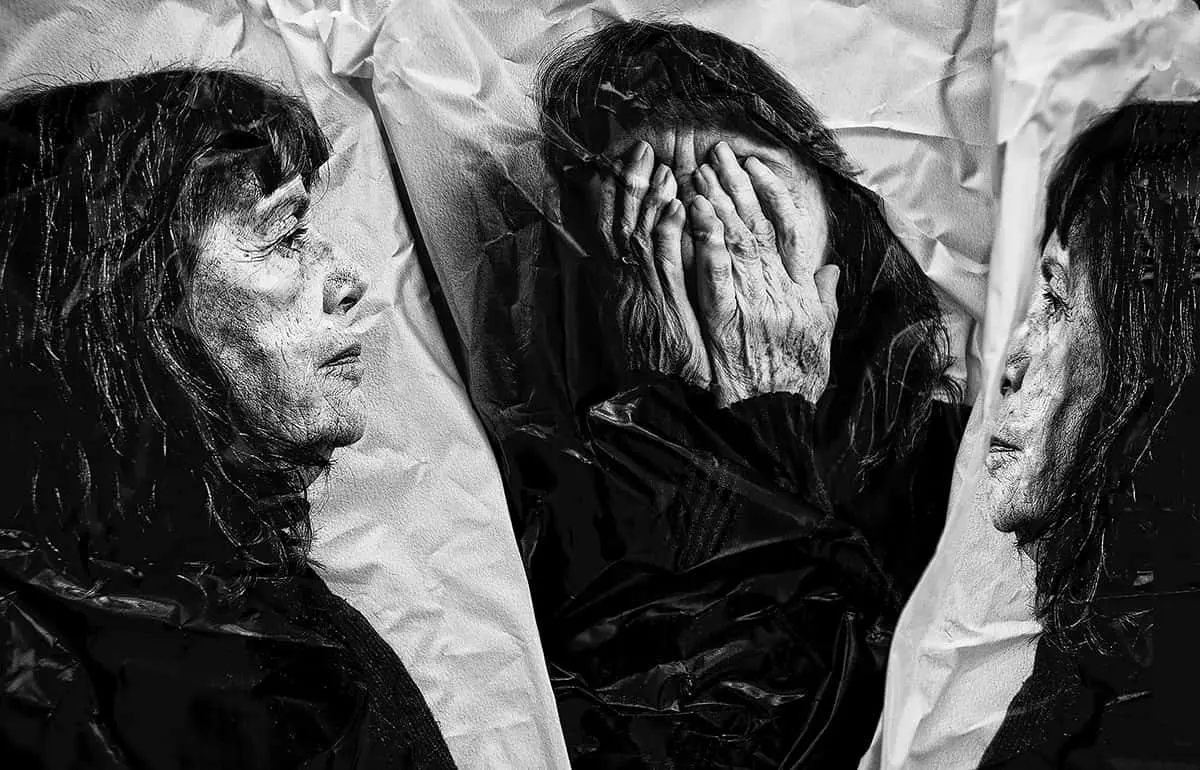
Specifically, the exhibition “El ojo en vilo” comprised a harrowing poetic action of the absent gaze that, in portraits/triptychs of artists and writers with their eyes closed posing as directed by Szinetar, contrasted the front and side view of the subjects in a strange, blind dialog. Szinetar spoke of this series as an exploration where he “reflected about the subject of the gaze and about what did artists look at, whether they looked inwardly at themselves, or outwardly.” The closing of this exhibition marked the beginning of “Deconstrucción salvaje” (Savage Deconstruction). As he took down from the walls his outdoor murals, Szinetar noticed an interesting effect on the tears and wrinkles on the paper: the faces had undergone surprising alterations, which in turn originated new processes. Szinetar reshot his original photographs and, readjusted, each image’s gesture began to acquire an overwhelming force. In the end, he obtained twenty-four inkjet prints on paper, in a smaller format than his 2013 murals, with an impeccable finish that contrasts with the violent irregularities of hands and faces. The neat arrangement and distribution of the works in the exhibition space reinforce the gestural drama that emerges from the interplay between the wrinkles and the paper residue.
For several reasons, this process represents a point of inflection both in Szinetar’s oeuvre and in the development of the portrait genre. First, there are the effects of the act of deconstruction as such: the work originates from a residue, from what remains of a prior experience that already contained upheavals of its own. The new image is built upon the non/being of the earlier one, and the result is a discourse psychological and poetic unity. With no other anchor for the creation of an image than the destruction of the earlier work, this takes us, as viewers, to a borderline zone, a threshold of meaning where, precisely because of its non/being, it is more. Second, there is the dual play of tensions that emerges from our recognition of the personalities portrayed: they are well known artists and writers from the Venezuelan and international cultural scenes—among them Antoni Muntadas, Beatriz González, Magdalena Fernández, Gilbert & George, Nelson Garrido, Sergio Ramos, Vladdo, Antonieta Sosa, Antonio Briceño, Gabriela Gamboa, Amada Granado, Ricardo Armas, Héctor Fuenmayor, Jorge Pizzani, José Vívenes, and Sergio Barrios—they become, even if we recognize them, illegible faces that brutally shatter the unitary notion of identity and transform it in a reflection of the contemporary experience, marked by the shedding of ballast and an imperative determination to survive overwhelming tragedies. They are deprived of individuality, but they gain, in the artist’s words, “an imprint of violence and great suffering that, in a way, is also a testament to what one is feeling as an artist.” This transforms them, inevitably, into ionic figures of the psychology of an era. The work does not end. One disappears into another, becoming infinite for as long as their creator continues to explore and investigate it. Third, the spectral materiality that the image contains—substance with no matter—brings the genre of portraiture and the place that faces occupy in photography to a new level. Szinetar subjects us to a heartrending yet wonderful, beautiful, and terrible experience that in the history of art is more akin to the anguish of Munch’s The Scream, or Bacon’s rendition of the face of Innocent X (or his self-portraits), than to the tradition we commonly and politely call portrait.
MARÍA LUZ CÁRDENAS