The Museo de Arte de la Universidad Nacional presented the exhibition La naturaleza de las cosas: Humboldt, idas y venidas (The Nature of Things: Humboldt, Comings, and Goings), as part of a program of events celebrating the 250th anniversary of Alexander von Humboldt’s birth. Displayed through the museum’s four galleries, the exhibition explored the work of nineteenth, twentieth, and twenty-first-century artists who combined their creative practices with the work of the renowned German scientist, in connection to the idea of nature.
Humboldt’s travels in several countries of what is now Latin America took place as the eighteenth turned into the nineteenth century, and for subsequent generations, including modern scientists and artists, the cultural representations he produced based on those experiences came to serve as a kind of foundational matrix for the creation of an entire imaginary of nature and society in the “New World.”
The exhibition sought to examine the persistence of the spirit of Humboldt’s work in Colombian and Latin American contemporary art, in direct dialog with documents and artworks from the past that seem to echo the cross-breeding of art and science found in the modern construction of the idea of nature, as well as in the appropriation and extrapolation of scientific procedures—such as the logic of the scientific journey, science’s measuring instruments, and its systems of classification—into the art field.
On exhibit alongside works by almost thirty historically significant scientists and artists were proposals by seventeen contemporary figures: Alfredo Jaar, Oscar Santillán, Regina de Miguel, José Luis Bongore, Nathália Favaro, and Gianfranco Foschino, and from Colombia, José Alejandro Restrepo, Liliana Sánchez, Camilo Echavarría, Carlos Motta, David Guarnizo, Andrés Matías Pinilla, Nicolás Gómez Echeverri, Luis Carlos Camargo, Antonio Bermúdez, and Mapa Teatro, and even by Japanese artist Miki Yui. In total, the exhibition featured nearly one hundred items, between artworks and documents.
The exhibition’s curatorial approach posited seven conceptual axes, conceptualized as “dialogs,” in order to explore from a variety of vantages the braiding of art and science around the idea of landscape, or to review the connections between the travel methodologies deployed by scientists and artists, or to arrive at an understanding of how to propose a revision of Humboldt’s figure and oeuvre from a queer perspective. Regarding this last dialog, it is important to mention the ways in which it was able to probe the silence that conventional historiography has kept about the non-normative sexuality of public personalities, seemingly oblivious to the fact that while sex and the pleasures that define it are situated in the private sphere, sexuality and the cultural representations it produces structure the public sphere, and, to that same degree, function as sounding board for the thoughts that circulate therein.
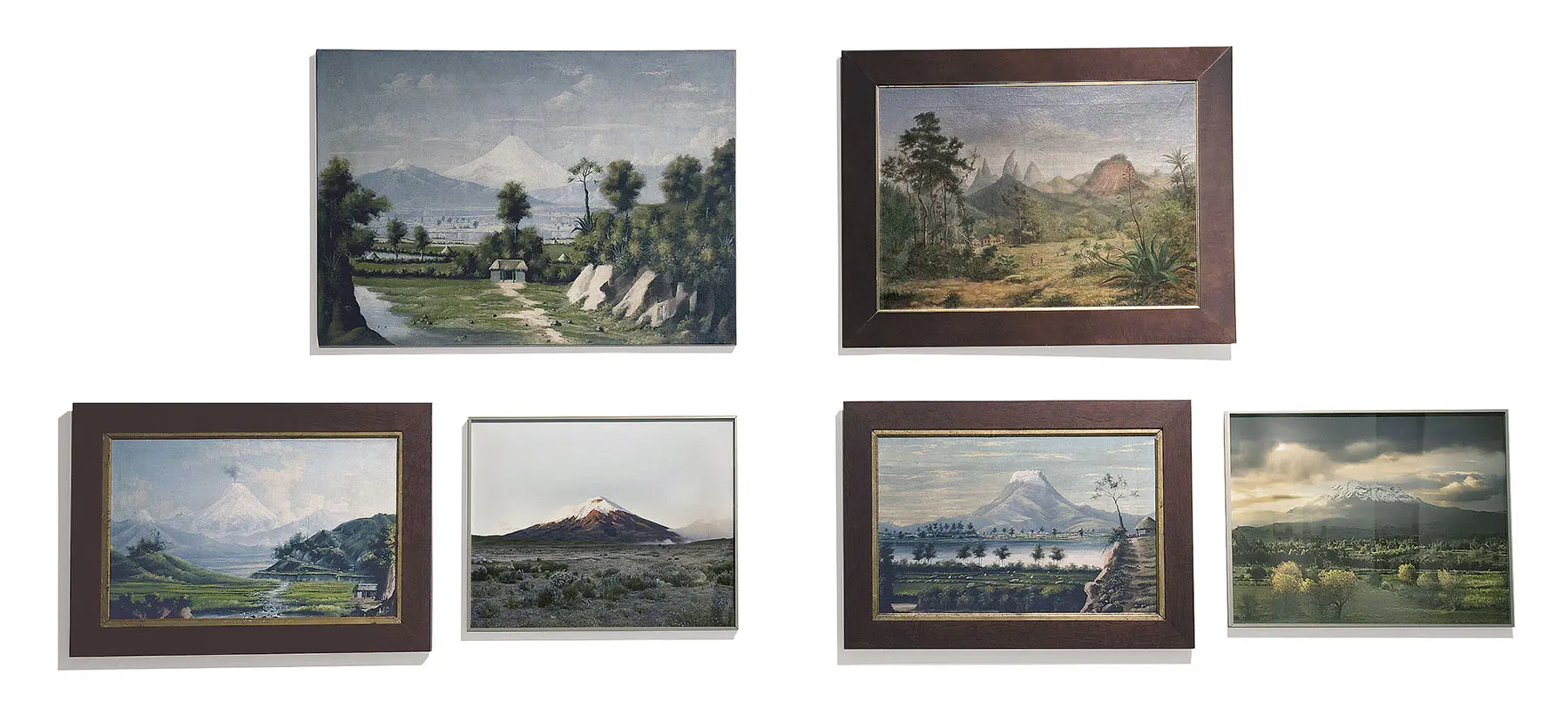
The exhibition’s course through the different galleries set those dialogs in motion, enriched by the heterogeneous cultural references emerging from the artworks and documents to carry visitors from the past to the present, and vice versa. In that sense, the iterative presence of landscapes was key; landscapes are the images that best administer the tensions between scientific and artistic representations of nature. Many of these landscapes were historical items connected to sites of particular significance in Humboldt’s expeditions, and, for that reason, it was important to have them be accompanied by contemporary works that engaged the same locations differently. A standout among the latter was the work of Camilo Echavarría, who exhibited a number of photographs and a video installation. The photographs depicting the Chimborazo and Cotopaxi volcanoes are part of the project Atlas de los Andes (Atlas of the Andes), where Echavarría approaches the landscape based on the relationships that people have established with the territory, involving idealization exercises that take precedence over the perceptual experience of each place. Since these two volcanoes appear in several pictorial works and historical documents in the exhibition, they end up functioning as an actualization of the emotional and subjective charge that the territory acquires when the logic of the landscape is appropriately formed.
Discursive approaches to landscape painting throughout history have tended to interpret it from at least two contrasting perspectives. It is possible that the subject of a landscape is the key fact when it comes to establishing its meaning, given that the specific set of geographical coordinates the represented site occupies can have a symbolic value associated with its social uses. For that reason, the landscape can serve as evidence of the way in which nature is configured by its cultural representations. From that perspective, it is even conceivable that what gives meaning to the landscape genre is the diversity of places it potentially contains.
Another perspective that needs to be considered when it comes to finding the meaning of landscape painting is the subjective experience involved in the artist’s decision to search for the idea of landscape in a specific geographical location. From there, it is possible to achieve a certain degree of continuity between the formal and conceptual features that underlie all landscape paintings. As several authors have pointed out, the pictorial landscape genre seems to precede the encounter of such scenes in reality; some have even asserted that every landscape found in the world is a copy of a previously painted one. In other words, all landscape paintings are copies of copies of copies. This perspective assumes that all landscapes are the same type of spatial situation, made singular only while each is perceived as a landscape. The section of the world that the artist sees as a landscape exists only during the few seconds when light and atmospheric conditions make it appear, indeed, as such. It is with this point of view that the viewer coincides.
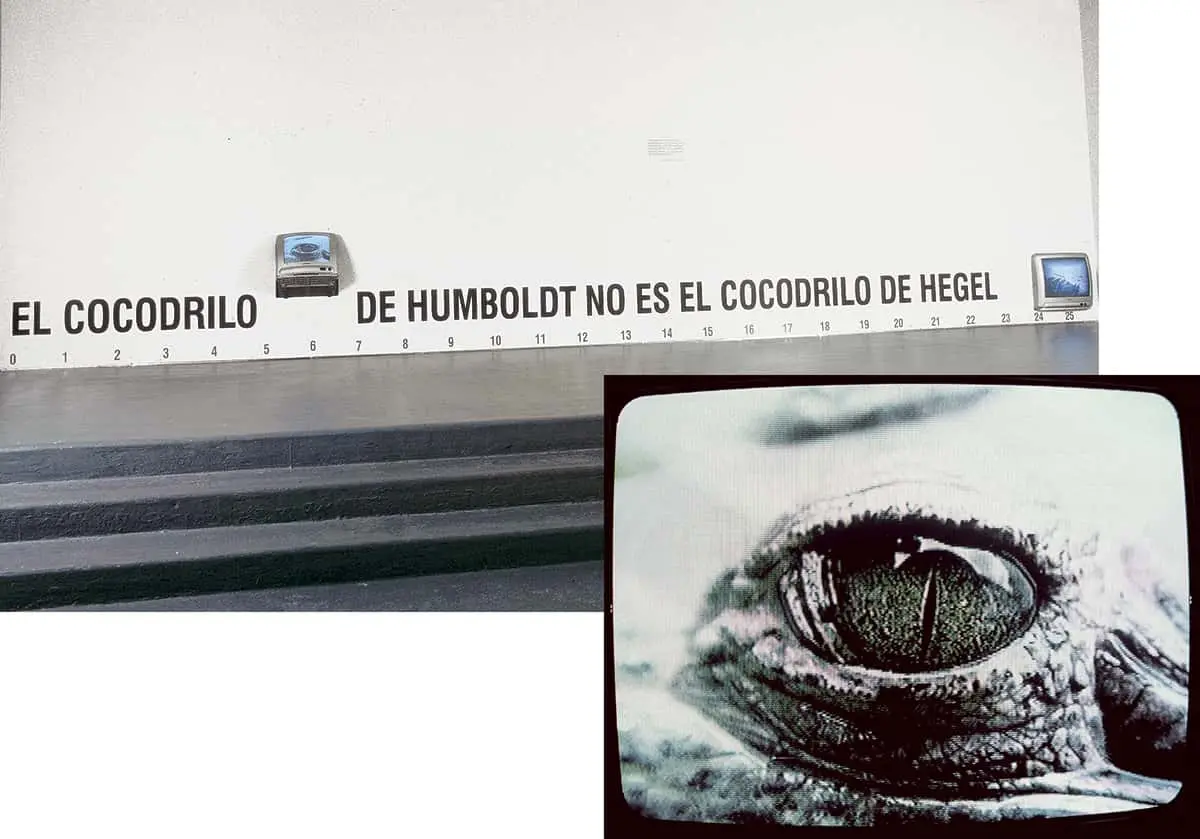
Equally pertinent was the presence of media-based works, such as video installations and other types of temporal process, as was the case with Camilo Echavarría’s Cauca, or José Alejandro Restrepo’s video installations El cocodrilo de Humboldt no es el cocodrilo de Hegel (Humboldt’s Crocodile Is Not Hegel’s Crocodile), which explores the way in which a cultural stereotype of Latin America as a subaltern place has been constructed around cultural representations of nature projected from different instances of power, and Paso del Quindío (The Passage of Quindío), which reviews narratives about the passage between Colombia’s central mountains towards the Pacific coast, where a natural blockage exists that prevented colonization but also fostered the social and economic marginalization of Colombia’s Pacific region by the rest of the country. The image of a porter carrying on his back a chair on which a colonizer sits turns the power dynamics of the master and slave relationship upside down: the slave would only need to lurch slightly for the master to fall off the cliff.
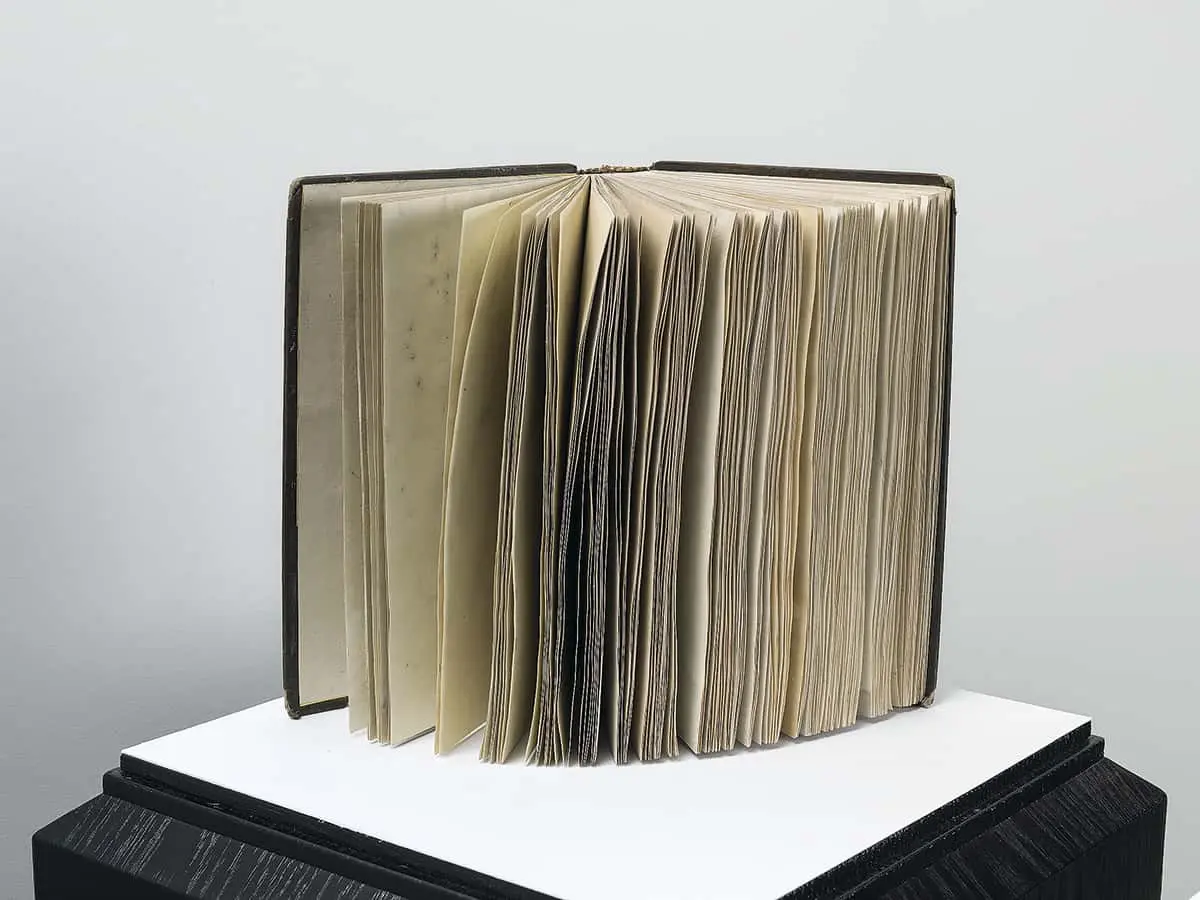
Finally, the presence of Oscar Santillán’s Kosmos was especially significant in the context of this exhibition. It consists in the deletion of all the ink from a copy of Humboldt’s emblematic book of the same title, and its presentation it as a blank slate upon which any history can be written. It is accompanied by the ink, now compressed into a gem-like shape that condenses everything Humboldt said about the universe.
This exhibition demonstrated that many of Alexander von Humboldt’s ideas concerning the notion of nature, derived from his travels in Latin America, have generated many dialogs over the years and that many artists in the region have revised, revisited, and redefined them as they expanded our understanding of the territory we inhabit.
JAIME CERÓN