Jardinera (Gardener) is the title of Susana Pilar’s exhibition at Galleria Continua in Les Moulins, Boissy-le-Châtel, a locality near Paris (France). It opened on October 14, 2018, and, given its significance, has been extended through September 2019. Susana Pilar lives and works in Havana, Cuba, where she was born in 1984. She studied at the Academia de Bellas Artes de San Alejandro and the Instituto Superior de Arte, in Havana, between 1998 and 2008.
Between 2011 and 2013, she was a graduate student at the prestigious Karlsruhe University of Arts and Design (Germany) and earned a diploma in Media and Communication.
The varied techniques in Susana Pilar’s oeuvre account for the artist’s multiple itineraries and diverse resources. Susana Pilar synthesizes different ways of seeing and building. An heir to Cuba’s abundant ethnic overlaps, the result of many migrations, in some of her works she refers to Eastern philosophy and African roots. The spirit of nature is a topic present in several of her works.
Jardinera provides an overview of Pilar’s production in recent years. The title alludes to cultural events and to human-made transformations.
The eclecticism of her sources coincides with the broad range of her techniques. Art as an instrument of knowledge allows her to explore the inner and outer worlds.
Pilar’s videos and installations take elaborate contemporary aesthetics as their starting point, and her language remains identical to itself. She also adds her travel experiences, particularly to the island of Réunion, as shown in the video Kont pa sï bato mon frèr pou sot la rivièr, from 2011. The video was recorded in the island, a French dominion originally populated by colonizers and slaves. The artist asserts her desire to take the possibilities of the body to their extreme by holding a large mirror for one hour.
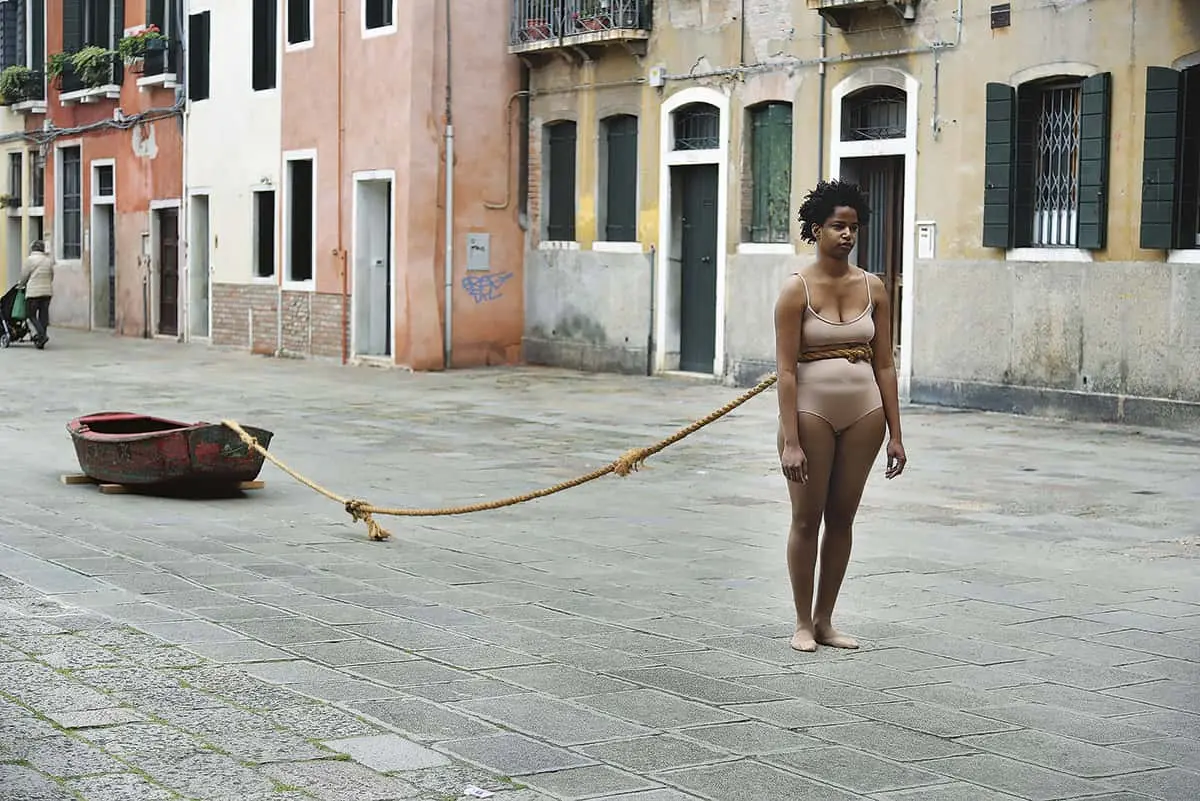
Dibujo intercontinental (Intercontinental Drawing) is the video of a performance presented at the 2017 Venice Biennale. In this piece, she executes the action of pulling a boat by a rope, using the Italian city’s public space as a stage. Pilar’s installations and performances situate viewers outside, prompting in that way an objective, almost scientific view of the act.
Not shying away from social issues in her portrait series Lo que contaba la abuela (What Grandma Told), from 2017, Pilar captures the memory of her ancestors, with particular emphasis on female psychology. The series is made of lightboxes made from wood panels and photographic prints, in variable dimensions, with mirrors in the back. In a simultaneous interpretation, Pilar reproduces emotional states, subjectivities, and surroundings in the portraits of her forebears. Their presences harmonize with a concept of “total art.”
Susana Pilar wields her aesthetic as a scalpel and intercepts the viewer. A kind of empathy emerges through form and image. She stows away and hides the presence of voices, of some elements of memory that, while silent, constitute a sound score. She produces specific sequences that will help different states of consciousness burst into being. The use of mirrors in labyrinth-like installations or as an instrument in her performances is part of her psychological game. Just like a violin player tunes the strings, she identifies and transfers different identities.
The photographs contribute to change the environment or the site in which they are situated and serve as transmitters, amplifiers of vibrations.
From subjectivity to historical praxis, from the particular to the collective, from the individual to the testimonial aspect, the exhibition closes with Llave maestra, photographs in black-and-white digital print of the artist holding a machete. The selection is sober, excellent in its effect and quality. Color is absent for the most part, except for the installation of Un chino llega a Matanzas (A Chinese Man Arrives in Matanzas, 2015-17). Created with silk, China ink, and sound, it alludes to an old relative of the artist who arrived in Cuba in the late Nineteenth Century.
Susana Pilar rewrites the subject of nature and reconstructs a sort of final archaeology in a direct, emotional manner. She composes a space with works of art that draw lines of force, interrogating, and deciphering the essence of the human. By revealing the parcels of history, she also gives coherence to a vision of the whole.
In short, she wishes to demonstrate complementarity and antinomy towards the not always peaceful nature, and culture as a social fact.
As in a silent concert dedicated in part to the logic of nature, it is shown in all its aspects, what it offers us from contemplation, ecstasy, and cruelty.
SUSANA SULIC