Combining the immersive installation experience where the videos coexist with other materialities, Silvia Rivas develops in “Diagonal Force” a new content in her extensive work on the subject of time. Rivas revisits here a plan she had already explored in 2004, in Todo lo de afuera (Everything That Is Outside), an installation based on bodies performing choreographies as they struggled to occupy the same space, holding each other every time one threatened to abandon the fight. A group of people metaphorizing the conflict of impossibility or containment as the essence of the everyday. In Fuerza diagonal, explains curator Jazmín Adler, “that knot is untangled into an individual-based possibility, in counterpoint with its predecessor.” This turn towards the positive was encouraged by texts that resonated and illuminated, which Rivas took care to bring into the exhibition space so that her viewers can read them as well. Rivas notes that her inspiration does not come from ideas or texts; instead, they are entirely intuitive situations intended not to provide a literal rendering of the text, but rather to build, using a variety of elements, a metaphor for her own poetics.
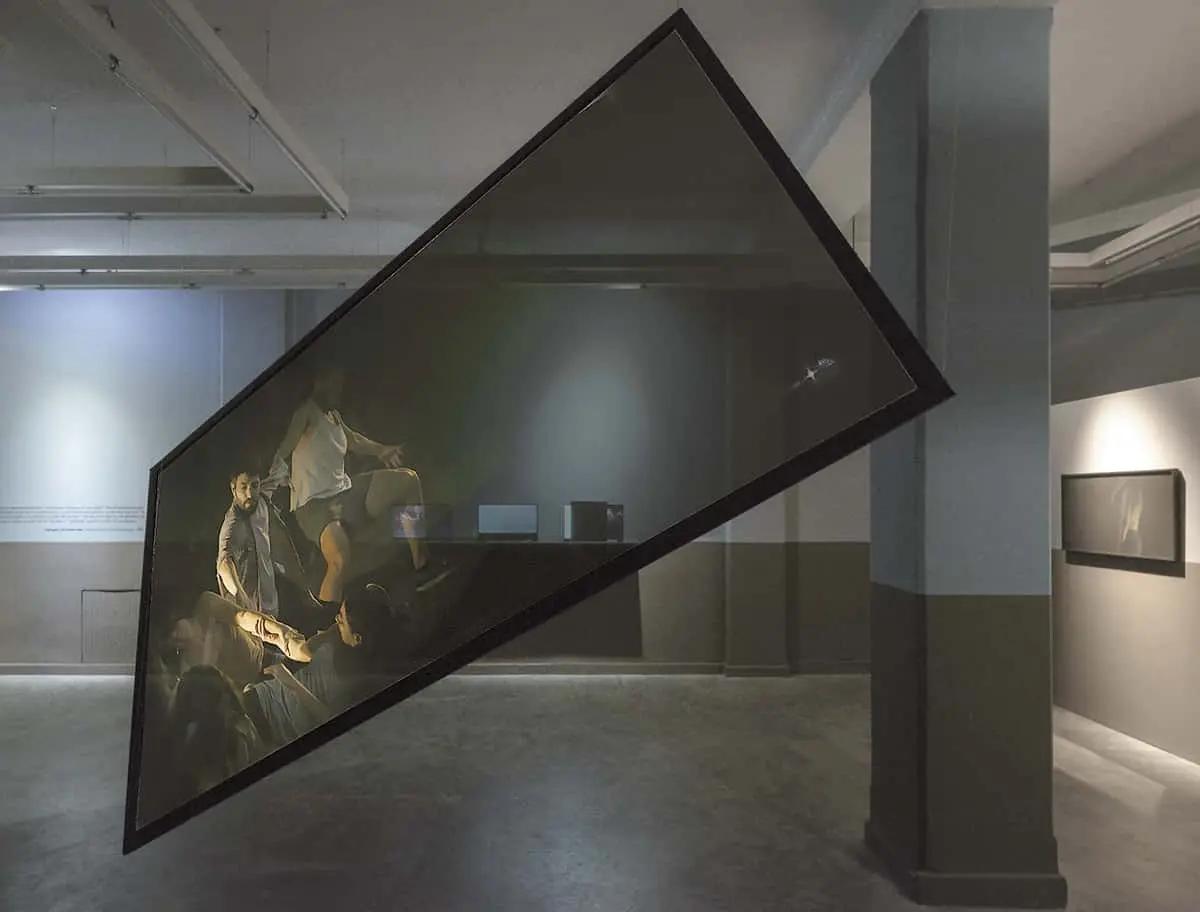
In Survival of the Fireflies, initially published in 2009, French theoretician Georges Didi-Huberman notes an interesting aspect of Hannah Arendt’s Men in Dark Times. It describes a genre of time where “the public domain has lost the power to enlighten” and, for that very reason, we feel not enlightened by reason nor radiant with emotion, but like a depleted force. Meanwhile, Arendt’s Between Past and Future: Eight Exercises in Political Thought presents an argument about diagonal force. Such force is described as a concept that fractures the metaphor of a rectilinear temporal motion by the insertion of human action, which “cannot but cause the forces to deflect, however lightly, from their original direction, and (…) no longer clash head-on but meet at an angle,” producing a gap between the past and the future, a place in time, “a position from which to judge the forces fighting with each other with an impartial eye.” With a small action, an otherwise fragile subject can change the course of something infinitely more substantial than his or her own existence. Transforming this practice into human movement and using a few inclined planes, the bodies in the video play at occupying the same measured space; they jump in order to prevent each other from rising above the boundary marked by a light beam, in a kind of nonviolent, consensual struggle that in some cases, extending to the space outside the screen, is subtly accompanied by other materialities. These can be of the artist’s own creation, like clothes dyed to match the low and medium earthen hues that gracefully accompany the movements; or they can be the rectilinear sandblasting on a glass sheet that is placed before a screen or the square-shaped, fixed ceramic tile plate that hides from view part of the movements taking place beyond it. All of this happens soundlessly, as silence is deactivated by the combined interplay of the walls, the floor, and the ceiling, along with the rhythm produced by devices actuated by the viewer’s motion. Marked on the plane of the room is a horizon where viewers can perceive the above/below of the space; some of the artworks installed are fixed in place and high above the horizon, like evasive replicas. The projection passes through the grid of a large screen, tilted at an angle, to the empty space of a corner, while the jumble of bodies in motion accommodates itself ceaselessly to a small space that reverberates into another, expanded one. Two small screens supported on a tall base come close to each other on an inclined plane and pass one another the same sequence.
In an article about her work, Rivas said: “I think I work basically with time both as a lived sensation and on the basis of its very materiality, but also with space as a vestige of sculpture, and, of course, the subject as a necessary component, a necessary gear to which I add a variety of materialities provided by certain technologies, from the most remote to the most binary. I don’t produce long narratives; these are situations lasting between three and five minutes.” She says she is after “that for which there are no words, that which cannot be said, that which is precisely in the middle, and for that very reason, though is absolutely connected” to everything she does. Exploring sensibility and poking around technology to adjust them to an investigation that unfolds in the work of art, but always begins with a hand-made sketch. Silvia Rivas can display her refined production in those planes and bring an experience closer to us.
PILAR ALTILIO