“Unrealized” is a weighty title. Regina Silveira valiantly presents ten projects she was interested in, received as a commission, and/or submitted to competitions. It can’t be doubted that she worked intensely on them; yet, none came to completion. Silveira’s extensive curriculum reveals abundant exhibiting experience, and the inclusion of these projects, seen in New York this year, speaks of her professional self-assurance. The show begins with a video section projected at the entrance to Alexander Gray Associates. The exhibition also features the models for the projects, organized on two black tables located on the gallery’s first floor. Each project can be viewed inside an acrylic box and trough several projection openings. The white space, the intensely black tables, and the reflections of light on the plexiglass that surrounds each project provide for flawless viewing. However, the intense cold whiteness does not resemble an operating room. It is interrupted by horizontal, vertical, and parallelepiped-shaped boxes with color sections and subtle elements where the artist applies, in various ways, her known artistic languages.
Regina Silveira is an internationally renowned Brazilian artist who uses painting as a means for expressing her sustained interest in formal and spatial experimentation. While exploring conceptualism, she shows an interest in light, shadow, and the projections of objects in space. Sometimes, spectators notice “movement” as part of her aesthetic language. Those who know and admire her works think is the module, what predominates in Regina Silveira’s work. Prolific and multidisciplinary, she usually expresses herself in larger formats. She has been exhibiting in this gallery for a decade. Over the years, she has shown excellent lithographs and woodcuts (prints made using lithographic stone and wood). She has also produced wall pieces with vinyl plotters and other types of digital media. There are “isms” that link themselves. In this case, the expressionism of her teacher Iberê Camargo can be perceived without noticing the influence of this notable painter. In Regina Silveira, thematic simplification tends to establish units; her rhythms are dry percussions that vibrate with light.
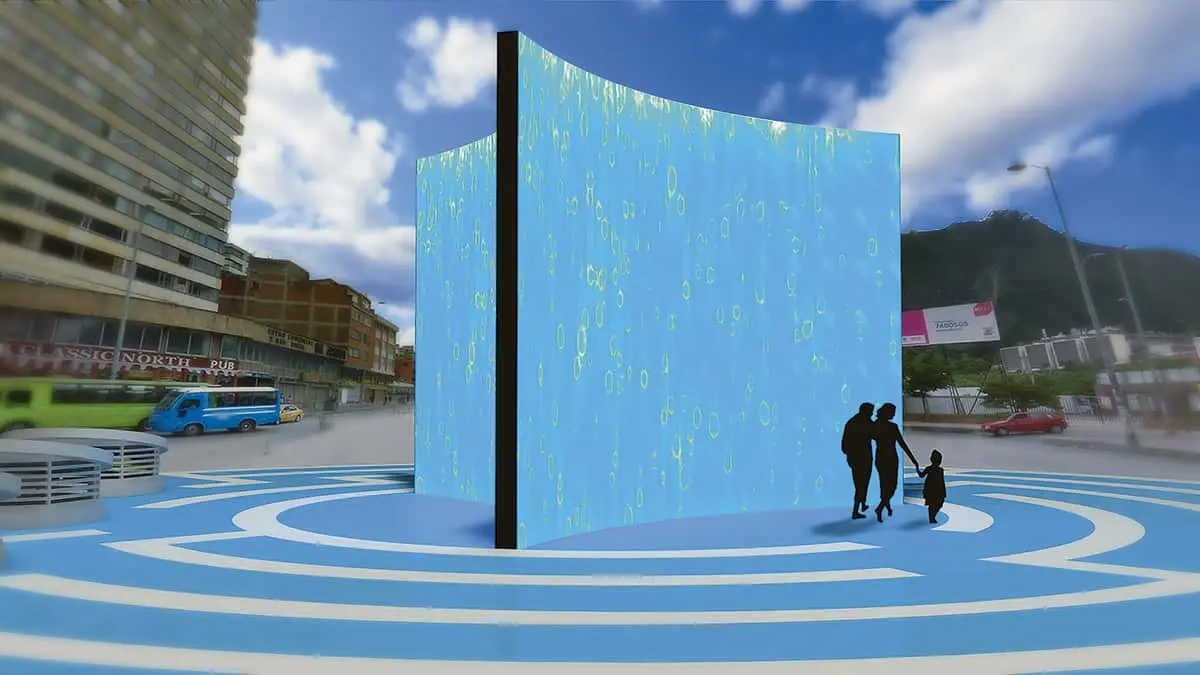
Unrealized projects are predominantly of monumental urban works, spaces for population’s use, entertainment or transportation, and some are luminaries, stairs, and other accessory elements. Architecture is not set aside in her studies; on the contrary, walls are emphatically present against Silveira’s delicate conceptual contributions. Among them is a dual-function-project: road management and transportation—a traffic circle with a tunnel for a Metro station—in São Paulo (Brazil). Similarly, the studies of clouds for the Santa María Novella station in Florence, Italy, in 2012, create a grid of techniques and materials for the roof of a large portion of the station and part of the façade. Another proposal, titled Double II and dated this year, consists in the tracing of a faux staircase cube on the exterior side of an actual staircase. Given Brazilian’s passion for soccer, Regina Silveira’s preparatory studies for the Pacaembú stadium in São Paulo (2004) are like a gesture of identity. That is also the case of part of the presentation in paper, wood, adhesive vinyl, and lacquer, titled Supersonic Goal.
Silveira’s preparatory studies for the Central Library in The Bronx, in New York, feature a grid with the institution’s name on the floor. The typography of the capital and lower-case letters resembles cross-stitching embroidery (with the letter “x”) in alternating grays, soft yellows, and blacks. To confirm the speculation of the building’s content, the artist displays a needle and a strand of thread in the design. The exhibition presents more than one view of each project. By sections or as a whole, Silveira’s solutions drive viewers to share her frustration with what did not come to fruition. Unable to compare her projects with others submitted for the same sites, we find it difficult to accept that more appropriate solutions/expressions than hers existed. The repeated elements present in Regina Silveira’s creations are a metaphor for the multitude that inhabits Brazil and the human overpopulation of the planet. At the same time, the artist herself can be seen/heard in every theme she proposes.
GRACIELA KARTOFEL