Brazilian artist Paulo Nazareth is known for the historical and social content of his works. He is renowned, above all, for provocative artworks that recreate ideas and readings of historical events in a revisionist vein.
“Melee” is Nazareth’s first solo US museum exhibition, for which Miami’s Institute of Contemporary Art (ICA) commissioned several works. One of these is 49 Medals (2019), a large-scale installation situated at the center of the exhibition space and delimited by red curtains. Nazareth designed and cast in bronze 49 medals memorializing historical characters who, from his point of view, have not been recognized or have been distorted in the official historiography of different countries of the Americas and the Caribbean. Many of these figures are controversial for the events they triggered at the time, shifting and shaking the social order, yet they are all part of their countries’ intrinsic development. Nazareth left the last pedestal intentionally unoccupied to signal the continued march of history and the potential for its manipulation.
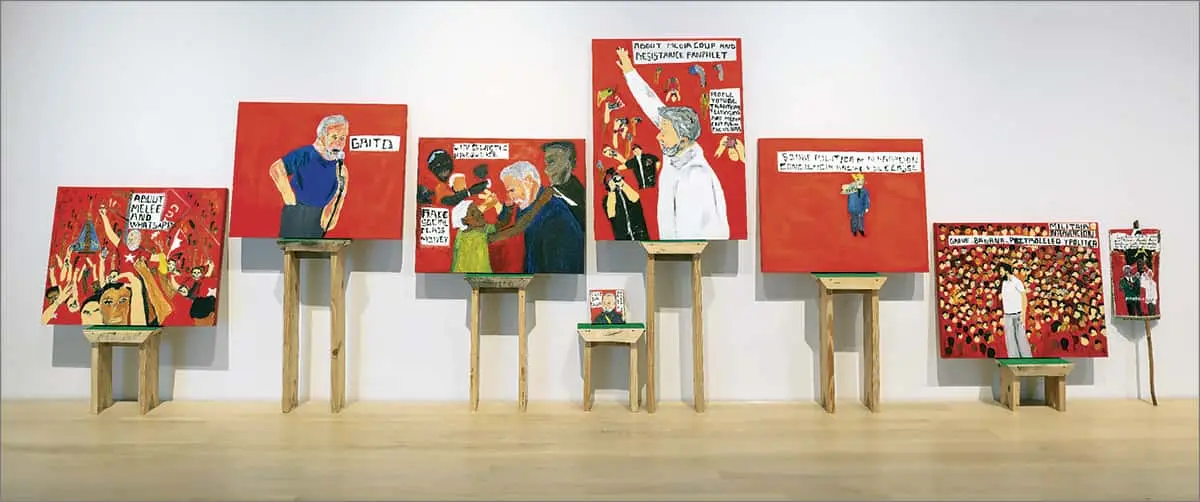
Another salient characteristic distinguishing Nazareth’s work is the diversity of media he uses, from performance and installation to more traditional ones such as photography or painting. He appropriates the latter for the first time for one of the ICA commissions, a series of paintings about the political career of Luiz Inácio Lula da Silva, known as Lula. Formally, he harks back to a primitive language, includes texts, and creates scenes against a bright red background. Nazareth takes as his inspiration Lula’s political trajectory from his beginnings as a union leader to his ascent as President of Brazil, and later his imprisonment on corruption charges.
Nazareth also finds inspiration for illustrating his ideas about injustice and discrimination in aspects of social and political life in the hemisphere. The profile of his work is indisputably connected to his vision of the world around him, and his life experiences. His approach is a kind of link between the past and the present, based on his research into and interpretation of both. Works like Buracos en La Ribera (Holes in La Ribera), from 2009, the oldest piece in the show, and Antropologia do Negro I and II (Black Anthropology I and II), from 2014, illustrate this idea. Nazareth explores events of the past and their consequences for contemporary society in two countries: Argentina and Brazil. Buracos en La Ribera is a video recorded in La Ribera, an important detention center during what is known as the “Dirty War” in 1970s Argentina. That decade was painfully notorious in the region for the forced disappearance of people whose fate remains unknown to this day. In this performance video, Nazareth digs on the ground for hours using an animal jaw, in a symbolic search for remains. The act of digging becomes a reminder that this chapter in Argentinean history has not been closed. Antropologia do Negro I and II are based on an analogous methodology. These videos were recorded in two locations, one in Bahía’s forensic office, and the other one in the city’s public archives. In them we see Nazareth dressed in white, with skulls on his head and torso, alluding to the region’s history of violence involving people of African descent. Through these images, Nazareth summarizes the social—and, to a degree, economic—history of the region, from the beginnings of slavery to the present.
Sem título (Untitled), part of the series Cadernos de África (African Notebooks) that Nazareth began in 2010, connects with these works. Here he combines photographs, videos, maps, and even fragments of blog entries in his search for connections between Africa and the Americas, through the social history of exchange between the two continents. For this project, which Nazareth started in his home in Palmital, Brazil, the artist decided to travel to countries in both continents. Included in this exhibition are a series of photographs illustrating these journeys.
Paulo Nazareth’s art is deeply engaged with his times and his political position. This selection of works confirms him as part of a socially committed group of artists for whom the boundaries between art and activism are almost imperceptible.
IRINA LEYVA