Nacho López (1923-1988) is perhaps the most prominent member of a generation of Mexican photographers who, breaking into the scene after World War II, took the baton from the extraordinary interwar cohort led by Gabriel Figueroa and Manuel and Lupe Álvarez Bravo, and were deeply influenced by great masters of international photography who had Mexico in their sight: Edward Weston, Eduard Tissé, Tina Modotti, Henri Cartier-Bresson, and Leo Matiz. López’s career began in photojournalism during the presidency of Miguel Alemán, who wanted an image of gleaming modernity to complement and promote his development policies. It was the era of the Hispanoamericana Tower, a defiant skyscraper that abruptly broke the skyline of the city’s historic downtown still dominated at the time by the styles of the Porfirio Díaz years. It was the era of the construction of new roads and the massive spread of the automobile. The graphic press of the period, the cinema newsreels, and even the movies themselves covered these new realities. Alemán sought to bring the dominance of indigenista aesthetics and the glorification of the peasantry to an end, in favor of an image of US-style modernity that soon seduced Mexico’s fledgling—and growing—urban middle class.
Nacho López swam against that current, however. His camera captured the underbelly of this unleashed modernity, represented by the poverty-stricken people whom Luis Buñuel, exiled in Mexico at the time, featured in his film Los olvidados (The Young and the Damned, 1950), around the same time. In this exhibition, held between May and September at Instituto de México in Madrid, there are outstanding examples of this facet of López’s work. One example is a photograph shot inside the infamous Lecumberri prison, where we see a pair of pleading hands emerge from the bedraggled slot of a cell’s heavy metallic door, cut almost at floor level.
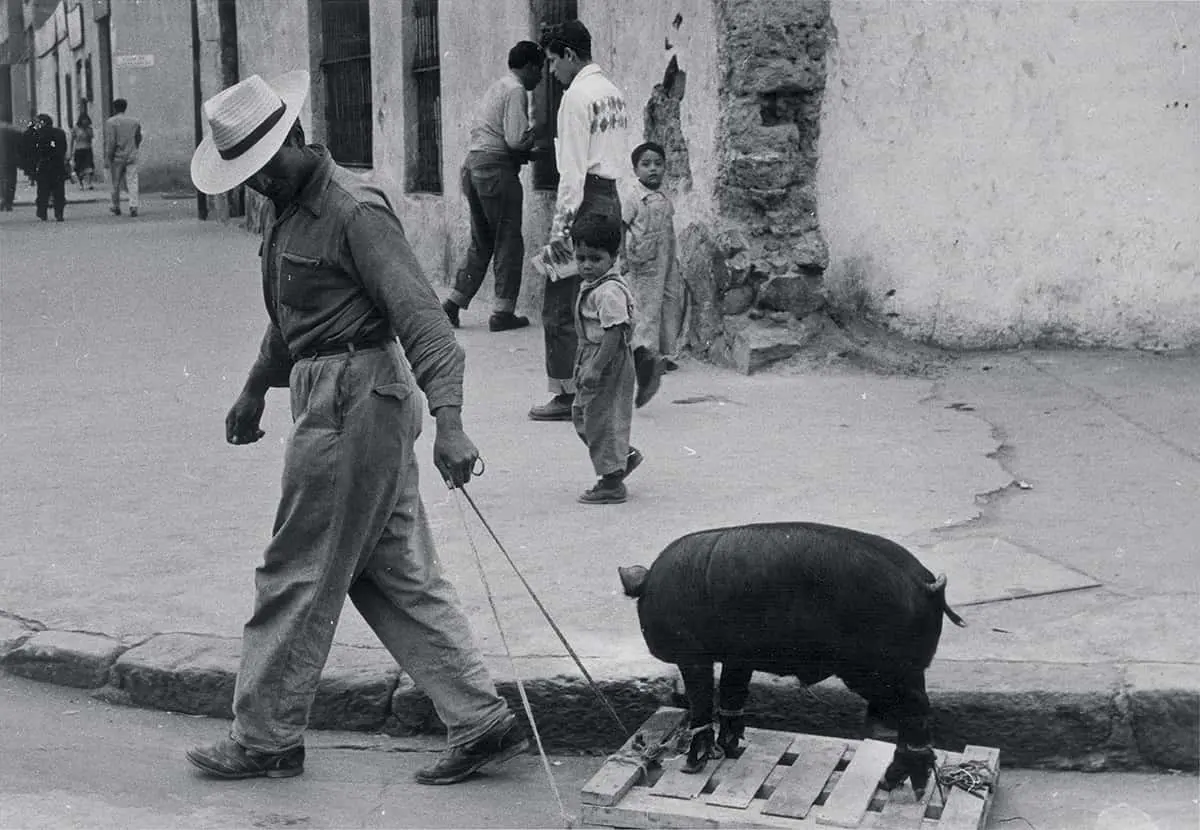
All in all, though, the revealing nightmares that accompany the dreams of modernity do not provide a full account of Nacho López’s art during that period. Lopez’s creativity drove him to invent an entirely new genre in Mexico, reinterpreting the Surrealist promenades of the 1920s and in a way anticipating the happenings that Allan Kaprow promoted in New York in the 1960s. In essence, it consists of having someone do something unusual and entirely unexpected in the street or any other public space, to record the reactions of the startled bystanders or the captive audience. The exhibition included several such sequences. The most surprising one has for its protagonist a common-looking man who walks along a street pulling a little cart, with a pig tied to it. A rural scene is suddenly transformed into a surrealistic image. Equally striking, it must be said, is the photographic sequence documenting a humble and rattily-dressed man’s stroll in the city center, carrying a ghostly-white female mannequin. A third sequence in the exhibition was more predictable. It records the reactions of male pedestrians as a fetching young woman in a tight dress walks by.
But these series did not exhaust López’s talent, either. He also entered the territories of formal experimentation. As he did in a photo that is legendary and in which the iconic Palacio de Bellas Artes of Mexico City is seen through a glass globe. Or in that other very complex one that disassembles or deconstructs, if you want, the entire photographic device: the eye that looks and is looked at, the frame, the camera, the lens, the mirror.
This exhibition is an abridged version of the extraordinary Nacho López retrospective, a full account of his prodigious output, held at Palacio de Bellas Artes in México City in 2016, on the occasion of the 30th anniversary of his death. In addition to a photojournalist and documentary filmmaker, he was a film director, photography theorist, and teacher of the new generations of photographers at the Autonomous University of Mexico and the Universidad Veracruzana. Alberto Tovalín and José Antonio Rodríguez, the curators of the show under review, opted to focus only on his Mexico City works.
CARLOS JIMÉNEZ