The opening of Miguel Rio Branco’s exhibition Maldicidade (Maldicity) coincided with the launch of a book of the same title, published by Taschen. The show, curated by the artist, selects forceful, striking images from the book; both exhibition and book shine a light on Rio Branco’s anthropological interests and the decline of the great cities. Visiting the environment created by Rio Branco at Luisa Strina gallery provides an opportunity to experience the process through which the artist has been giving shape, for more than forty years, to an investigation about urban realities, metropolises, and citizens. The selection on display in this solo show is a work in progress, as the artist explains: the new elements are “construction and intention.” Following this strategy, the show features a large-scale edition of photographs taken throughout Rio Branco’s career. They are organized on the basis of the context in which each one is placed to dialog with the others, be it by attraction or by repeal, taking advantage of the form, color, points of connection, and oppositions that occur as the images interact. This creates a new narrative environment based on the particular meanings of the museographic scaffolding.
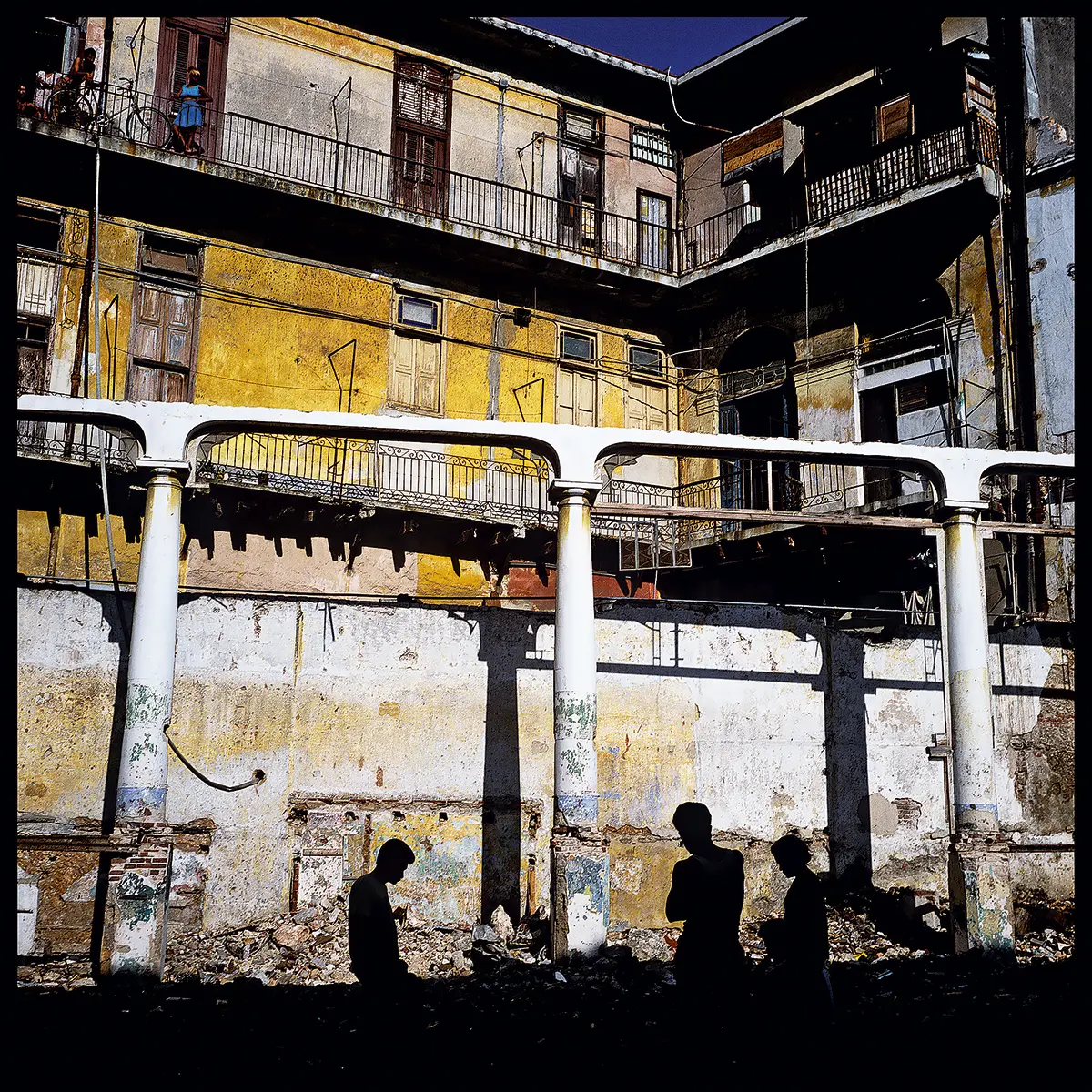
The images, captured between 1970 and 2010 in different cities in the United States, Brazil, Japan, Cuba, and Peru, possess great expressive power in themselves. The protagonists are not the cities where the photographer worked, but the stories told in images, frame after frame. The new meanings achieved by the work, in both the exhibition and the book, signal Miguel Rio Branco’s cumulative power and his interest in interpreting the stories constructed by his images, which unfold into many possibilities—the artist’s extraordinary legacy along with his ability to organize, orchestrate, and design an environment in the exhibition space, and even the pages of a book, with great dramatic flair and emotion—told by Rio Branco, as he enmeshes himself in the scenes captured in his shots or his built images. The verb is “to feel.”
Together, these images show a photographer who participates in scenes and interferes with events, a flâneur who reports his passage through and experience of every space he occupies. An Elohim, perhaps. An angel who volunteers to discuss urban life using his aesthetic, to illuminate and give meaning to the imaginaries that appear in the streets, in hidden corners, on roads. A poetic of contrasts and opposites builds a metropolis where great urban dramas are revealed, regardless of space-time concerns.
Maldicidade is the invention of a city where words structure the very meaning thought up by the artist, in the joining of evil and the city, the accursed city, the restless, abject city. Again, the angel organizes and gives aesthetic meaning to the extreme dramas found in all big cities. Maldicidade brings to light the entrails of the city imagined in marginal and unconnected fragments, where ambiguities gain greater resonance. Miguel Rio Branco ventures with no hesitation into dilapidated territories, where fear and terror find meaning and reveals the emotional beauty of that which cities usually seek to conceal.
The exhibition space imagined by the artist covered the walls of the white cube in an intense gray, heated by lighting design—also conceived by Rio Branco—that accentuated shadows and reflected a view of the vast metropolis, its harshness, its cement, its distance. In that environment, the images, organized either individually or in groups, provide emotional meanings for the selection as a whole. Viewers are carried into new dimensions experienced through the artist’s provocations. The black and white tones emphasize the dramatism of the scenes, in contrast with other groups captured in color. Placed opposite each other, they relate in the manner of energy-charge poles.
The strategy of organizing groups in polyptychs while presenting other photographs individually is a constant in Rio Branco’s thought. Starting in 1977, with Strangler in a Strangled Land, and then with the exhibition Negativo Sujo (Dirty Negative) in 1978, which featured forceful references to painting and film, the artist began to create poetic narratives with arrangements of grouped photographs. Back then, he felt the need to create dialogs between his images, designing visual narratives by connecting and contextualizing different sets of photographs. Others gained more powerful meanings in their isolation. It is through those editorial concepts that Miguel Rio Branco creates his grand fables, both in his exhibitions and in his books.
The Maldicidade series evolved from the continuation of a photographic essay Rio Branco produced in the 1970s while living in New York. In 1978, he carried his investigation on big city blight forward with the Negativo Sujo show. The next stage of his exploration was published by Cosac Naify in 2014, and now Taschen brings out an expanded edition, presented during the opening of the exhibition at the Luisa Strina gallery. The graphic project for the Maldicidade book is also by Miguel Rio Branco, assisted by Isidora Gajić.