
The value of art as a historical testimony is evident in Peruvian artist Maya Watanabe’s audiovisual project titled Liminal (2019). The video was inspired by the discovery of approximately 6,000 non-exhumed mass graves, in which the remains of more than 16,000 people who disappeared during the internal conflict that took place in Peru in the 1980s. The bodies correspond to hundreds of victims of violent acts perpetrated for over a decade by the insurgent guerrilla groups Sendero Luminoso and the Túpac Amaru Revolutionary Movement, and the government’s military forces.
Watanabe becomes a sort of forensic archaeologist who witnesses and records the exhumation process. In many cases, the remains found are merely bone fragments which are challenging to identify. In her video, she transforms the Dantesque scene of unrecognizable corpses into a visual abstraction in which the viewer can hardly recognize what is being depicted.
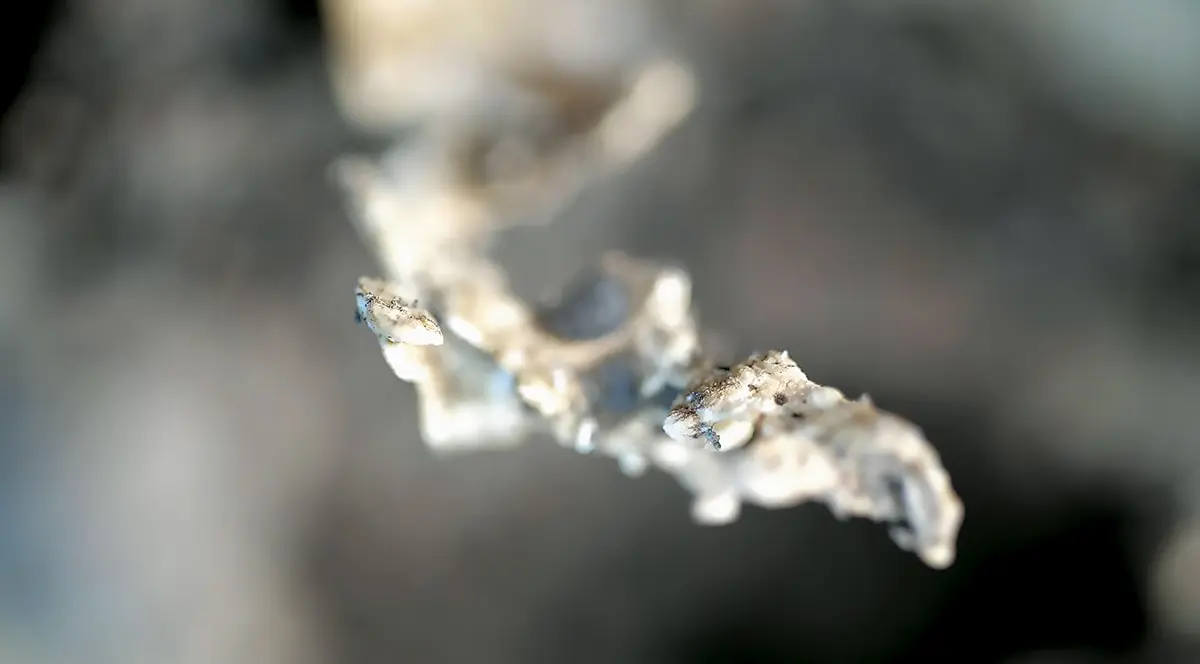
The one-hour-long video shows an unfocused terrain of arid soils with various textures. When the blurred image becomes sharper, fragments of bones, teeth, and even pieces of cloth from the victims’ clothes can be seen among natural elements, such as dirt, roots, and rocks. Archaeological markers and measuring tools confirm that these are human bodies. These objects are hardly identifiable in Watanabe’s video, either because they are shown out of focus, or because she chooses to accelerate the speed with which the lens passes over them.
The almost microscopic image of the details captured by the artist contrasts with the magnitude of the theme, the murder of thousands of people, whose whereabouts were unknown until recently. Such significance is emphasized by curator Caitlin Julia Rubin, who successfully projects the video on the oversized wall of the Lois Foster Gallery. The viewer must stand or sit on the floor to observe the one-hour-long visual narration without the comfort of a bench. The size of the projection and the subject matter makes you feel as insignificant and helpless as one of the small insects that occasionally come up on the screen.
The image that appears during most of the video is a kind of hazy, almost abstract landscape. The speed with which the lens moves, sometimes slow, sometimes fast, indicates that it is a meticulous and at the same time desperate search. Only at the specific moment in which something is found, a detail, a clue, the image becomes clear for just a few seconds. Even then, it is difficult to guess what it is. The questioning is constant: Was that a skull? Were those teeth? Are those strings of cloth, or are they plant roots?
The monochrome aspect of the land, which over time has absorbed the remains, makes the identification of the remains even more difficult. Besides, Watanabe visually dilutes the possible distinctions between human remains and the nature that has appropriated them, after more than twenty years of being buried, precisely to generate a state of reflection. Perhaps the easiest to identify is the bloody clothes, red fibers that have survived the passage of time as a testimony of the violent way the victims were killed. Even so, it is unknown how they died, for what reason, and who they were. Again, doubt prevails. As Rubin indicates in the exhibition catalog, the artist’s first individual in a museum in the United States, “Watanabe blurs distinctions between these remains and the environment within they are set. They are never entirely represented, never fully stable, or completely defined. Liminal prompts viewers to engage, again and again, in a struggle for recognition. Remnants of a tragedy long-hidden from history and with the landscape as the primary witness, Watanabe’s fluid portrayal of these elements is a reflection of their liminal state. Awaiting forensic identification, they are on the cusp, pictured at the not-quite juncture of in between. They are remains on the threshold of a decades-delayed return to subjecthood, no longer “missing,” but yet to be declared as an official, and recognized death.”
By carrying out projects such as Liminal, Watanabe assumes a social responsibility, telling stories that have been silenced, and becoming a spokesperson for those who, despite the passing of the years, still seek answers.
FRANCINE BIRBRAGHER-ROZENCWAIG