A crucial “time” difference may be the accidental centerpiece located in and outside of the reinstallation of Marta Minujín’s now-legendary 1965 labyrinthian constructed walkthrough, “La Menesunda,” in the New Museum. The nature of lived time in relation to historical time is found in her title. “La Menesunda,” reportedly a word from Buenos Aries street slang (“Lunfardo Porteño”) for “confusion.” It has also been translated as “mayhem” in its relation to the 1960s global art context of the conscious destructions of art boundaries that took their assumptions of relevance from the social turmoil of the time. Munijín was a major player then.
Today, commentators want to relocate it slightly as “confusing situations.” The word “experiences” was the critical favorite argued by the Argentine art critic, supporter, and Director of the Torcuato di Tella Institute, Romero Brest, where Munijín and Rubén Santantonin (1919-1969), along with friends, first installed “La Menesunda.” The institute’s mid-1960s progressive aesthetic became an address known as “la manzana loca,” the city block of madness.
No matter the translation, good art continues to remain relevant through its various readings but in different ways. The goal then was the center of modernist avant-gardism, to destroy preconceptions using embodied and participatory awareness, and shock through the confusions presented by nameless things and situations. But time changes “things.” In other words, can that goal be achieved when read in a different time? The answer is obvious and yet not obvious.
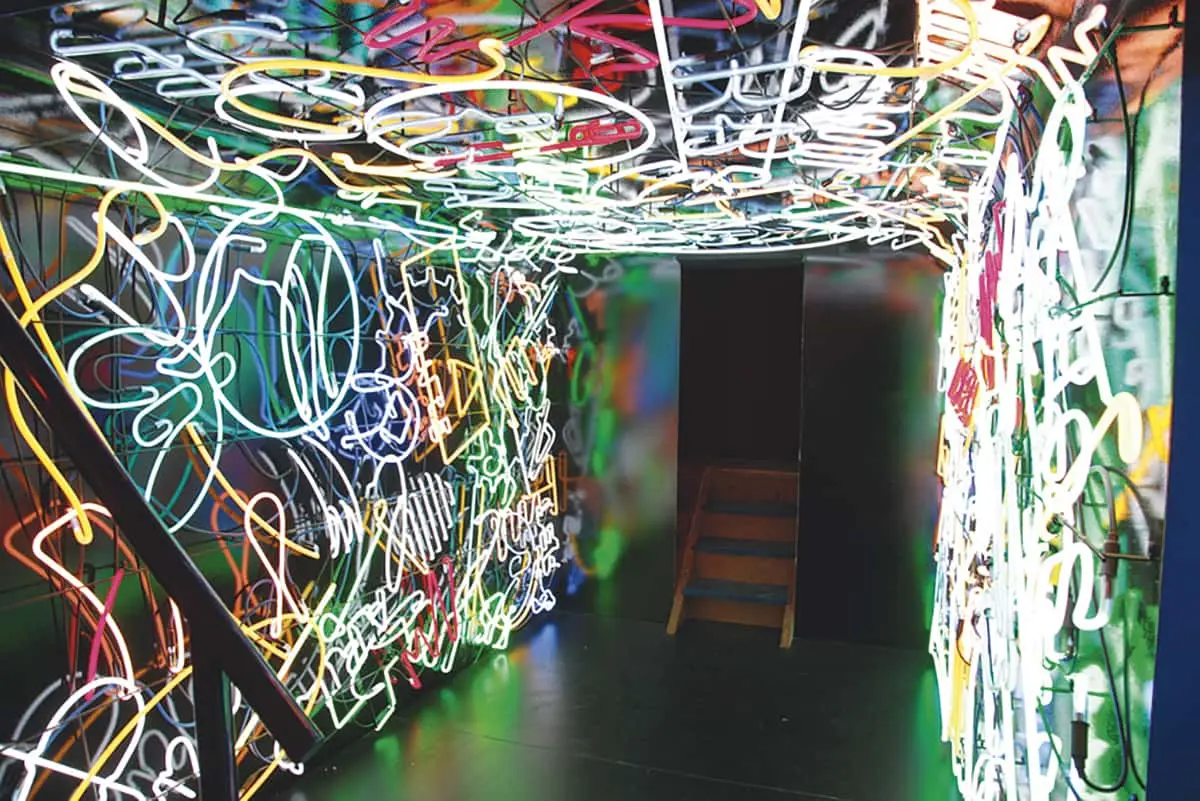
As the viewer cues up at the pink plastic facade of “La Menesunda Reloaded,” the title of this iteration, one confronts at eye level a black tunnel filled with a jumble of bright, multi-colored neon tubing that in the electric 1960s signaled excitement, amusement, avant-gardism, modernity, commerce, and technology. It hides a convoluted two-story wooden construction of about eleven rooms, depending on the installation and your counting. The New Museum configuration is the third version and differs slightly from the 2015 Museo de Arte Moderno de Buenos Aires (MAMBA) iteration, which co-produced this installation and reconstituted the lost original blueprints.
Enticed by the neon, the spectator was immediately denied and diverted towards the left, up a staircase, past neon signs that seemed to reference Futurist sound poetry and a commercial lighting company (Neolux). A video camera projected the visitor’s steps on a monitor. When he entered the room, he was confronted by several TV screens that looped black-and-white clips of politics, news, and pop culture events of the time. Today, not much effect, but back then feedback systems (think cybernetics) and even televisions were cultural signifiers of modernist faith in technology and the emergence of a mediated world—think Marshall McLuhan—that bound people across the globe.
After the televisions, what else but stairs that lead to a bedroom with a couple in bed, reading and relaxing. For young adults, perhaps sex was implicit, but for older people, it was merely a nighttime ritual. It is the first of several low-key confusing situations. First, it was the shock of seeing people, then the problem: Do I stare at them? Do I hover around? Do I talk to them, or do I move on? Following the stairs towards the neon tunnel, one recirculated back up, as ironically had been told to do so to avoid confusion, and now it was time to take a different doorway to go down to a new pink tunnel. The experience changed.
A manicurist awaited, offering to paint at least one of the fingernails, in a room with curved walls thickly hung with make-up accessories such as hand mirrors, lipsticks, brushes, and multi-colored squares of foam sponges (In the original installation there was also a masseuse who gave back rubs, thus increase the emphasis on the body). To the upper left, a sign indicated to “LOOK” through a small peep-hole. Here, without knowing, one ended looking into the forbidden center of the installation and the emergence of 1960s feminism.
One could not enter, only glimpse periodically through peepholes at a large woman’s head made of paper-mâché. It evoked Munijín’s friendship with Niki de Saint-Phalle (1930-2002) in Paris when she was working on promoting New Realism around the world. In retrospective, the meaning seems obvious. The woman, which this constructed world revolves around but whose role is neither known nor fully respected, especially her embodied exuberance, is often confined by patriarchy.
A room with a hand-driven revolving center provided choices more than confusions. One tunnel-shaped room was filled with inflated vinyl tubes spread across the pathway. The audio track of gurgling sounds made believe one was inside the intestines. Another tunnel was filled with soft scraps of foam on walls and under the feet. Here the audio track suggested chewing: the throat!
Three more rooms did not extend the bodily comparisons but provided gave the spectator choices that had to put to work to fully function. In other words, body, mind, and imagination were challenged and integrated.
The radicality was apparent for its time. Today, when reality provides far greater daily shocks and mayhem, the “experiences” here are entertaining. But maybe that’s the point, in part. Our increased need to escape our mad normalcy for fun and laughter indicts our own current lack of identity. We hope that times continue to change.
RICHARD LESLIE