The multi-disciplinary Venezuelan artist Marco Montiel-Soto (1976) has disembarked in Las Palmas de Gran Canaria with his most recent exhibition proposal, curated by Lidia Gil Calvo, to introduce us to the artist’s vast creative universe. About one hundred works have been arranged in more than 200 square meters of exhibition space, for a course filled with surprising finds and complex installations. Visitors are invited to explore the wide-ranging investigation initiated by Montiel-Soto four years ago in the Canary Islands, in parallel to his intensive study of Venezuelan reality through a broad diversity of artistic metaphors.
The show is organized in the manner of those “cabinets of marvels” that delighted observers with countless treasures coming from newly discovered lands, and later captured the interest of scientists, intellectuals, and merchants. Many new objects were found and organized into the categories of Naturalia, Artificialia, Exotica, and Scientia, used in the eighteenth and nineteenth centuries to catalog items in Natural History museums on the one hand, and Art museums on the other. Nevertheless, Mal de mar hacia un triste trópico: notas sobre la otra isla (Sea Sickness Towards a Sad Tropic: Notes on the Other Island) gives an account of the splendid contemporary bounty that Marco Montiel-Soto has been distilling, with keenly critical yet poetic sense, in order to demonstrate, from a variety of perspectives, the close ties that have historically connected the Canary Islands and Venezuela, considered “the eighth island”.
The main argument put forth by the artist consists on the localization and subsequent delocalization of a magnetic destination known as Venezuela, a majestic oil-producing country that attracted large contingents of Canary Islanders with its economic prosperity and familiar weather during the second half of the twentieth century.
Those migrants were pursuing a better future, away from the Civil War and the Franco dictatorship. Unfortunately, that bonanza is a mirage today. The recent history of the country has abruptly turned the compass in the opposite direction. The vast majority of the population of what was, for centuries, a promised land, now expresses the desire to escape.
Our journey begins with a lush artificial garden, followed by El comandante y la india Tibisay (The Commander and the Tibisay Indian Woman, 2016), the traumatic paradigm imposed on Venezuela by Hugo Chávez, its populist former leader, represented in a folk wood carving set on a podium, with his left arm raised, in front of the indigenous princess Tibisay, an allegory of a diminished people. What follows is Venezuela el más bello país del trópico (Venezuela the Most Beautiful Country in the Tropics, 2014), a collage highlighting how traveling painters presented the New World, enveloped in a sublime halo. Then comes Muerte en la tierra tropical naranja (Death in the Orange-Colored Tropical Land, 2019), an installation that slashes through one of those landscapes by the sharp edge of a machete.
Moving on, we encounter spectacular installations like Mal de mar hacia un triste trópico (Sea Sickness Towards a Sad Tropic, 2015), which gives the exhibition its title. In it, Marco Montiel-Soto combines objects found across the Canary Islands’ territory, from volcanic rocks to a pre-colonial past that had the aboriginal Guanche people as its protagonists. The enigmatic pintaderas found in Gran Canaria are re-elaborated through the neat arrangement of a variety of them in a display case. The collection is complemented by representations of the sailboats, or balandras, used by furtive Canary Island migrants on their way to the Americas. The artist uses fragments of navigation logs included in the 1989 book Historia de la emigración clandestina a Venezuela (A History of Clandestine Emigration to Venezuela) by José Ferrera Jiménez for documentation. He recites these fragments in an audio passage that can be heard throughout the exhibition space. The cadence of his voice communicates nostalgia and longing.
Completing this journey through the Canary Islands’ tri-continental past are a sixteenth-century cannon and a map of the islands, on loan from the Columbus Museum, as well as small bots made by the artist, on which he places small African statuettes loaned by Casa África.
Visitors are often advised of the depth of the Venezuelan crisis, warned of an ironic and sad tropic: twenty-six items from the series La verdad no es noticia (The Truth is Not News, 2016), with real headlines from the Venezuelan press foregrounded against color fields applied to the paper. In another series, Sucesos de día a día (Day-to-Day Events, 2015), twenty collages of images of local animals found in illustrated booklets from the 1970s seem to recite a litany of blood-curling recent events, gleaned from the Venezuelan press. One standout is the large-format Papel tapiz (Wallpaper, 2019), 6,50 x 3,5 m tall, made with real 100-Bolívar banknotes, now worthless.
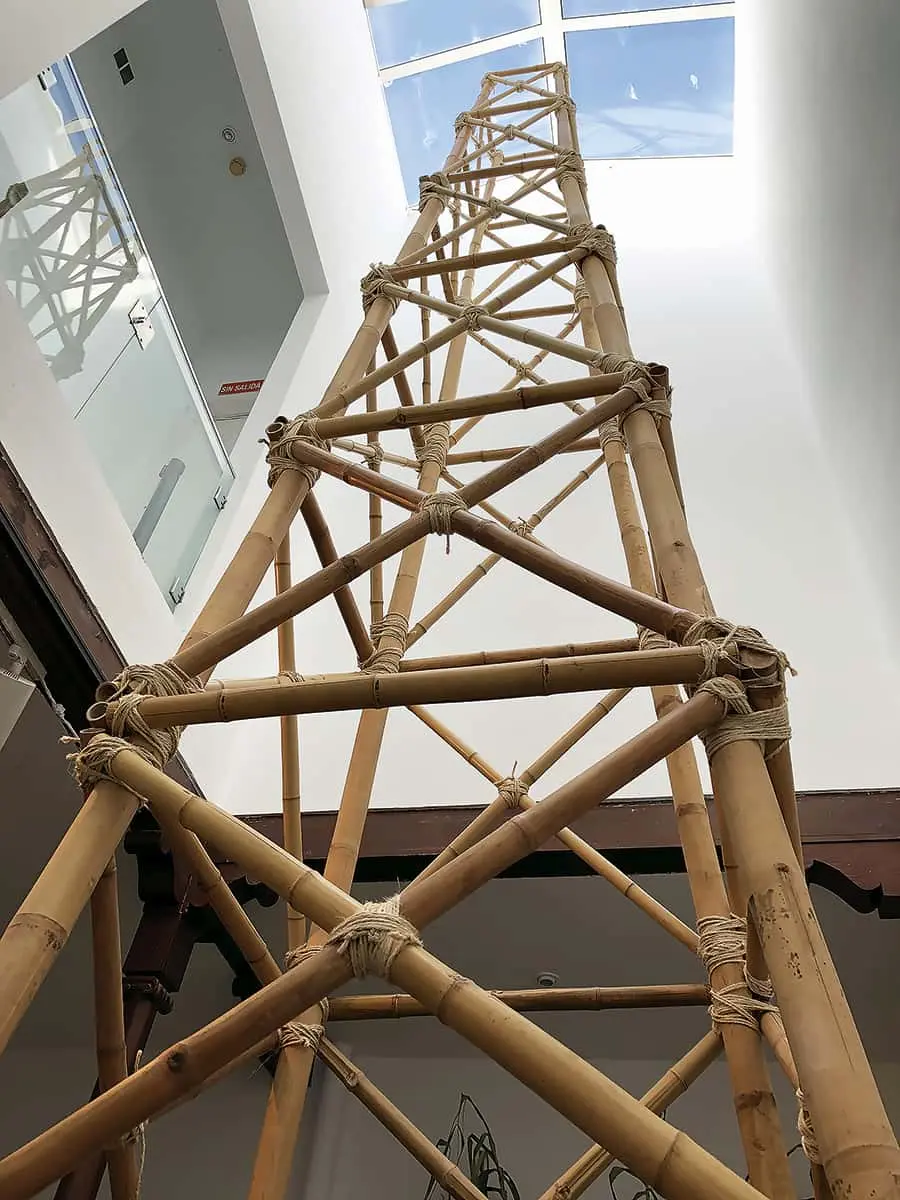
Visitors also encounter Postales desde Venezuela (Postcards From Venezuela, 2019), a series of vintage images of monuments and landscapes sent by Spanish immigrants living in Venezuela to their relatives back home. These can be seen in recto and verso. A now-unreachable tropical utopia sways on a hammock inside one of the galleries. There is also a representation of the Barroso II oil tower, which once spouted a 40-meter jet of crude oil for two straight weeks. The artist’s native Maracaibo, famous for the oil that came out of its entrails, is one of the country’s hardest-hit regions.
Marco Montiel-Soto documents this contrast in two videos recorded from an automobile’s rearview mirror. In one, he has recorded a trip around the entirety of the islands.
Expedición en las Islas Canarias (Expedition in the Canary Islands, 2019) gives an account of the return of the grandchildren of those emigrants, tracing back the steps of their forebears, who raised their families in Venezuela. Meanwhile, Recorrido Maracaibo (Maracaibo Tour, 2019) documents the current state of a despoiled society, forced to stand in unending lines to find food, its most basic rights trampled on.
A Venezuelan flag dresses in black, the color of giving, and hangs at half-mast in a Canary Island Museum.
ELISA RODRÍGUEZ CAMPO