Exploring abstract composition as a territory of sensible and reflective experience is the main thrust of this exhibition, which receives visitors with a sculpture installation that breaks down the space containing it into vertical and horizontal planes.
Visitors are able to traverse this work, 3/019 (2019), a site-specific creation with rope, iron spheres, and aluminum tubes, and to softly push its elements to propose a new pattern of spatial experience, different from yet connected to the one posited by Magdalena Fernández.
On the one hand, curator Carlos Palacios emphasizes an expands rereading of nature; on the other, a rereading of the ways in which this Venezuelan artist articulates a genealogy of international abstract and geometric art (and especially the abstract and geometric art of twentieth Century Latin America) as a personal/professional history in her production of the last ten years.
Magdalena Fernández’s projects call forth other meanings and media: space and time, not only in visual terms (as was the case with those creative predecessors) but also at the kinesthetic and sound levels.
Several works from the series Pinturas móviles (Mobile Paintings), following different investigations on diverse supports, are included in this exhibition. 1/HO008 Homenaje a Hélio Oiticica (1/HO008 Homage to Hélio Oiticica) is one of them. All the walls in one room are occupied by this video installation, featuring digital animations by Marcelo D´Orazio. In collaboration with the Isabel and Agustín Coppel Collection, it unfurls a video projection of rectangular blocks of different sizes in a blue hue found in Oiticica’s work, which moves around and connects with one another in a section of their perimeters, as if executing a soft dance together. White spaces open up between the shapes as they clash, and this also becomes a visual motif. Which of these surfaces are containers and which are contained?
2/PM009, another video installation with digital animation by D´Orazio, comes from the same series but is dates from 2009. The spread of horizontal and vertical planes at the entrance to the exhibition is transferred here to a mobile video support, in dialog with an experimental audio that mimics the sound of rain in varying intensities, from a light drizzle to a thunderstorm through the audio of another experimental process: the body-based percussion of the Perpetuum Jazzile vocal ensemble.
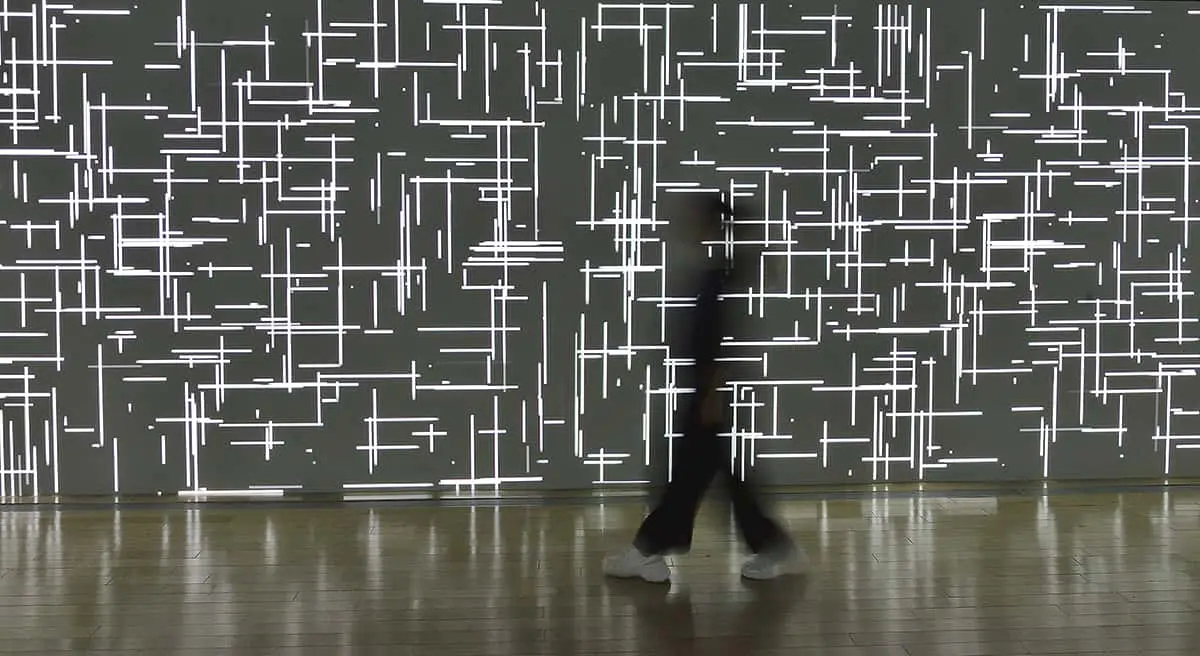
D´Orazio created another deployment of this group of works with audio by Gerardo Gouverneur: the digital animations 1pms011 (2011) and 1pms015 (2015), projected on large-format screens. One, with patterns of overlapping dots, used sensors to register the variations and layers of simultaneous sounds produced by birds. There are overlapping dotted planes, each “reacting” like a visual pulse to the rhythmic pattern of the bird’s cawing. Another screen brings together the sounds of birds and those of the city (vehicles and their alarms). Equally sound-sensitive linear grids are gradually incorporated as new planes, adding density to the image. The strangeness of this combination of digital technology with the sounds of nature and human intervention in an environment favors a state of meditation and contemplation.
Another aspect of these Pinturas móviles is the inescapable allusion to the current situation of scarcity, precariousness, and social unrest caused by arbitrary government policies: collaborative videos with loop animation, edited and produced by Carlo Grata, Tetelo Fernández, and Elizabeth Otero. The actions of the group are recorded in entirely vertical shots as they set bread loaves down in a circle and surround them, first standing still and then in crisscrossing motion around the perimeter, and finally picking up the bread to disassemble the circular pattern, or as they arrange candles also in a circle and move around and between them.
Some of the videos with formal and audio explorations belong to the series Pinturas móviles (2006), Video apuntes (Video Notes, 2011-2018), and Dibujos móviles (Mobile Drawings, 2004). These display images of physical bars that change places in patterns of vertical and horizontal planes, or with more irregular contours. There are other videos with lines in constant and unstable motion resulting from digital or electronic effects, and yet others featuring the audio of specific actions that trigger a visual mechanism: tearing up a piece of paper, shooting an automatic rifle or a handgun against a surface, puncturing a piece of fabric with a pointed object. Watching these works, one wonders whether they carry a critique of violence.
In Geometría móvil (Mobile Geometry), a graphic series produced between 2018 and 2019, Magdalena Fernández probes instability as a source of sensible experience. The series’ intaglios and overlapping prints in different inks—made by Norma Morales of the TAGA Studio in Caracas—combine with its varying intensities of application and the angular turns of equally overlapping rectangles. Even in a two-dimensional context, the interweaving of the latter multiplies the perceptual planes and escarp the image, an effect made more pronounced in regions where less ink is used to print the motifs or near patches of raw paper. Sometimes paths, intersections, or crossings are formed. One group of these works features only an almost-black ink; another one, the interplay between a light hue and black outlines; one more, uses inks in a variety of colors. In all cases, the inks are applied to each motif with uniform transparency, which contributes to give this graphic production a sculptural character.
One possible point of closure to the exhibition is 2/019, the site-specific installation Magdalena Fernández produced this year for the Museo Amparo’s terrace. The mirrored strips placed on the wooden steps bring into view clouds, light-blue colors, and the upper sections of nearing buildings and plants, doubling the space. With a degree of irony, it invites us to expand our senses: we see what is above, in the sky, by lowering our gaze.
EUGENIA MACÍAS