The outdoor exhibition “Structures of the Vacuum” is a specific site proposal with which the artist Lydia Azout has had the opportunity to occupy the MAMBO’s public space. One of the most successful bets of the museum has been to activate its transit surroundings, in this case, the “Carrera” 6th between 24th and 26th streets. Azout presented one of her first exhibitions at the museum in 1986, having developed her own language after studying with Colombian Master, David Manzur. In a city where the idea of public space is almost non-existent, one of its museums extends its exhibition space the outside, generating exchanges between the artwork and visitors or passersby. Azout’s works are designed to create, in themselves, spaces for interaction so that the public is introduced physically and visually to the pieces. Azout is an artist with two facets: part engineering, part alchemist. Like the two faces of the god Janus, traditionally the god of beginnings, doors, transitions, and endings. These two identities, at the service of artistic creation, are the engine of Azout’s work, who, regardless of the format of the works, generates portals of sacred forms and plots. The artist applies engineering and alchemy to raise the sculptures, physically and conceptually. These are located on the stairs that lead to the museum and in front of the entrance.
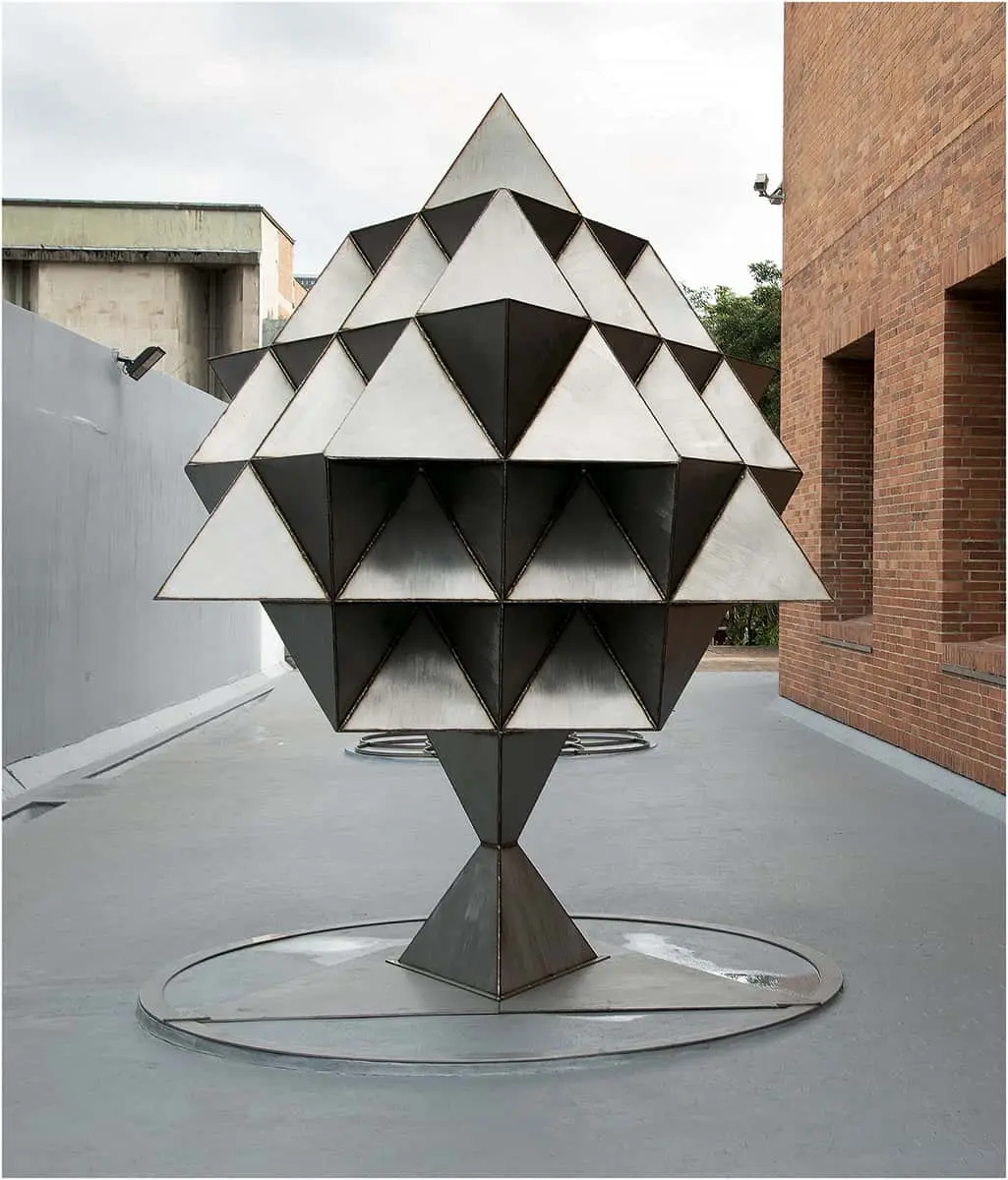
Often, art in public spaces is static and merely contemplative. This series of sculptures are interactive. To enter or exit the exhibition, one has to go through Dynamic Thresholds II. The piece made of five concentric circles that, by way of a spiral, crosses the stairs, simulating that the work enters and leaves the floor, giving rise to a series of binomials, as visible/invisible, inside/outside. The idea of threshold also appeals to the liminal or transitional space, the one in which we enter being someone and come out being someone else. The transit space symbolizes a moment of metamorphosis. This threshold leads us to the sculpture titled Female Forces. With a more personal plot, it gathers circles and triangles, lines and curves. Azout uses counter positions such as masculine/feminine, not so much in terms of gender but rather of different energies. This piece combines circles with triangular shapes making a hinge piece between the previous one and the following two: Structure of the Vacuum I and II. In these two works, the artist exposes both the process of creation and their complex geometric compositions. Structure of the Vacuum I is the skeleton, the absence, the air. The piece features 64 tetrahedra, inspired by the Flower of Life. It also has a golden heart-shaped octahedron at its chore. We can see through the bowels of the connected forms as if observing the functioning of a vital system.
Its complement is Structure of the Vacuum II; this one is skin, coating, solid. As Azout says, it is “the dressed twin” that reveals the surface, the outer beauty, without giving clues to what is inside. With both pieces, Azout delves into her world of platonic solids, not as a structural form, but as a clear display of her study of sacred forms. Polyhedral, belonging to Platonic solids, have been a source of research and knowledge because of their geometric, aesthetic, symbolic, mystical, and cosmic nature. These open the possibility of understanding the structure of reality. Regardless of religion, sacred geometry has been a way of understanding the world and its mysteries. This concept is the core of the artist’s interest. This is what brings together the two identities mentioned above: engineering and alchemy are the keys that combine science with experiment and intuition.
These large-size sculptures display forms and plots that have been the basis of the artist’s work. She is particularly interested in those that evoke the feminine, the masculine, the energy and strength of the sacred geometry dissected and reinterpreted from personal interests. Through these plots, the artist makes visible the invisible and the mysterious, which in power can hardly be named. Azout proposes a path to be followed with the body and with the gaze. The movement, though, is a fundamental aspect of the experience as it determines how each visitor roams all the possible planes of the exhibition.
CARIDAD BOTELLA