Luchita Hurtado (1920, Venezuela) presents her first solo show in the United Kingdom. “I Live I Die I Will Be Reborn” covers the entire span of Hurtado’s eighty-year career, unveiling the importance of her legacy in spite of the obscurity in which her work remained until recently. A fortuitous event brought Ryan Good, director of the Mullican Studio, to see several paintings signed “L.H.,” Luchita Hurtado’s maiden name’s initials. The treasures then discovered would never again be ignored. The explosion of interest in Luchita Hurtado, recognized by Time magazine as one of the 100 most influential people in 2019, is something we celebrate.
Taken to New York by her family at an early age, Venezuelan-born Hurtado studied art at Manhattan’s Washington Irving High School. Her marriage to Chilean journalist Daniel Del Solar brought her to the prestigious milieu of artists and intellectuals in the city, with whom Luchita developed friendships and exchanged many experiences. To mention but a few, among them, were Duchamp, Noguchi, and Rufino Tamayo, who introduced Hurtado to the fascinating world of color. After her first divorce, Luchita Hurtado worked as an illustrator for the fashion-world publication Condé Nast. Later she relocated to Mexico with her second husband, W. Paalen, the editor of the journal DYN, dissident from Breton’s Surrealism. In Mexico, the couple made inspiring archeological trips and established connections with the leading international representatives of Surrealism and magical realism. After the death of her child, Luchita Hurtado moved to California, where she has lived since the late 1940s.
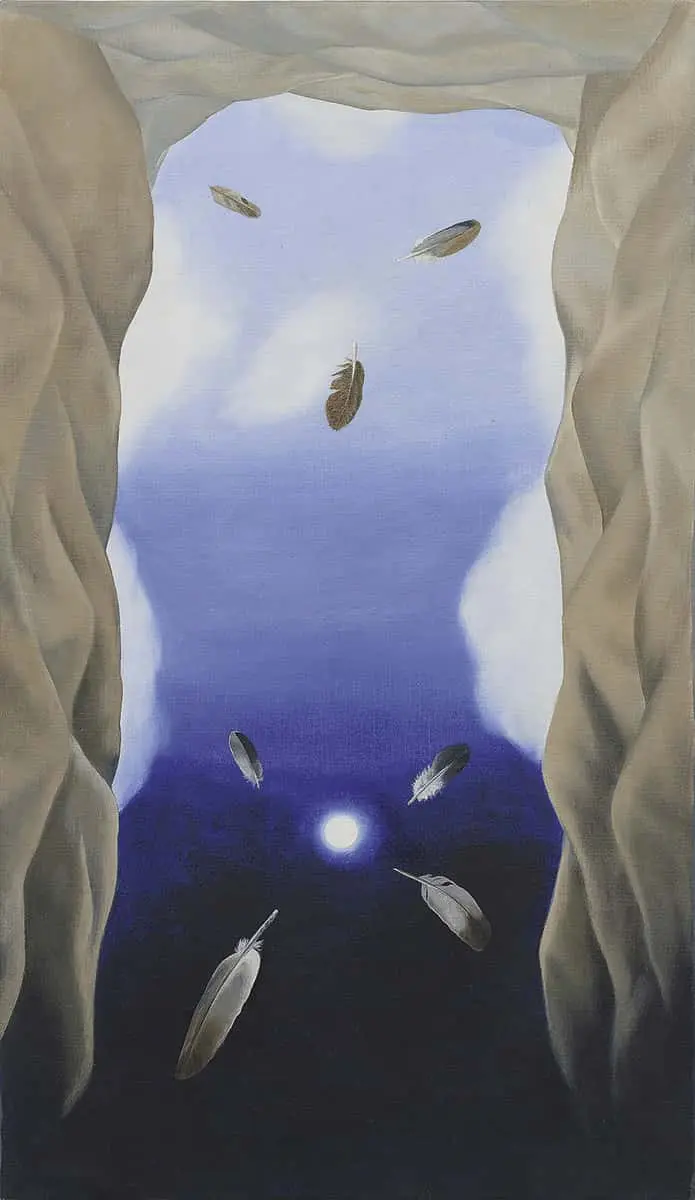
From the beginning, Luchita found herself indirectly immersed in the Dynaton group, which sought to take the expressive potential of the unconscious to an even deeper level. Dynaton included W. Paalen, Onslow Ford, and L. Mullican, Hurtado’s third husband.
She worked relentlessly on her art, night after night, despite the intensity of the period and the increasing demands of her family and social life. Luchita Hurtado questioned her existence in connection with the universe, capturing her interests and her main pictorial subjects in remarkable canvases and notebook sketches.
Luchita Hurtado always saw the universe as an extension of her being. Throughout her career, we witness her body being made to relate with the cosmos in which it is immersed, as a living, familiar organism.
The exhibition includes one hundred works arranged in chronological order, in a curatorial proposal that must be followed counter-clockwise.
Seven different areas interconnect the visual, compositional, and thematic explorations pursued throughout her career, as well as the “many people” she has had the opportunity to be for almost a century. Regarding the first themes that fascinated her, we find the representation of fire, a reference of everyday life which can be seen from the kitchen’s burner in graphite and colors on paper (1938). At times, Luchita Hurtado would offer a glimpse of the small flame of a match held in the intimate moment that was for her the lighting of a cigarette and being alone. Some oil on paper compositions, dating from the 1970s, invite us to peek over her body (sometimes naked) and contemplate her feet (or her multiple feet) and her hands. In some cases, they show the brightly colored rug with indigenous paths on which she rested, and even a tenuous light that entered through the half-open door of the closet in which she often secluded herself to paint.
The installation “Moth Lights” gathers squares of different colors with an inner radiance that symbolizes the pictorial representation of energy.
Of this quest for light and a connection to the cosmos, we also see, in a low-angle framing (from Luchita Hurtado’s point of view), the vastness of the celestial cover, in paintings grouped as “Sky Skin,” from 1970.
The section titled “Language and Archetype” contains clear messages, with the words You, Womb, Adam, or Eve functioning as metaphors for humanity’s origins on Earth.
In “Language and Abstraction” we find seemingly abstract compositions that result from cutting up strips with phrases painted by the artist, which she later extracts and machine-sews onto a different canvas, generating new geometric patterns and recycled meanings. Luchita Hurtado also presents paintings featuring the words “I Am,” from the late 1960s, understood as a linguistic mode of self-portraiture that she was to develop in the following decade. Thus, the title of this exhibition, “I Live I Die I Will Be Reborn,” is taken apart, dissolved, and reorganized in a geometric abstraction she titled Self-Portrait, also included.
During the last twelve months, the artist worked on a variety of paintings, and these are presented for the first time here.
Luchita Hurtado returns to the representation of illumination as a persistent verb and the outline of the human as an integral part of the cosmos, already with the elements embodied graphically in words like “earth,” “world,” and “fire.” She also sends a powerful message: There is no place to hide (2018). This is the only planet we have, and we and its elements will continuously be recycled y in it.
ELISA RODRÍGUEZ