The Luna Park Sports Palace, a covered arena built in 1931, has been the stage for many grand events in Argentina’s history including Carlos Gardel’s wake in 1935; the disgraceful Nazi rally, in 1938; Eva and Juan Perón’s love at first sight, in 1944; Frank Sinatra’s performance; Pope John Paul II encounter with Argentina’s Polish community; and Diego Maradona’s 1989 wedding. The same week it was announced it was for sale, a “For Sale” sign appeared on the façade of the Museo de Arte Latinoamericano de Buenos Aires (MALBA). For a good reason, many were surprised. “There goes yet another iconic building in the city,” they thought. Because, if the Luna Park was for sale, the MALBA could very well also be (perhaps for its transformation into a shopping mall). But, no: MALBA’s owner, Eduardo Costantini, continues to support this cultural enterprise with enthusiasm (and, one assumes, at a loss). Setting it up required effort, as many neighbors were concerned for their peaceful and quiet environment, but it has become an inescapable presence in the city’s landscape.
The sign read: “Erlich Properties. Exceptional opportunity. Apt for any use. Six hundred eighty works of art (Tarsila, Frida, Diego, etc.). Theater, auditorium, library, shop, cafeteria. 218 m2 terrace/parking. Heated pool.” The sign, Se vende (For Sale, 2019), is a central piece in “Liminal” because it functions as the threshold for access to the world of Leandro Erlich (Buenos Aires, 1973). Situated outside the Museum, it is part of the exhibition presented inside. Another site-specific work displayed in the terrace is Window and Ladder (2019). Invisible Billboard (2019) is the Argentine version of a similar work created in New Orleans when the city was devastated by Hurricane Katrina. It features a ladder and a wall with a window leading nowhere and containing nothing. It differs from the one presented in New Orleans in the materials and the type of construction which resembles those found in low-income neighborhoods.
In Liminal, Erlich, a conceptual artist, posits uncertainties and alternates between questioning certain everyday experiences, perceptual trickery, and testing the boundaries between fiction and reality. His installations seem simple, based on their standard architectural appearance. Nevertheless, they startle viewers, offering several levels of experience and understanding. With their optical effects, they interrogate pre-established notions, expand perceptual capacities, confront common sense, and provide illusory perspectives. They invite to play and think, the indispensable engagement of observers who, seduced, activate the works with their ambling. Depending on their cultural baggage, each will see what they see and think about what they believe. Erlich considers art as a tool for integration. This is perhaps why he is so interested in installing his works in public spaces and has done so successfully on many occasions.
Liminal features a selection of twenty-one installations of high visual power, produced since 1996. Curated by Dan Cameron, the works are exhibited in chronological sequence. According to Cameron, “The cumulative impact of experiencing several works by Leandro Erlich in a single exhibition intensifies our awareness of an inherent duality in the real, and prompts us to wonder under which circumstances would we be able to assert whether we are here or there assuredly.”
The exhibition is Erlich’s first anthological exhibition anywhere in the Americas. This globalized artist has previously had two large shows in Japan and is currently presenting—at the same time as his presence at MALBA—“The Confines of the Great Void” at the prestigious CAFAM (Central Academy of Fine Arts Museum, Beijing), in China.
Although Erlich’s work has been exhibited in several art events here, larger Argentinean audiences know of him as the artist who “stole the tip of the Obelisk.” On a very cloudy morning in 2015, worried pedestrians and drivers stated calling radio and TV stations (social media was not as popular yet) to report a strange event. That structure (the tip) has four windows, but no public access. Erlich installed the “stolen” simile at the doors of the MALBA and projected four videos showing what could be observed from the openings located 70 meters high. Later he found out that the work La democracia del símbolo (The Democracy of the Symbol), was seen by millions of people (online, graphic press, “live”).
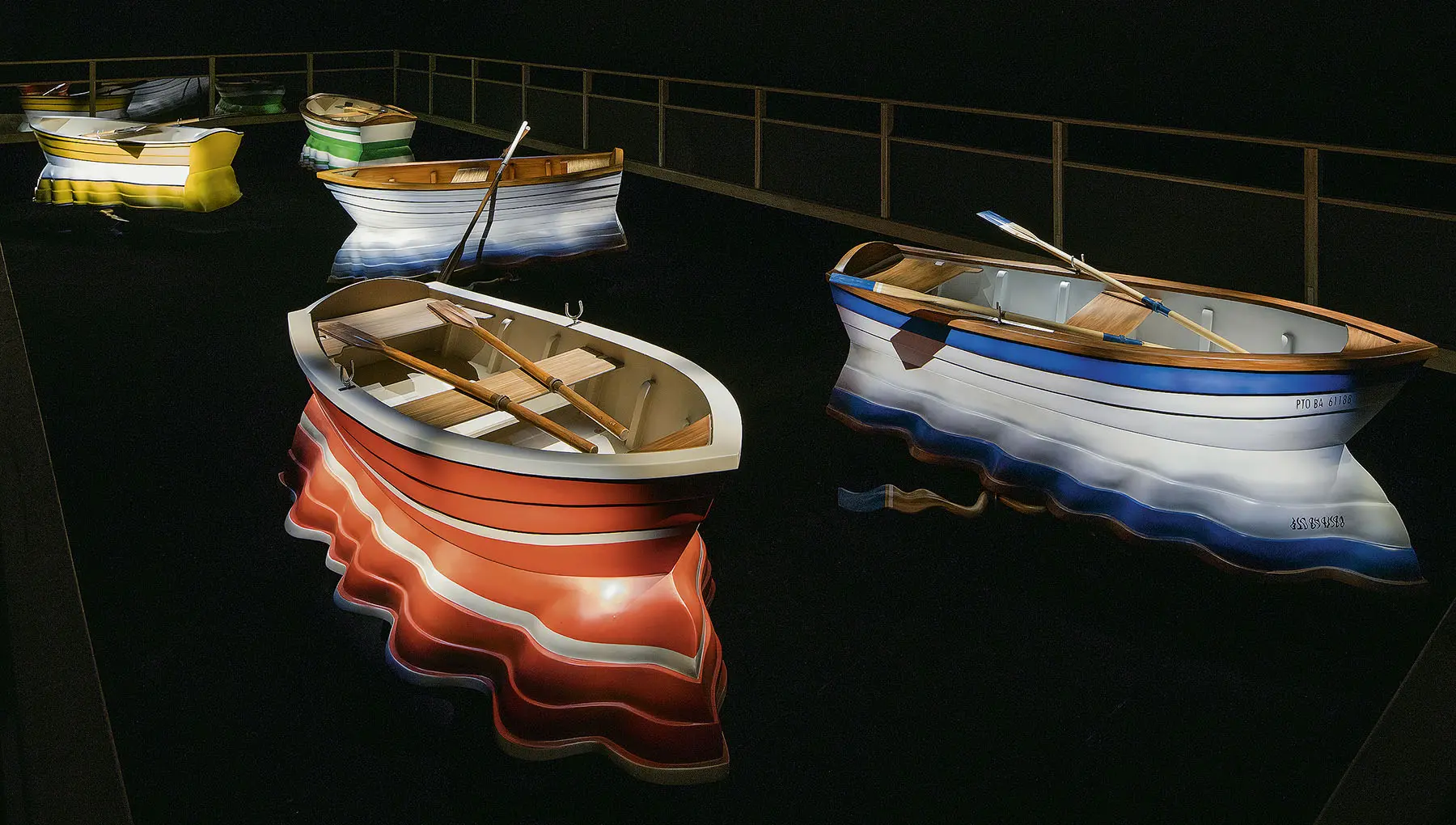
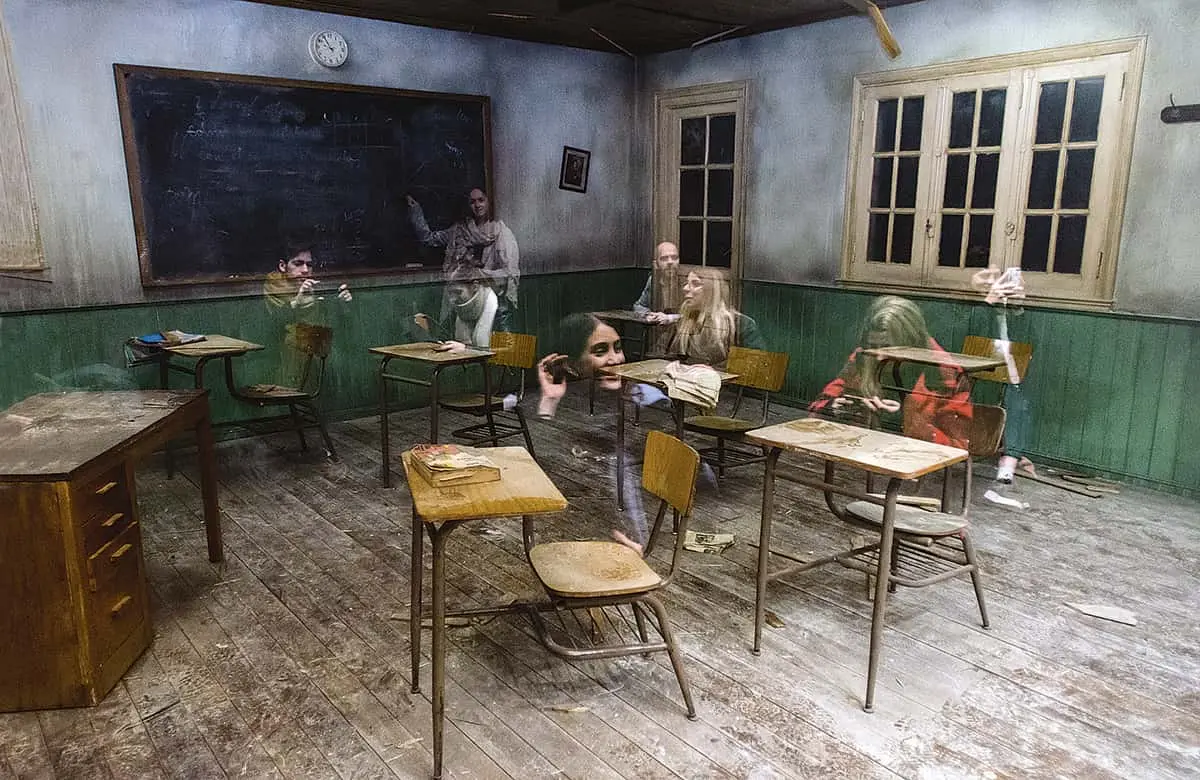
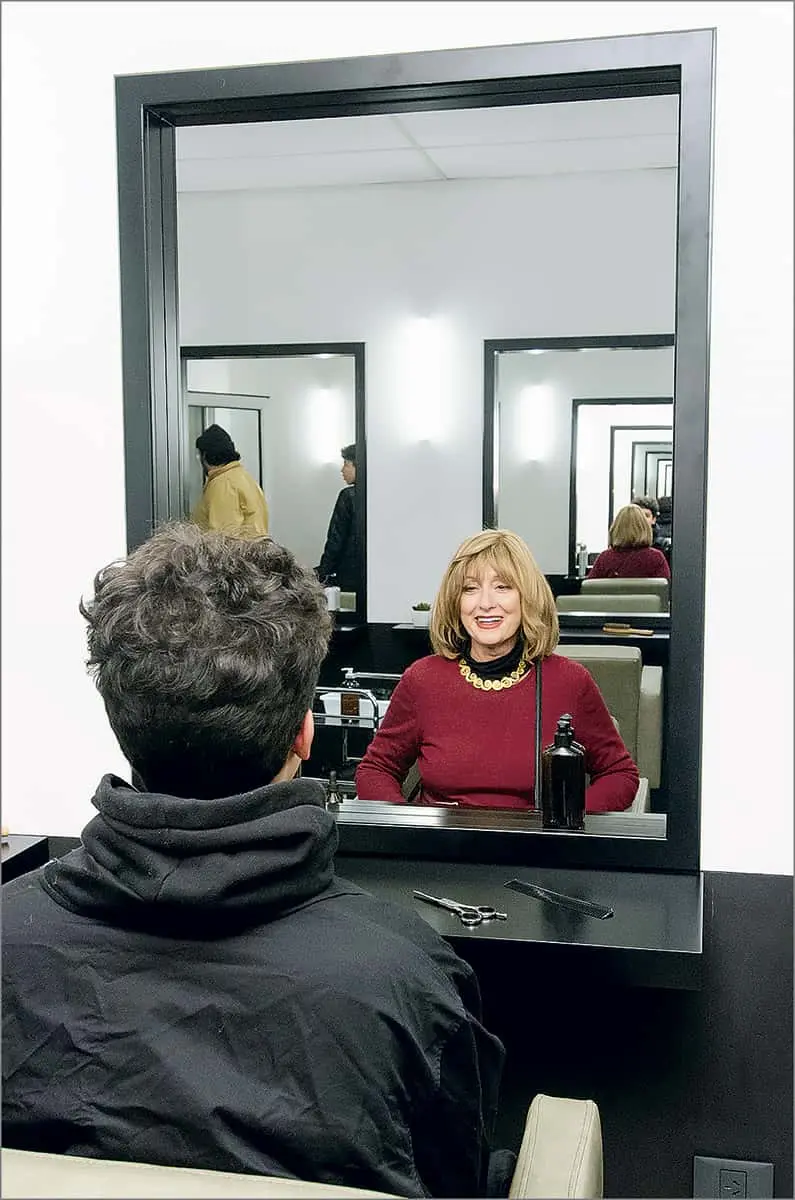
Viewers engage physically with Erlich’s galvanizing large-format installations by entering them. There is no magic involved. In Classroom (2017), Hair Salon (2017), or Swimming Pool (1999), however, the artist deploys his considerable talent to make the ordinary, extraordinary. Anyone can go through a glass panel and settle on the bench of a somewhat abandoned classroom, go to the hairdresser and lose their own image or get in a pool wearing clothes, or walk underwater and leave without getting wet. We can all walk along the Sidewalk (2007/2019), approach The Clouds (2018), experience the feeling of traveling on an airplane (El avión, 2011). In The View (1997/2017), we peek through a window into the life of people living across the way; we try to spy on the Neighbors (1996), set out on a Night Flight (2015), and many other things, from going to the laundry to traveling on the subway. On display in these works—some with Borgesian accents, with their insistence on infinity—are, then, several key topics of the era (precariousness, instability, memory) that beget emotions as dissimilar as freedom and constraint.
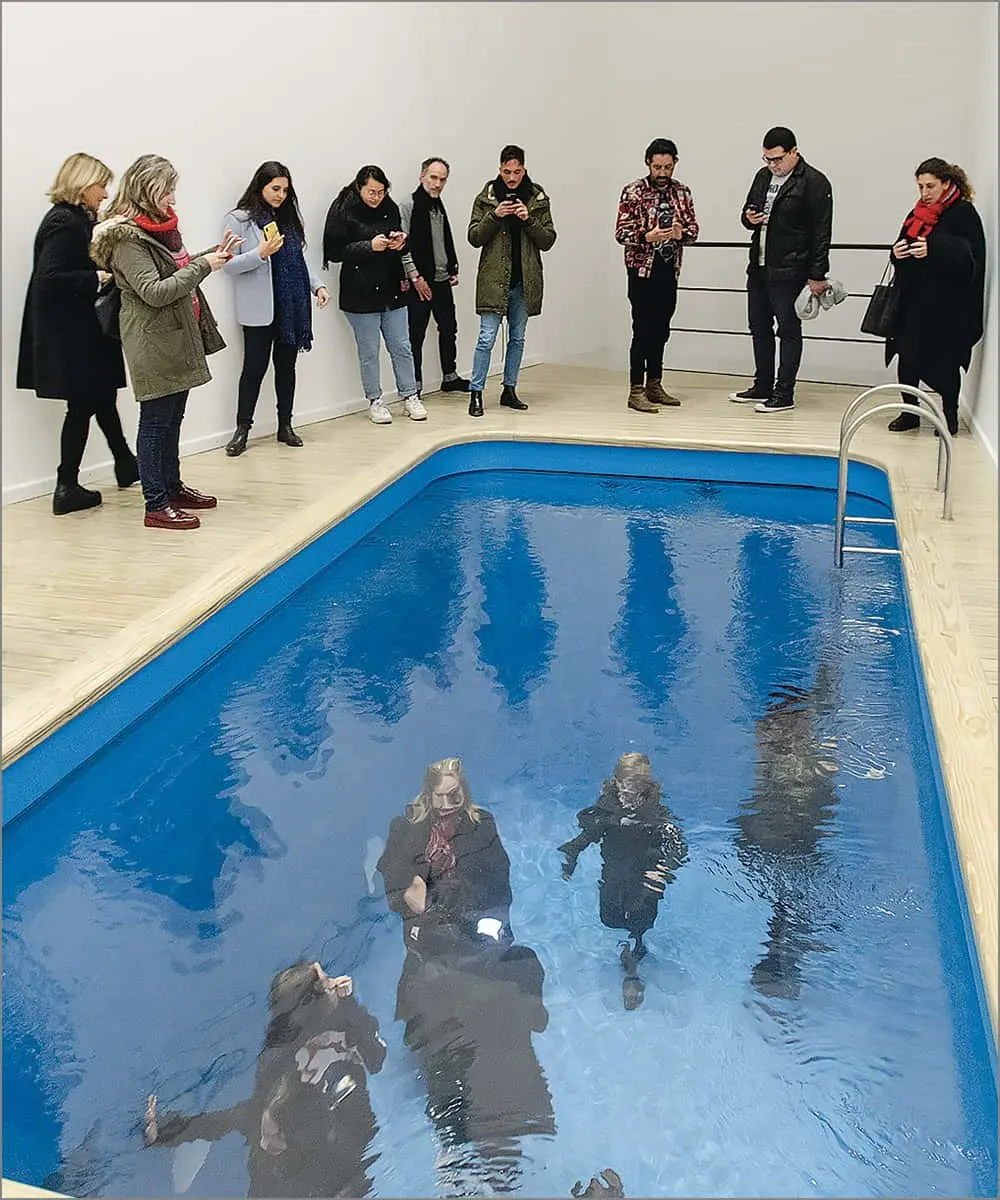
The works in Liminal were coproductions between MALBA and Estudio Erlich. Putting together the exhibition required more than a year and a team of 150 people. The perfection of the installations, made to endure sustained interaction with a large number of visitors, is astonishing. The 200-page bilingual catalog is profusely illustrated. It features Dan Cameron’s curatorial essay,” Crossing the Threshold,” artist Luis Camnitzer’s text “Arbitrary Orders,” and editor Julia Napier’s “Things as They Are, as They Aren’t.”
For a month, parallel to the show at MALBA, Ruth Benzacar Gallery presented Próximamente (Coming Soon!), an installation occupying the exhibition space in its entirety, with a theater-like marquee outside the gallery. The spectators had the feeling of entering the hall of a movie theater. While they waited for a movie that was never screened, they looked at advertising posters of films directed by Charlie Lendor (Leandro Erlich’s anagram). These were oil paintings by Ehrlich, presented as advertisements for films based on his famous installations.
VICTORIA VERLICHAK
The autor is preparing the launch of her latest book, Mildred Burton. Atormentada y mordaz