The absurd and the real intermix in the art of Laura Lima, just as they do in life. The boundary between those two territories in the construction of experiences of meaning is blurred, as can be glimpsed in the potency of Lima’s provocative, mysterious, almost inscrutable work. Paradoxically, Lima invites viewers to be part of her creations. This was clearly the case in the solo exhibition titled Balé Literal (Literal Ballet), a new work that used an ingenious move to connect the two buildings of the A Gentil Carioca gallery directly to a crossroad. Eleven years had passed between Balé Literal and Fuga (Flight, 2008), Lima’s previous solo exhibition at A Gentil Carioca, where she is one of the founders. On that occasion, the artist transformed the facilities into an aviary for fifty live birds. In her new work, Lima presented the results of an investigation into architecture: she orchestrated the motion of dozens of individuals to create a living spatial organism, in a happening of sorts performed on June 29. The exhibition remained on view through the end of August.
The gallery’s interior and exterior spaces where arranged like a theater hallway. The artist proposed the construction of a bestiary of coming-and-going things and people: instead of dancers, there are artworks, machines, devices, architecture, sound, and lights, alongside an audience that, like a choreography, circulates in the space. The ups, pauses, and downs of this “ballet” follow the tempo set by a symphony composed at Lima’s invitation by the young carioca singer Ana Frango Elétrico, performed for the first time here.
With recourse to a dictionary, Lima explains that “literal” is something “explicit and avowed, restrictively defined.” She, however, subverts this meaning and points to an ambivalence in the term: while the work is freed from the shackles of classic conceptualism, the literal has a place here as one dimension of a production affirmed in the recognition, above all, of everything it isn’t. In such an unstable and fertile terrain, her works ultimately choose for their protagonists a guerrilla spirit and the element of chance, in their many possibilities and pitfalls. At the crossroads, the organic intertwining of poetic materialities and logistical challenges weaves an experiment where mistakes, successes, and unforeseen events all derive from the power of “doing by doing.”
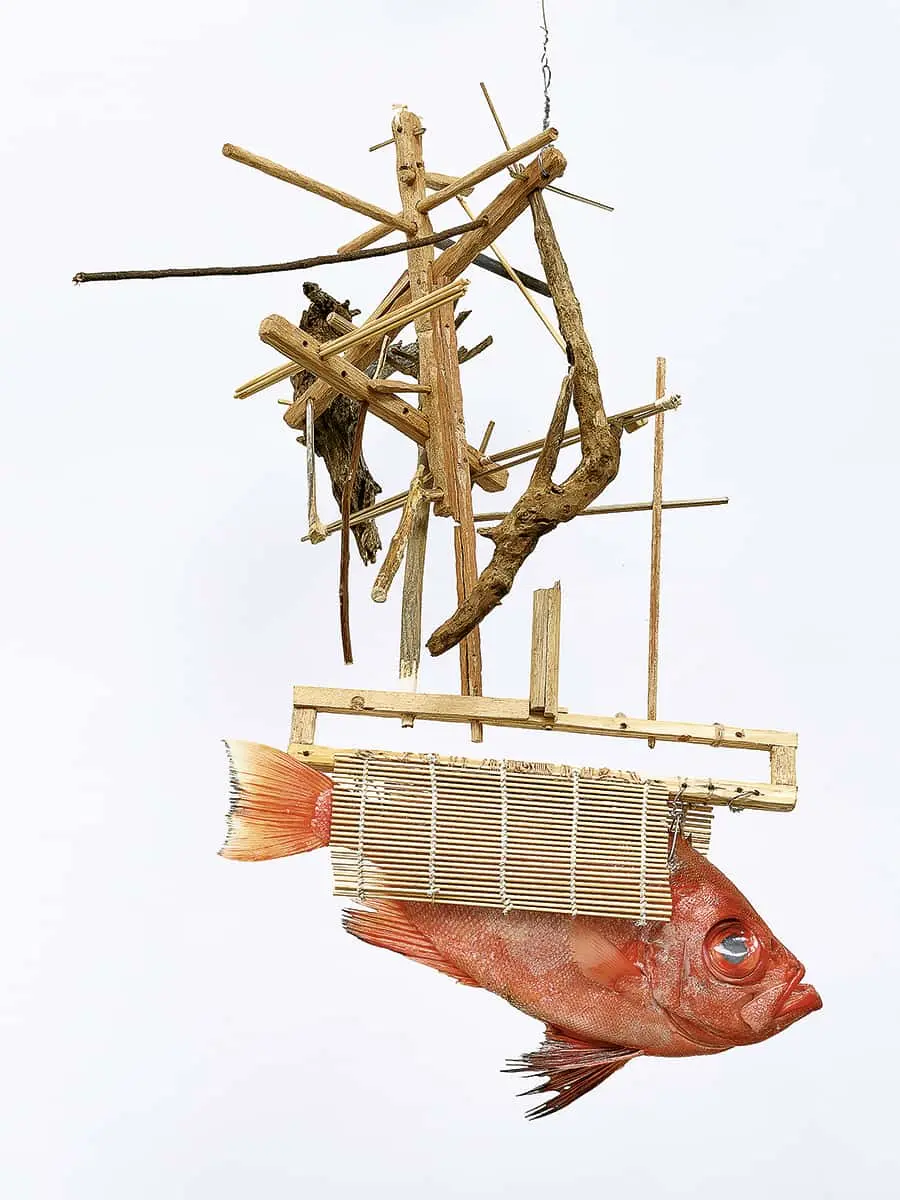
In context, during the process of construction of Balé Literal, loose threads are pulled for the elaboration of other, newer languages, confounding the positions of signifier and signified. Operated as a triad, the following components are present: 1) the development of an image-related/textual lexicon, with words like defenestrate, ritornello, balaclava, etc.; 2) impulses anchored to historical references (Bosch, Berkeley, Hilst, Tatlin, de Sade, etc.) in connection with the genealogy of previous works; and 3) the figurative contextualization of “dancing works” (a chandelier made of chicken wings, raining fish, cloaks made in collaboration with other artists, like Fernanda Gomes, João Modé, and Cabelo).
If it is true that art and the spirit of an era walk hand in hand, Laura Lima presents signs of an era rendered absurd, unstable, and shaky. From contradiction to contradiction, she prompts us to ask: what is literal in the era of “fake news,” of extreme visibilities, of distorted narratives? How can we deny the power of now, with all its eloquence and vertigo?
Laura Lima has used living models, animals, and plants, as supports for her creations for several decades now. Despite having rejected the terminology of “performance,” she was the first Brazilian artist to sell works in that category to a local museum, the Museu de Arte Moderna in São Paulo, in 1995. Lima said at that time she was not in search of the historical meaning of performance and emphasized that bodies always become flesh, like molded clay. Two examples of that intention are O Monte de Irônicos (The Mountain of Ironics), featuring people dressed in clown costumes, and O Galinheiro de Gala (The Fancy Henhouse), an actual pen with chickens that had artificial feathers attached to their natural ones using the same elongation technique used in humans.
Lima was selected to create a series of four site-specific installations for the newly-minted Fondazione Prada in Milan last year. She produced Horse Takes King, which alludes to a chess game in which viewers are invited to move freely without knowing what, based on the artist’s impulse, they will encounter. With her work included in several national and international collections, Laura Lima is an artist concerned with social relationships and how human behaviors alter our perception of everyday realities, and she brings into her work metaphors of behavioral conditioning. Nothing fits the contemporary era better than an interrogation of the boundary that separates fiction from reality, like the one she presented in Balé Literal.
ALESSANDRA SIMÕES