Intense admiration for someone’s work, voyeurism, the desire to be ever closer to a subject using a zoom lens, and the determination to discover the secrets held inside a home—to traverse its walls and lay it bare—all come together in the exhibition Paparazza Moderna. It is the culmination of a project of the same title launched in 2011 by Lake Verea, the artistic entity formed by Francisca Rivero-Lake and Carla Verea. Presented in three chapters, Paparazza Moderna exhibits materials gathered in the course of a prolonged investigation and seven years traveling across the United States. During that time, Lake Verea photographed—with no authorization from the owners of the property or warning of any kind—residential projects developed by some of Europe’s most renowned Modernist architects (Walter Gropius, Marcel Breuer, Richard Neutra, R. M. Schindler, and Ludwig Mies van der Rohe) after their relocation to the US at the start of WWII, and by Philip Johnson, the only US-born architect in their viewfinder.
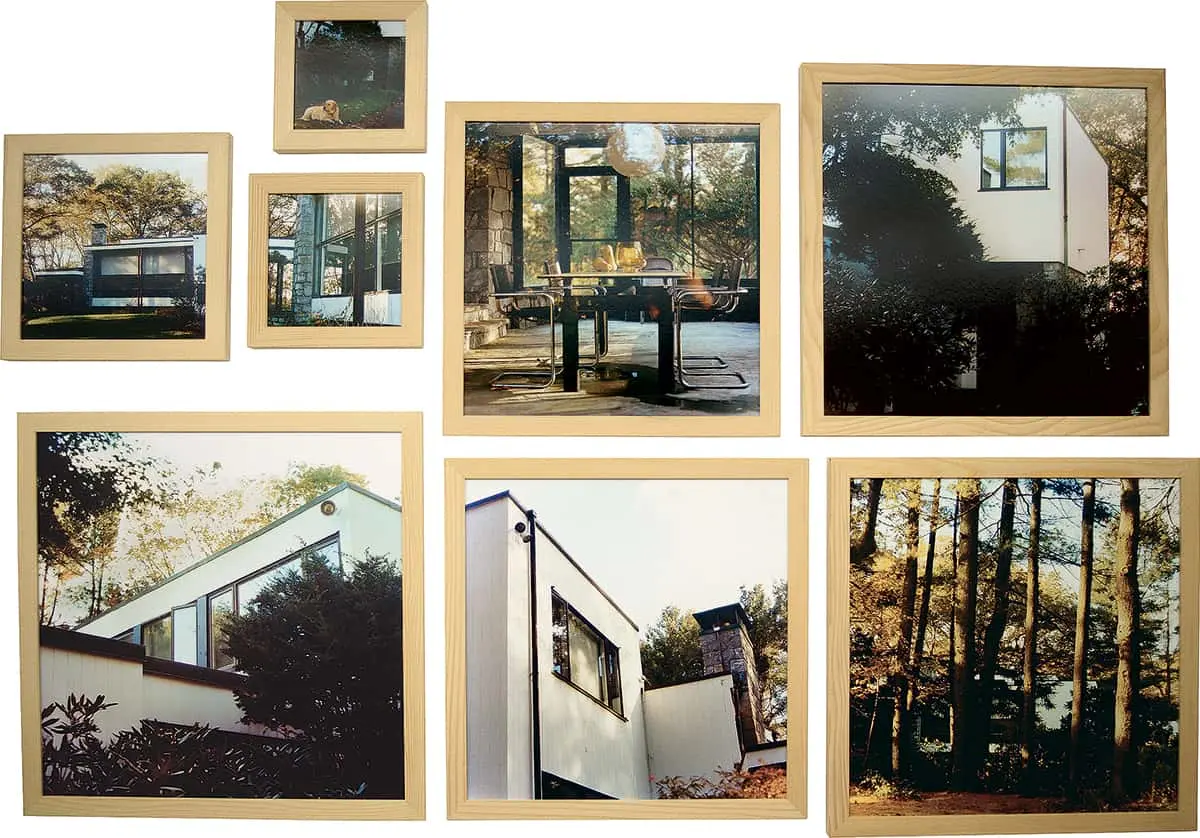
The Paparazza Moderna project sets aside the conventions of architectural portraiture—it is interested not in the pristine image of a house, but in its occupied life, when the windows are scratched, the materials have changed (walls crack and become grimy, banisters rust and their paint peels off), and the grass has grown—and also keeps its distance from documentary projects associated with conceptualism, like, let’s say, Bernd and Hilla Becher’s, which, driven by the seriality of industrial architecture, attested to the systematic transformation of the landscape in the course of the Twentieth Century. It would be perhaps more productive to understand this exhibition as akin to fan fiction, a derided literary genre wherein admirers of one or several characters created by an author (or even of real people) appropriate them and write new stories, outside of said author’s control, and feed the desire for their stories to continue.
The chapters of the exhibition are inspired by the houses and by their creators, grouped in pairs according to the (convoluted) professional and personal relationships they maintained over the decades. The cards accompanying the photographic nodes detail events that help define the famous architects as frenemies. For example, Gropius is the director of the Bauhaus, and Breuer, his student. A year later, they work together, and upon changing continents, both are hired by Harvard. They are colleagues, partners, friends, and neighbors; nevertheless, they have a falling out and remain estranged for the rest of their lives. Neutra and R. M. Schindler, meanwhile, met as students in Vienna and were brought together by their shared admiration for Frank Lloyd Wright (with whom they actually worked, briefly, once resettled in the US. Neutra, Schindler, and their wives share a Los Angeles home; they establish an office together. Five years later, however, the relationship abruptly ended. Finally, Philip Johnson had admired Mies van der Rohe since the latter’s time at the helm of the Bauhaus and had followed his work attentively as a critic, a curator, and a fervent admirer. Years later, under the tutelage of Gropius and Breuer, Johnson became an architect, and his relationship with Van der Rohe transformed into one of pointed competitiveness, marked by his desire to surpass the master.
The photographs, furtively captured by the paparazza, portray their collaborative and individual works. “We seek details that reveal the passage of time, and the imprint left by their inhabitants and their architects,” we read in one of the texts welcoming visitors to the exhibition. The information provided suggests entanglements and conflicts, and the fascination of these stories translates into images that search, tenaciously, for clues. Besides the façades tarnished by cables or overgrown vegetation, Lake Verea shows dogs resting in gardens and garbage strewn in yards, and, with some luck, can capture views of the house’s interior: elegant dining rooms and their modern furnishings, unkempt terraces, or work studios.
The lives of these characters—the houses—continue, now under their lens, who stalks, reveals recent adventures in the darkroom and captures them on film.
Paparazza Moderna, then, exists after the “geniuses” and narrates apocryphal chapters, as though inspired by Internet gossip. And, although Lake Verea—in black-clad and hauling gear (also on exhibit in the gallery)—cannot determine what came between Gropius and Breuer, nor whether Neutra, Schindler, and their spouses lived a swinger relationship, architecture appears here as a complex phenomenon not exempt from aging and change, unlike what their presence in specialized, airbrushed and glossy catalogs suggests.