
It is possible to trace an axis between two radically opposite points in the work of Julieth Morales (1992); on the one hand, that of a highly entrenched tradition of a community like the Misak, to which the artist belongs; on the other, the contemporary conditions of lightness and apparent non-belonging to any tradition. Srape Pøtø Tul-yu/El último círculo (The Last Circle), Julieth Morales’s exhibition with Museo La Tertulia’s Celsia-sponsored C Program, curated by Jim Fannkugen, deals with the position of women between those two opposite points: to be part of a specific set of traditions and to assume herself as not belonging to any one culture. This dilemma is approached based on the artist’s situation, from the standpoint of a specificity that in practice is founded on two different ways of looking at the world.
Misak cosmogony has in the spiral figure a symbol that brings together a conception of time, in which it rotates while still seeing its origin. The generational outcome is always connected to the origins in such a way that the values and traditions are being experienced from generation to generation. The youngest receive them, assume and transform them under the new historical circumstances. Julieth Morales presents the audiences with a meditation about the community’s rituals based on her situation as a member of a young cohort, at a time when it has become imperative to question the gender policies and implications that coexist (at times in inexplicit naturalized ways) in our behaviors. With these actions, the artist does not seek to reject the rituals she redefines or to critique them in moral terms, but to expand their possibilities, bringing into view the situation of women and widening the space for sorority as these actions are susceptible of being performed by the Misak (in other words, of becoming adopted by the community.)
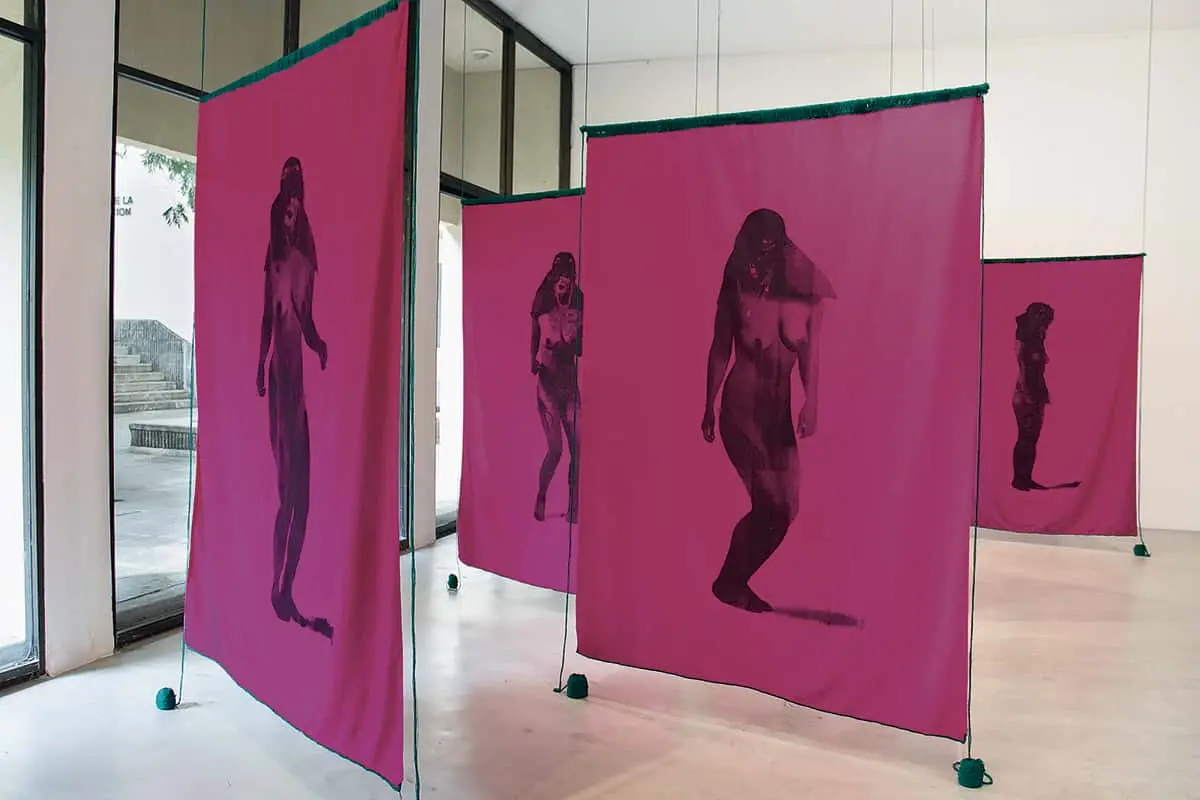
Six magenta-colored looms, with green wool finishes that fall in skein to the ground, show photoserigraphs of the nude artist personifying “la señorita” (the young lady) (La señorita, la danza [The Young Lady, The Dance], 2017). “La señorita” is one of the characters of the Mojiganga, a ritual dance performed to prevent food shortages, and to celebrate the Misak New Year and the arrival of the dead. The dance is exclusively practiced by men, who dress in various archetypes, such as the Devil, the Grandfather, the Baby, the Married Couple, and the Young Lady. The latter wears a mask depicting a mixed-race woman who, as the artist explains, has no trade, has no tradition, and is lazy (besides being a deity possessing the ability to travel between the world of the living and the world of the dead).
While a number of different counterpoints are important in analyzing this ritual (which, as an aside, is much more complex than can be covered here), further complications arise when Julieth Morales stages “the Young Lady” in the nude, stripped of the character’s Misak costume and the symbols associated with the community’s values. In this way, a woman personifies a female deity who finds a kind of balance in belonging and, at the same, time not belonging to the fabric of the ritual. In other words, for the Young Lady mask to be carried by a young Misak woman is more than a metaphor, if we take into account Morales’ transit between the two worlds she inhabits. Perhaps this action can also be connected to the condition of contemporary art, a Western construction around human creations and their drive to provide meaning for existence (which has been reduced, in a way, to the accumulation of objects), and the fact that Morales is both a university-trained artist and a member of a specific culture.
One of the looms contains a list of all the people who participated in the exhibition. The presentation becomes an essential presence when we pay attention to the videos that surround the shawls and comprise a different section of the show. These videos record original performances of the rituals (such as the Mojiganga, with a clip of a man wearing the Young Lady mask) without focusing on any single individual, but rather bringing forth the density of the group’s cohesion. On one of the screens, we see a dance in which women, holding hands, spin, and spin to create a spiral figure, again without focusing on any individual.
This is an important point, union and communion beyond all particularities, as can be noted in connection to the gesture of presenting all the names in a loom or when the artist modifies the wedding ritual, in which the woman must dance for almost four hours in order to demonstrate the strength needed to get married. Julieth Morales gives new meaning to this initiation ritual by accompanying a woman during the process, alongside her female friends and neighbors, changing the choreographies and holding hands as a sign of mutual support (sorority). With this work by Morales, new paths open up for reflecting about the resilience of the new generations, based on their capacity to transform and rethink their rituals.
BREYNER HUERTAS