Two vertical glasses swing on the floor while one is walking through the exhibition. Nothing physical is holding them. Only the forces of some magnets make the distance between each glass and the wall stay four or five centimeters apart. Another one beyond, of a larger size, similar to a door, lies diagonally against a pineapple. A series of glass sheets support each other in a way that one feels that the weight some sheets could easily yield against the others and eventually collapse. The glasses are translucent, fragile, and strong. At the same time, they cut, they make noise when they break; when they are long, they have a certain elasticity. Glasses are dangerous if they improperly placed. And that is exactly what happens throughout the exhibition halls of the gallery Nueveochenta. The magnets that balance the glasses are invisible forces that leave them on the edge of the accident. In a nearby space, a pineapple gives in to the weight of the glass—and the weight of time—. The fruit will end up yielding, losing balance, and collapsing. It is undoubtedly an exhibition that requires caution when walking and approaching the pieces. Everything can change, just as one passes near these “unfair” balances. And we highlight this injustice, strange, in such clean and simple pieces, because they point to the fragility of the moment
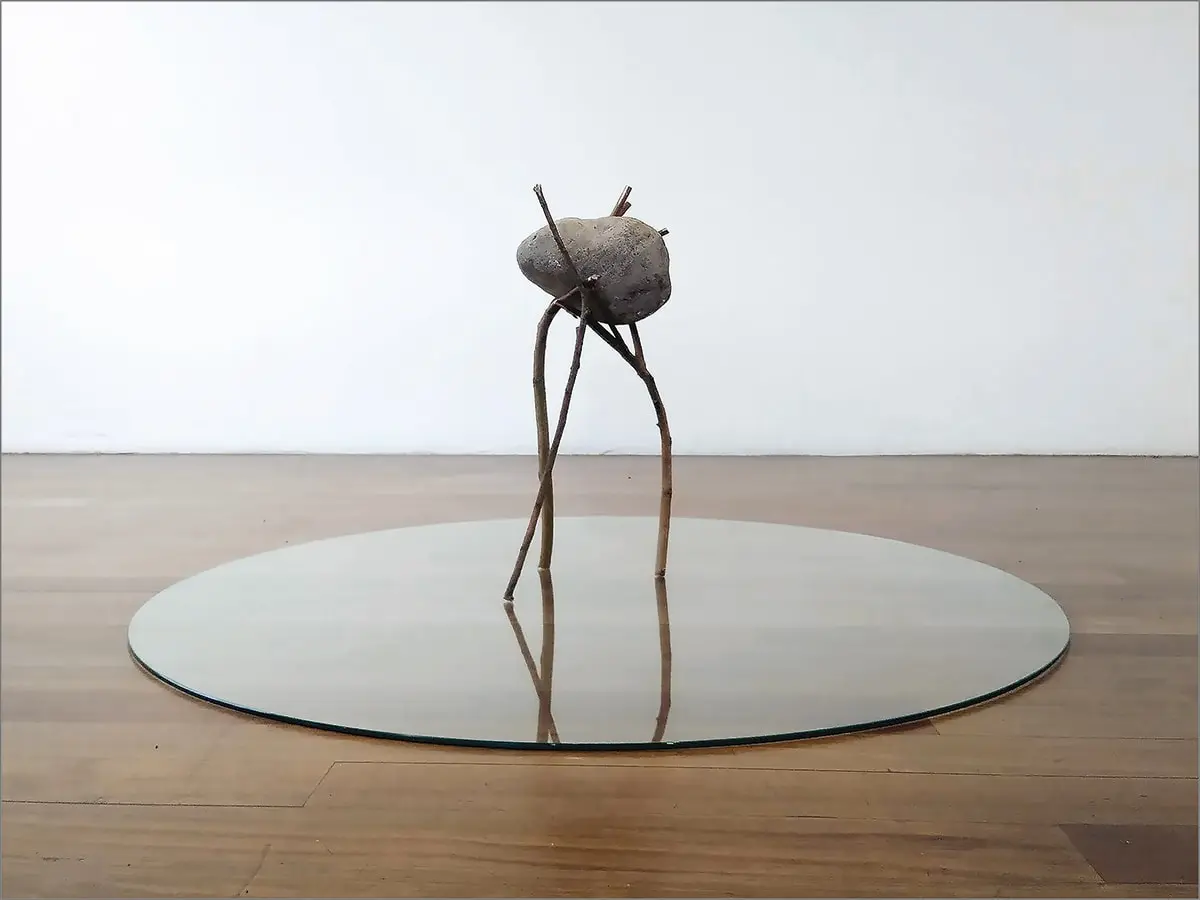
Regarding the use of glass José Olano says: “With the glass, there is no going back ... It crumbles.” Each piece is awaiting to crumble, for the accident, the ruin. Each piece is in that state of waiting for something to happen. This is one of the things we could well point out.
What’s important is not only the gesture of being close to falling but also to be near the unrepeatable and irreversible event. Like when you are facing a glacier, whose purpose is to collapse in the lake that receives it. The glacier, which takes decades of slow crossing, sounds, becomes restless, vibrates, rumbles, and at any moment–only by chance, moved by weather conditions or by the force of the spectators’ gaze, forces as hidden as those of magnets– ends up yielding and throws a good portion of ice that turns into an iceberg, whose purpose will be to melt and transform into water.
As children, as Eugen Fink said, we are fascinated by the collapse, knocking things down, or at least seeing them fall. We laughed nervously with accidental falls; we wanted to witness the accident, the ruin. Fink wondered: Could it be that in them (the collapses in the games) we saw our own fragility and we got to perceive traces of our own death? We built castles of sand, of cards, of cubes, of whatever, to give us the pleasure of knocking them down, of ruining them at the end.
The exhibition is a game but, let’s highlight this; it does not mean it is not serious. Games are serious. They have their rules. It is a game where chance is a fundamental piece. The possibility of witnessing the right moment in which a piece falls and breaks so as not to reverse. We see how a work of art, what we all call work of art, collapses, how it is ruined. It varies between magical and distressing. That “sacred” object we call a work of art—exhibited in a gallery, in a specific space—, is becoming shattered, and we enjoy, we laugh nervously, almost throwing ourselves to save it, and suddenly we decide that it is not our fault. Guilt exists, both in ruin and accident. Everything is mixed with the fragility of the glass and with the instant of the crash: moral, economic, ethical, aesthetic, or perhaps political problems?
And when we get back to reality, we realize that the nature work of art includes the ruin, its own destruction. That is, the piece does not work if it does not carry the intrinsic possibility of falling and not turning back. The exhibition, in that sense, “is a random laboratory,” Olano would say. It is a place where the pieces are transformed. The pineapple was giving way until time melted it, the magnets continued to play with each other, and the glasses fell and drew, as their broke, the accidents they suffered.
What if all this were a metaphor for who we are? With this exhibition, Olano tells us that the human being has decided not to give value to the unstable and fragile. However, there may be the distressing fortune that everything is in permanent change. Meanwhile, the glasses fall. What they were is as important as what they are, during and after the accident. Without the iceberg, the lake would not exist.
ANDRÉS GAITÁN T.