The exhibition “From Soto to Vigas” was on view at the Gary Nader Art Center between May and August. The show brought together for the first time the work of two masters of Venezuelan Modernity, Jesús Soto, and Oswaldo Vigas. It showcased and contrasted two ways in which the renewal of artistic languages in Latin America was expressed. The selection featured works from different periods, encompassing a wide historical arch that made it possible to review in parallel both artists’ explorations, findings, and creative processes.
Relocating to Paris in 1950, Soto had joined the artistic circles exploring geometric abstraction. From early on, he realized that his own interests moved towards experiences of motion and vibration, which laid the ground for the development of kinetic art. On exhibit in the show at Gary Nader were several works from Soto’s Cuadrados vibrantes (Vibrating Squares) series, started in the early 1960s. In works like 7 et 1 (1963) or Medio vibrante (Vibrating Medium,1976), metal squares in flat colors are arranged with regularity against striped backgrounds, resulting in vibration by the contrast of planes and colors, enhanced by the viewer’s own motion. Visitors also encountered Vibrations métalliques (1969), one of Soto’s Vibraciones horizontales (Horizontal Vibrations). These are cascades of metal lines hanging against the striped background, in which a real and subtle movement is in evidence.
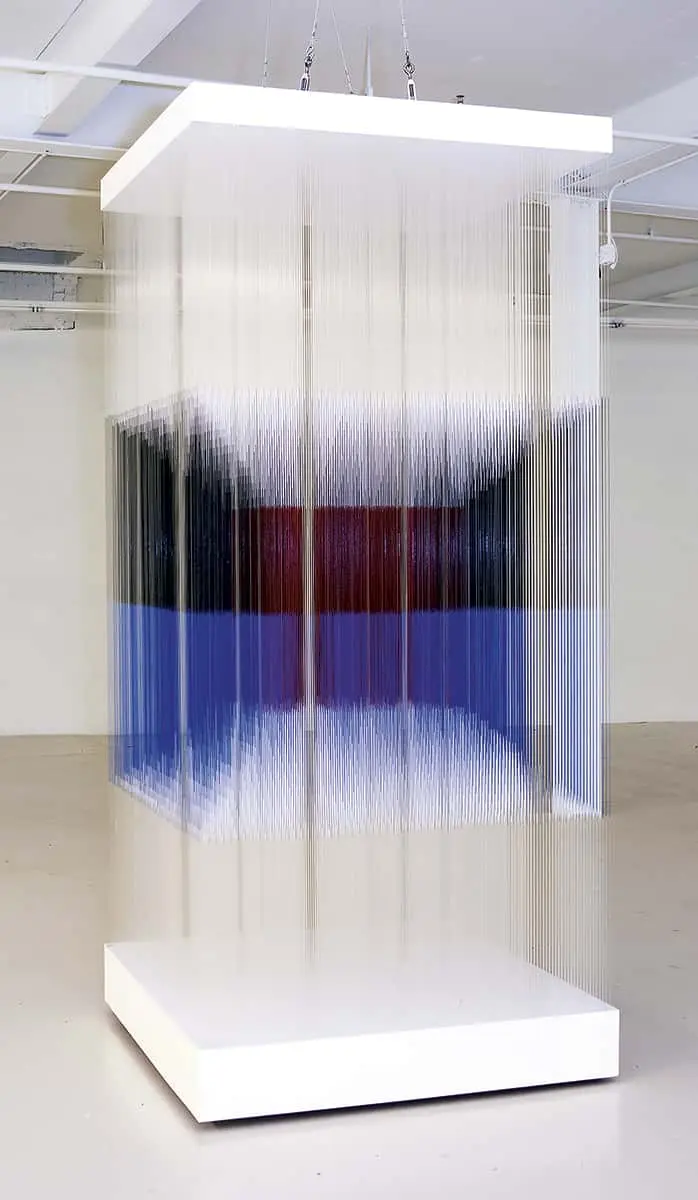
Cuadrados y escritura blanca (Squares and White Writing, 1979) is part of the Escrituras (Writings) series, which Soto began to conceive in the early 1960s. Moving away from orthogonal strictures, Soto brought into his work curved wires arranged, like lines in space, against backgrounds with vertical parallel strips. This interaction between curved and straight lines opened new paths for his explorations of vibration. The exhibition also included some of his Ambivalencias (Ambivalences), a series he began in 1981, and connected with Soto’s study of the late-period Mondrian. These are random compositions where primary colors create spatial ambiguity. Cubo Hilda (Hilda Cube, 1997) and Ovoide azul cobalto (Cobalt Blue Ovoid, 1999), the last works of the show, mark the culmination of an investigation that materialized in 1984 with Cubo de nylon (Nylon Cube). In this piece, Soto incorporates the space as an expressive element and its dialectic of invisibility/visibility.
Oswaldo Vigas was among the Venezuelan artists who in 1950s Paris coalesced around the geometric-art avant-garde. However, and in contrast to Soto’s, Vigas’ work was never dominated by rationalistic explorations. His language was rather permanently connected to the telluric, occasionally to the gestural, and repeatedly to the new figuration.
Vigas had been exploring abstraction since 1943, while at the same time developing an interest in primitive and pre-Columbian art. By the end of the 1950s, after creating his earliest “witches,” he began to synthesize forms but in a different direction than those derived from Neo-plasticism. The show at Gary Nader Art Centre begins with La red (The Net), a work where abstraction is connected to the symbolic, created before Vigas left for Paris, in 1952. It continues with an Objeto Negro (Black Object) from 1951, where the artist’s intention to cleanse his painting “from anything not indispensable to the composition” is in clear display.
La novia (The Bride, 1963), Signos de verano VI (Signs of Summer VI, 1963), and Signos de Cuaresma III (Signs of Lent, 1964) present viewers with an almost unknown Vigas. These works belong to his gestural period, which came after a period of interest in matter painting and the telluric. Somehow at the edge of Expressionist abstraction and figuration, their shapes seem to come from the subconscious.
From 1963 on, Vigas returns to figuration, updating a universe full of imaginary characters, from a quarry linked to the mythical Latin American world.
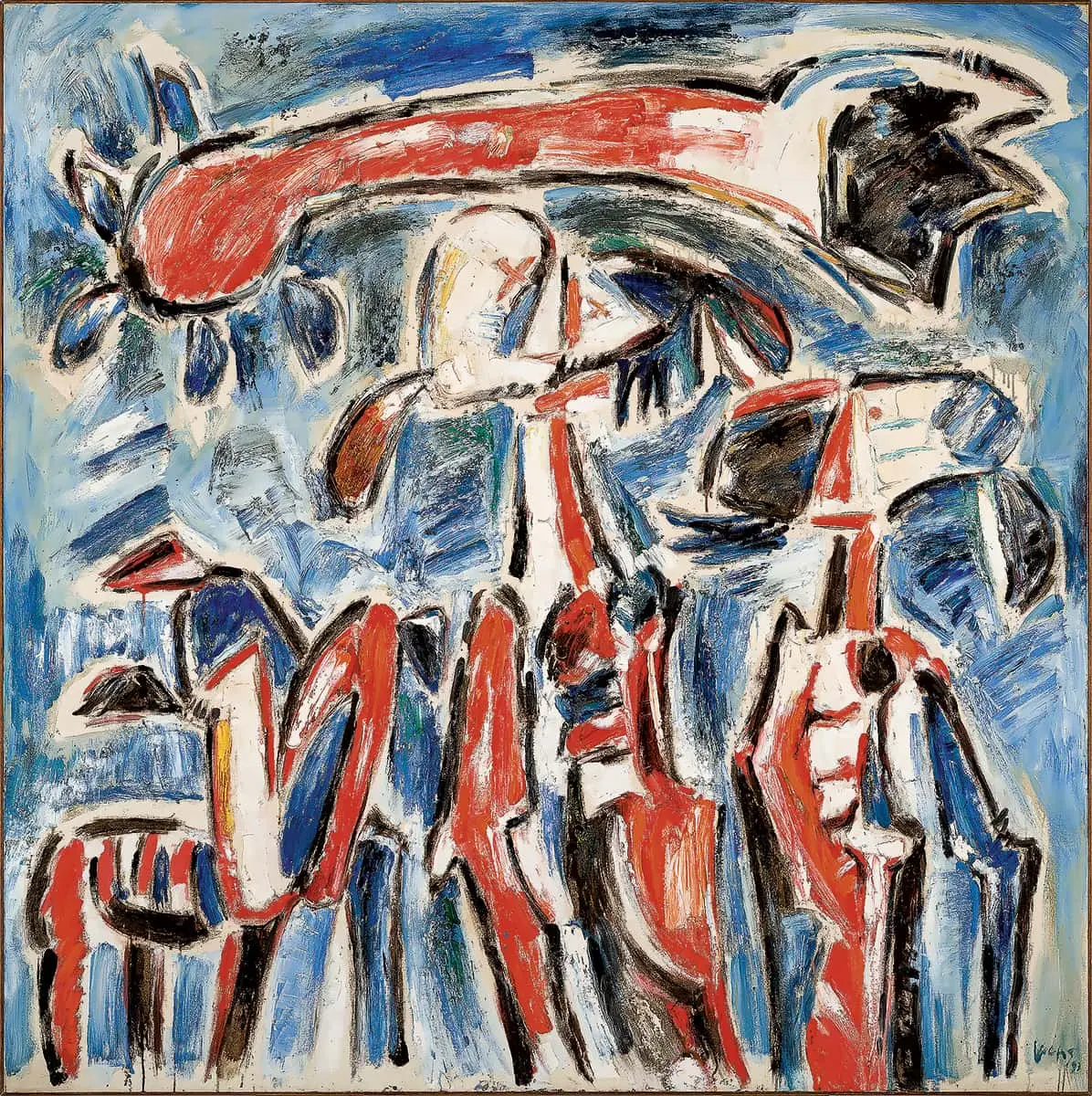
Several series emerged. Some had figures of a close geometry-leaning construction (as in Lúdicas, Playful). Others represented well-defined planes made with quick brushstrokes (Transfigurante IV, Transfigurant IV, 1972) that gradually became freer and more expressive. Finally, he leaned towards open forms made with quick tracings and increasingly more matter-bound blotches (Isleña, Island Woman, 1989).
Some pieces of his Synthetic Figuration series from the 1990s, as well as others of his last period (Gran Curandera IV, Great Shaman IV or Gemelares, Twins, 2009), reiterate the power of his immense creative flow. Also, they are linked to an imaginary nourished by the earth and a vital passion that endowed him with a great expressive mood.
“From Soto to Vigas” was an excellent opportunity to see masterful works from two great Venezuelan artists and to understand, from a vantage point that favored the following of historical threads, their relevance in the landscape of Twentieth-Century Latin American art.
KATHERINE CHACÓN