A work of art, in the traditional sense of the term, is something possessing an aesthetic and conceptual charge, destined to be apprehended (not exclusively, but mainly) by means of vision. Vision, it is clear, is often stimulated and sharpened by the viewer’s cultural, social, and subjective repertoire. At any rate, the artistic phenomenon is generally located within the sphere of the image.
Ivan Grilo’s creations take as their starting point an expanded definition of the concept of the image. Often, words are explored not only because of their meaning but also their form, in phrases that are cast on bronze plaques or patterned sheets, mental lucubrations made weightier by the materiality of a noble metal. Appreciative of oral narrative traditions, Grilo finds fascination both in the real or imagined stories he collects and in the ones he creates in his travels. Be it in Brazil or abroad, he jumps into the world as a “foreigner” who experiences the possibilities of scientific distance, and the aspiration of a researcher who does not get entangled with his object of study. But Grilo’s method is not necessarily the same on every occasion, nor does his narrative construction always follow the same script. In the solo exhibition Amanhã, logo à primeira luz (Tomorrow, At First Light), there are several stories, built at different times and based on various elements. Meanwhile, given the socio-political scenario that has taken shape in the country in recent years and more clearly after the ascent of the current far-right government, a connecting bridge, a convergence, emerged between these works and underlay the entire exhibition. A dialog between the artist and show curator Tiago de Abreu Pinto, set on a baseboard, makes this tension explicit: “Are we talking about politics or love? About something that connects the two.”
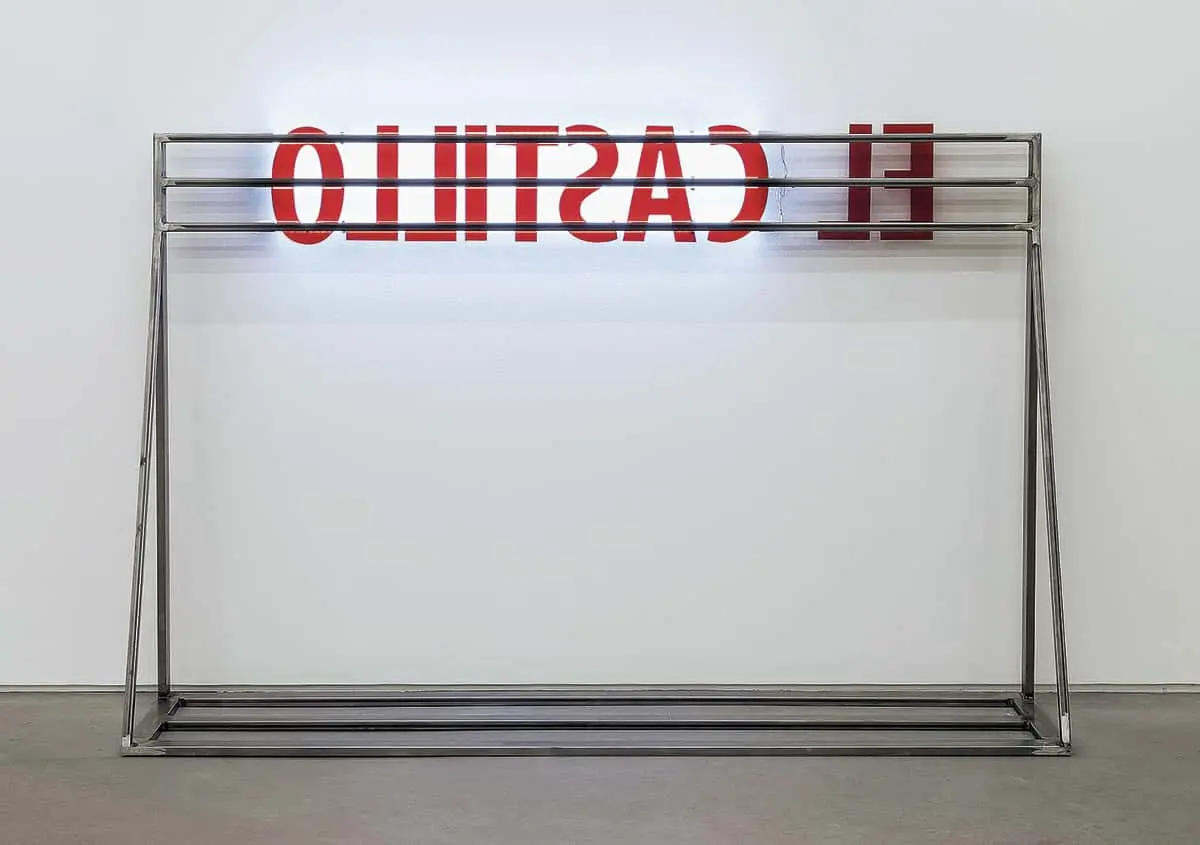
Inside Casa Triângulo’s main exhibition gallery, part of the installation alludes to a fictional king who, rather than being naked as in the famous tale, never actually achieved the majesty that the position requires. The corresponding symbols of power, such as his crown and mantle, appear inadequate both in scale and material. There is no kingdom, and what could be his castle is upside down. It is a reduced-sized replica of the background of the sign for a hotel located near the apartment that Grilo occupied during a stay in New York: The Castle Hotel. A game is played here with the gallery wall. From the sidewalk, the façade covered in a translucent material would let the red light of the sign seep through, legible from the right. It is not the name of the hotel that appears, but the sentence “Ainda há chão” (“There is ground still”). This expression can be read as positive, if we understand chão (ground) as a base, or as negative, if we interpret that word as the distance (as in the field to be covered before reaching a destination).
This interplay of truth and invention, past or present, joy or despair, is replicated in two other sections of the show: one traces a parallel between a fire that took place at the Juqueri psychiatric hospital in 2005 and a different fire that occurred at the Museu Nacional, in 2018. Both are historical buildings; both housed institutions whose mission is to care for sanity and the production of thought; both fires were caused by inattention towards whatever produces no immediate profit or interferes with the productive cycle of consumer society. Counterbalancing this sad realization is a series of four photographs from the 1930s, freshly edited, illustrating the guidelines offered by a wise man from Maranhão for a better society: sing, dance, tell stories and keep silent. All these connections happen on a mental plane, in the elaboration of realities or fictions that nevertheless belong in the sphere of spiritual concerns.
The smaller gallery, meanwhile, is closely concerned with facts. The most salient subject is, no doubt, the land. It is the land that provides us with food and wealth. And it is in its name that conflict arises, wars between peoples who place themselves, or are placed, at one or another side of arbitrarily established borders. On a table, the artist arranged various objects connected to the sowing of staples, the conflict between large landowners and landless peasants, the demarcation of territories. The agrarian subject is ancient, although ancestral, remains current, and people continue to die and kill, and ultimately, regardless of the side taken, to return to the land. On the opposite wall, we read, in bronze letters, the phrase “Terra Protegida” (“Protected Land”), a message that has been deleted from the official signs marking indigenous territories. But instead of the two green and yellow diagonal stripes of the original sign, Grilo cut a gash, bringing to the fore the irony of the designation. Inside the gallery space, it indeed safe, it is possible to talk about a land that can be many things, but “protected” is not one of them.
SYLVIA WERNECK