In Formalismos Andinos/Andinismos formales (Andean Formalisms/Formal Andeanisms), Ishmael Randall-Weeks explores the linkages between pre-Columbian aesthetic forms and modern art, and finds in Twentieth-Century abstraction an imagined bridge between those two universes and historical epochs, which in turn are connected to the present in which his works are produced and to which they allude.
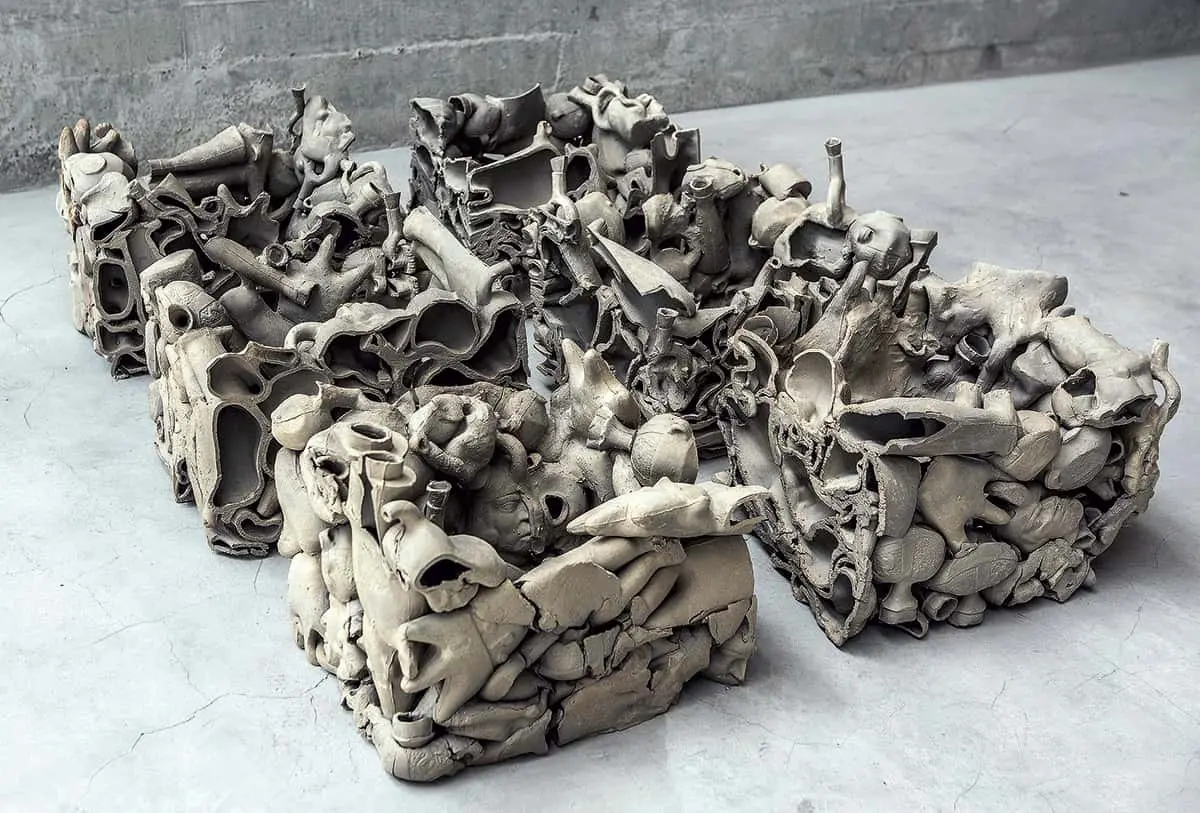
Huacas (2019) comprises a grid of six square blocks made from deformed and segmented ceramic fragments, replicas of pre-Columbian artifacts (from the Moche, Chimú, Chancay, and other cultures) that have been heaped together and lost their original shape in the baking process. The sinuous contours of the blocks bring to mind the agitated lines of tachisme and the shapes of arte informale. The title alludes to the temples, mummies, and sacred sites of the Inca civilization, evoking religious and mortuary rites, and the preservation of cultural memory. The inherently repetitive character of the ritual and the work’s checkered structure—with faint minimalist resonances—reinforce the idea of preservation, along with the very process of serialized reproduction of the original ceramic pieces (using molds). The work also speaks of the extraction and loss of cultural memory through the plunder and the destruction of archeological contexts, as these ceramic pieces appear to have been piled together by huaqueros, the illegal diggers who supply the black market with archeological artifacts.
The series Código atemporal (Timeless Code, 2019) is comprised of blocks made with layers of mortar mixed with different materials, which give each tier a different color. This color range is revealed by cuts on each item, in shapes resembling the plan view of a pre-Columbian building (like a mock-up), geological strata, and twentieth-century European and Latin American geometric abstraction. The materials that define the different layers are crucial elements in the work, and they are noted in accompanying signs. These materials range from soil from a variety of sites to agricultural products like artichokes, dried potatoes, cochineal, guinea pig blood, and more. In that way, Randall-Weeks creates stratifications upon which multiple temporal and cultural horizons converge.
Chacana (2019) is an installation of blocks made with mortar, iron, wood, and glass, arranged in a grid. Together, these blocks draw the ancestral figure of the Andean cross named in the title of the work. However, it appears disjointed, as if every piece had shifted from its original position and some had rotated. The back of the chacana is hollow, revealing the wall on which the work is mounted. This, along with the implicit mobility of the shape, radicalizes the interplay of relationships between figure and ground, suggesting a dialog between different times and places.
In Ushnu para Tatlin (Ushnu for Tatlin) I, II, and III (2019), Randall-Weeks creates a configuration of square shapes made with bronze rods, inspired by Russian Constructivism. These structures—which also seem to outline the edges of a modern building—rest on adobe bricks, and support objects such a stones or bronze-cast bricks, as well as prints of pre-Columbian textile designs, thus articulating the archeological and the architectural, the aesthetic and the political, based on the different models of city and society that the various referents and materials bring into focus.
Another notable work is Cubo para Arguedas (Cube for Arguedas 2019), a virtually-defined square formed by H-beams suspended from the ceiling (an echo of Bruce Nauman’s South American Triangle). These beams are made from clay baked from soil collected in the outskirt districts of Lima. The associations triggered by the H-beam (an icon of modern construction and skyscraper building) contrast with the traditional materials and self-building techniques that characterize the poverty-stricken sectors of the Peruvian capital, raising a question about the relationship between precariousness and the development models. Located at eye level the installation operates as a visual and physical barrier, an apparent allusion to the dynamics of social inclusion and exclusion that are so central to the work of the Peruvian writer José María Arguedas, to whom the artist dedicates the piece. But these beams also embody a metaphorical coming together of the city’s poles, and, as such, of its inhabitants, divided by an urban, economic and social layout.
With this exhibition, Ishmael Randall-Weeks proposes the need to rethink the ways in which the past remains alive and how it potentially regains actuality in our aesthetic, political, and social horizons over time, like and old forgotten promise that is yet to come.
MAX HERNÁNDEZ CALVO