The work by Colombian artist Ícaro Zorbar invites us to reflect on the fleeting nature of machines, which, throughout history, have been created to improve or facilitate different aspects of life’s experiences. His installations put in evidence technology’s vulnerability and, at the same time, they create a poetic view of its constant transformation. Zorbar’s work acquires a new dimension in “ Extrañando al fantasma” (Missing the Ghost), his most ambitious and significant institutional exhibition until now, curated by Julia Draganović and Eugenio Viola. For this project, the artist modified three floors of Bogotá’s Museum of Modern Art’s building to create a path that stimulated all the senses.
At the entrance of the museum, the visitor encountered Satélites (Satellites, 2019), the first of a series of installations made of sculptural objects created with light, video, audio, visual, and sound projections, and/or found and modified objects. Zorbar used two large metal barrels connected with “chambira” thread–a natural material used in the Amazon rainforest–, inspired by the traditional toy built with two cardboard cups or metal cans joined by a thread through which, at a distance, two people could have a conversation. The installation expanded the proportions of this mechanism and included speakers and small video screens that connected the person standing on a platform, located at the entrance hall of the museum, to a barrel located at the opposite end on a second level.
Upon arriving on the second floor, the visitor went through different spaces created by the artist in which darkness prevailed. The first one, titled “Bosque” (Forest, 2019), was a corridor featuring several large screens in which Zorbar projected videos of natural spaces that told a story. In the first one, a hand activated the mechanism of a music box; the second one showed a lateral view of a riverbank; in the third one, the mechanism of a music box moved on top of a canoe; in the next video, a fisherman rowed as a storm approached; and finally, the last image showed thunderstorm’s lightning. The images referenced nature and its slowly changing and almost imperceptible condition, like the river or the canoe that traveled over it.
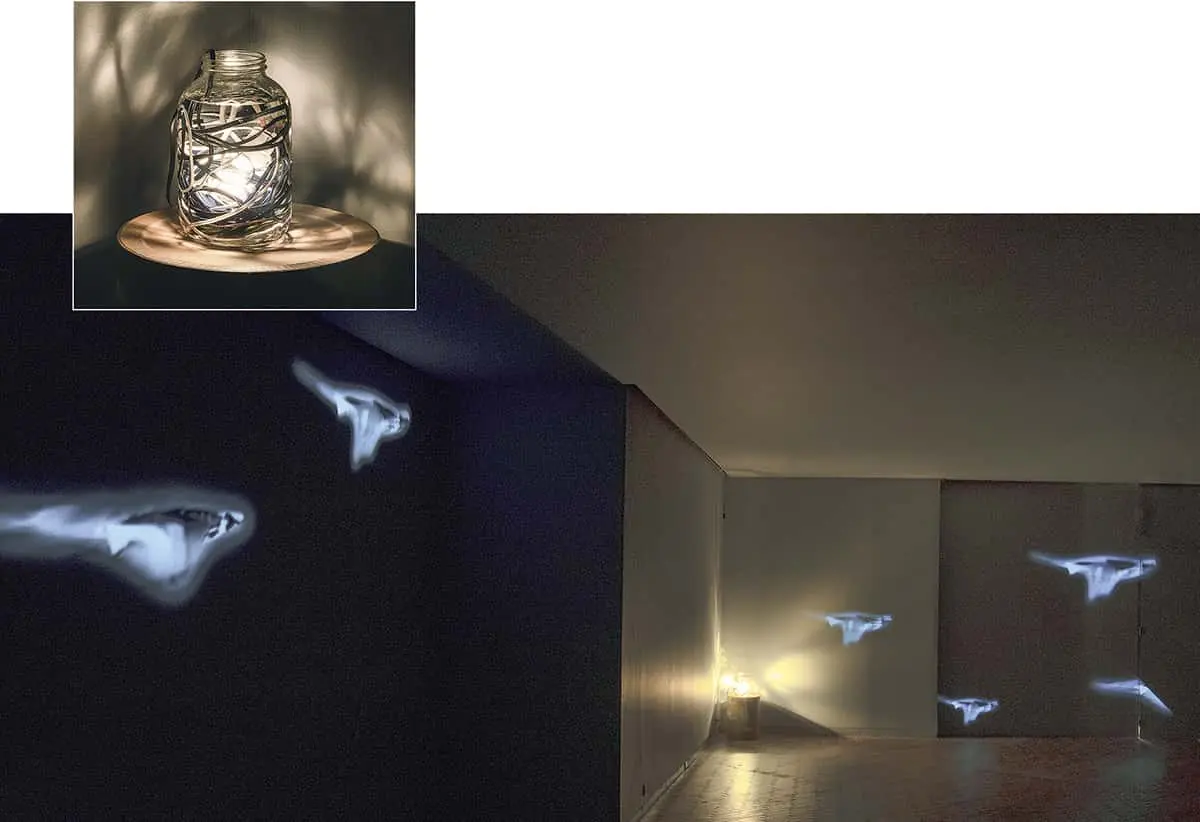
Nature and the animal world, in particular, were the main characters in the installations titled “Los intérpretes, un canon” (The interpreters, a canon, 2019) and “Centrífugos” (Centrifugals, 2019). In the first one, three screens showed close-ups of the same video featuring a moving spider on a web. By projecting a subtle light on wires connected to the screens, the artist gave the impression that the arachnids could move out of them. The second installation was one of the most impressive pieces of the exhibition. To access it, the visitor had to climb a wooden ladder and go through a hole made on the wall. Upon entering, you found yourself in an underwater world, surrounded by manta rays projected on the walls by mechanisms that recalled the first experimental machines used to create moving images.
Light played an important role both in the installations and in the transformation of the museum’s space. Zorbar covered the windows and the skylights of the building with cardboard sheets, perforated with small holes made with a screwdriver, which he called Agujeros blancos (White Holes, 2019). By doing so, he created what could be interpreted as a starry sky, as well as projections of lights and shadows that could be seen on the ground. These varied according to the intensity of the light rays that passed through the holes and the location of the sun throughout the day. The phenomenon responded to the artist’s interest in the ephemeral and for the phenomena that happen quickly, as well as what is hardly perceived on the periphery of the visual field. The subtle flashing lights that resulted from the passage of clouds and the almost inaudible sound waves of some installations required a particular effort, on the part of the visitor, to see and hear what that otherwise would go unnoticed.
The participatory character in Zorbar’s work is fundamental, as seen in Máquina de hacer truenos (Thunder Machine, 2019)–the only one the spectator was allowed to activate by playing threads connected to old wooden baffles equipped with an amplifier–, and in several “attended installations”(Nadie [Nobody], 2005; Triángulo de oro [Golden Triangle] 2006; and Primer Plutón [First Pluto], 2009,), works that generated temporary situations of fragile nature that could only be activated by trained museum employees.
In the last gallery, the visitor found the work Quédate un momento (Stay One Moment, 2016). Built with an old turntable, it featured a vinyl covered with charcoal waste that slowly rotated at the rate of one turn per eight minutes. The recording was extremely slow, almost imperceptible, which forced the visitor to stop and contemplate the piece with much patience. As the exhibition’s wall text indicated, “the appreciation and repair of old, decadent and even broken objects is the very heart of Zorbar’s artistic thought, and, of course, this also has political implications, in proposing alternatives to the predominant concepts of the ‘new’, to the constant and lasting growth and to a world in which consumerism is entirely at our disposal.”
FRANCINE BIRBRAGHER-ROZENCWAIG PhD