
Cacería inhumana (Inhuman Hunt) is the first solo exhibition of works by Hecdwin Carreño (Caracas, 1983). Several aspects invite reflection. First, the title of the show; second, the technique used; and third, the conceptual density behind this body of work, closely connected to how Carreño constructs his images. At any of these three levels of reflection, the relationship between what is denoted and what is connoted, to borrow two linguistics terms, is of singular importance.
First, the title carries problematic meanings. On the one hand, “hunt” invokes chasing and aggression, which undoubtedly connects with animality, with instinctual drives, and, as the artist notes, with the anthropological and the primeval elements that for him are involved in the act of painting. In turn, the need to articulate that drive pictorially implies taking into account a “relationship with the surrounding context and the adaptations we, as a society, have built to that end.” These ideas connect with the meaning the artist gives to the word inhumanity. For him, the human—or inhuman—has to do with man’s capacity for self-definition and for relating in society. Carreño questions the moral assessments of the term (and its opposite), wherein the human relates to goodness and the inhuman to evil. Ultimately, these critical conceptual considerations are expressed in the portraits of characters who, as María Elena Ramos points out in her presentation essay, “seem to speak of concentrated forms of humanity.”
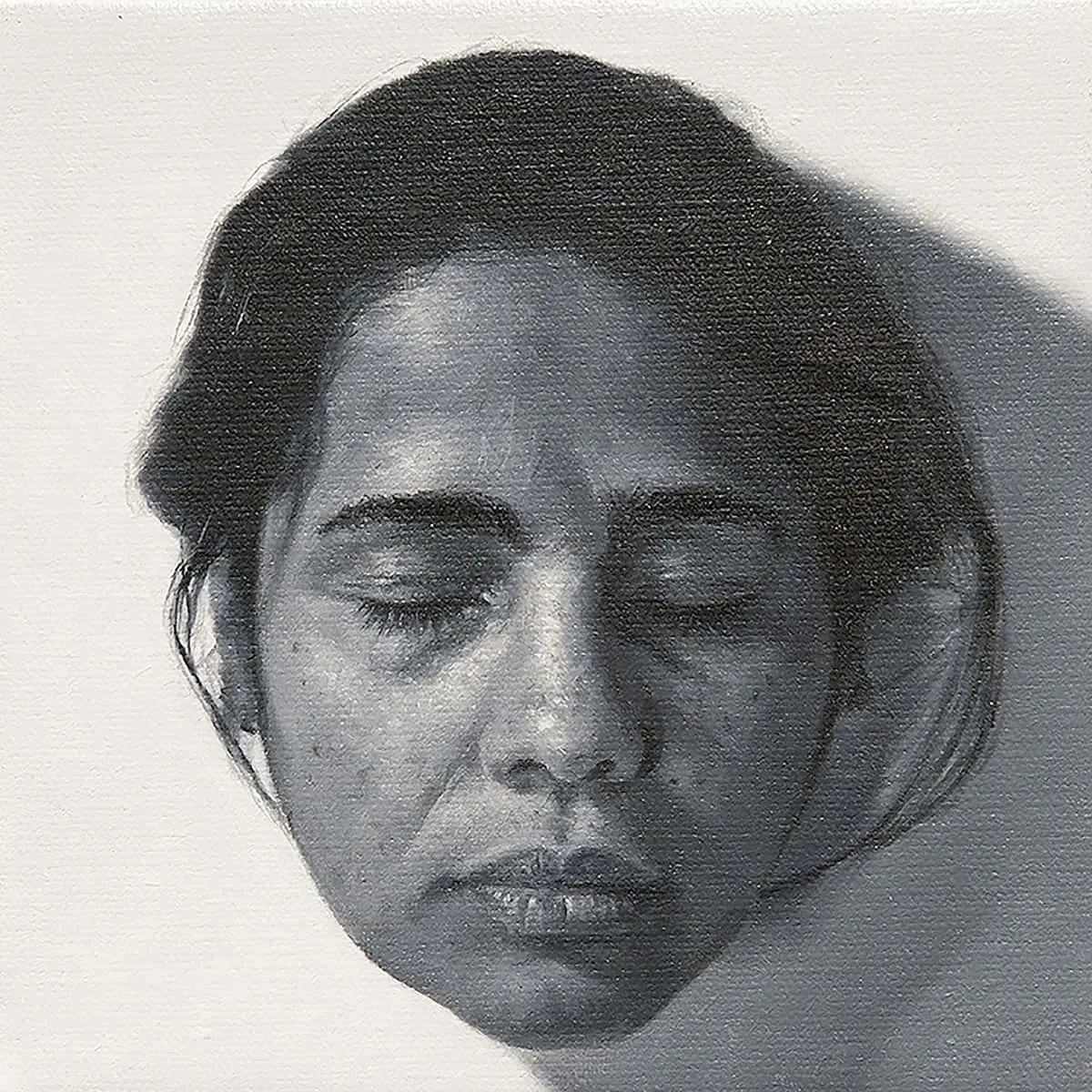
The exhibition featured sixteen paintings, distributed in three differentiated series: Fragmentos (Fragments), Proxemia (Proxemics), and Cabezas flotantes (Floating Heads). The human body is the axis of Carreño’s investigation. These are painstakingly detail-focused paintings, a quality accentuated by not using color. To achieve such precision, Carreño uses photography as a referent and, as he puts it, as a “symbolic trigger” for reflections about the subject of representation both in that medium and in painting. There is no doubt that the issues of veracity, on the one hand, and of verisimilitude, on the other, are present. Indeed, it is by means of the plausible that truth is approached, which is the reason why the artist chooses to speak in those terms rather than of “reality”. One could say what we have here is a denotative reading of the image. The truth is that to achieve this, Hecdwin Carreño’s painting is anchored—formally speaking—on his work with textures, tonal gradients, and, of course, chiaroscuro, which are properly pictorial factors. The focus on the fidelity of the datum brings to mind, as María Elena Ramos observes, the painting of classical masters who analyzed anatomy on the basis of the study of fragments.
Carreño’s black and white (and grayscale) treatment of the images, as well as his meticulous work with textures, inevitably connects these images with the crime pages of a print newspaper, that death-drenched, violent daily window into the faces of victims and killers. They are the utmost expression of the animality—of the inhuman hunt—of which everyday life in Venezuela partakes (like all social contexts dominated by violence do). Death expresses itself in the faces of the Cabezas flotantes, heads with their eyes closed, exhibited like hunting trophies. It is also expressed in bodily fragments: a brutal animality exhibited through fragments of bodies (arms, hands, eyes, and heads). All of this manifested as a trophy, an expression of dominance over the other, or as forms of “the subjection to life.” Something similar occurs in Proxemia, but with one difference: the characters are “alive.” Their eyes are open, they look at us, and some appear sitting on defensive postures, be it protecting their bodies or their personal space. Bodies and spaces that are “invaded,” as María Elena Ramos writes, by the camera or the painter’s brush; others were isolated, like the miniature ones, which stood out like accents against a large white panel. All, in their way, established precise relationships with the others, be it by directing our gaze to specific items, be it by generating a particular syntax where the connections between “the parts and the whole”—this is to say, between bodily segments, floating heads, and upright, awakened bodies—were exposed in a certain way as not unlike those between “victims and killers”. In the end, like hunting trophies.
SUSANA BENKO